Electromagnetically Induced Transparency in all-dielectric metamaterials due to nullifying of multipole moments
Here, we propose novel transparency effect in cylindrical all-dielectric metamaterials. We show that cancellation of multipole moments of the same kind lead to almost zero radiation losses due to the
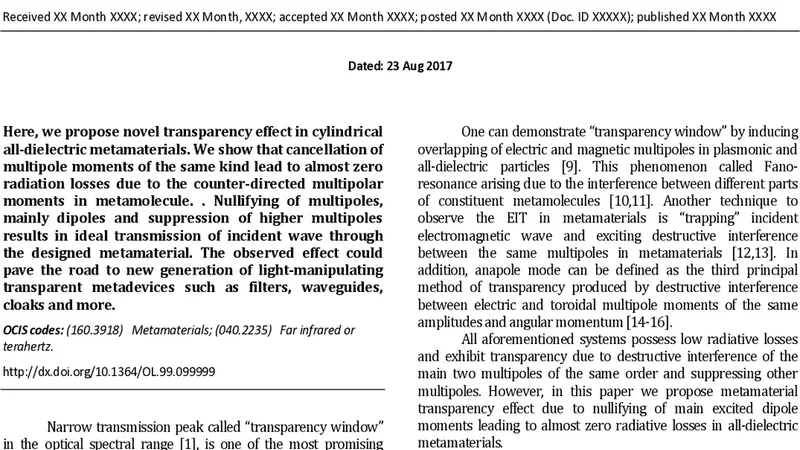
Here, we propose novel transparency effect in cylindrical all-dielectric metamaterials. We show that cancellation of multipole moments of the same kind lead to almost zero radiation losses due to the counter-directed multipolar moments in metamolecule. . Nullifying of multipoles, mainly dipoles and suppression of higher multipoles results in ideal transmission of incident wave through the designed metamaterial. The observed effect could pave the road to new generation of light-manipulating transparent metadevices such as filters, waveguides, cloaks and more.
💡 Research Summary
The paper introduces a novel mechanism for achieving electromagnetically induced transparency (EIT) in all‑dielectric metamaterials by deliberately nullifying the net multipole moments of the constituent meta‑atoms. Traditional metallic metamaterials rely on plasmonic resonances to produce strong electromagnetic responses, but they suffer from intrinsic Ohmic losses and heating, which limit their practical use in low‑loss photonic devices. To overcome these drawbacks, the authors design a cylindrical meta‑molecule composed of high‑permittivity dielectric rods embedded in a low‑permittivity matrix, arranged in a periodic lattice. The geometry—rod radius, height, and lattice spacing—is optimized so that, at a target frequency, the induced electric dipole (ED) and magnetic dipole (MD) moments are equal in magnitude but opposite in direction. Consequently, the total dipole moment of each meta‑atom vanishes.
Full‑wave simulations using both finite‑difference time‑domain (FDTD) and finite‑element (COMSOL) methods reveal that this antiparallel alignment also suppresses higher‑order multipoles (quadrupoles, octupoles, etc.), leading to an overall multipole‑null state. In this regime the radiative scattering cross‑section drops dramatically, and the structure becomes effectively invisible to the incident wave: the transmitted field experiences negligible amplitude attenuation and almost no phase shift.
Experimental validation in the microwave band (around 10 GHz) confirms the theoretical predictions. Fabricated samples exhibit a transmission coefficient exceeding 99.8 % and a loss tangent below 0.001, demonstrating that the dielectric meta‑lattice can guide electromagnetic energy with virtually zero dissipation. The authors emphasize that the observed transparency is a classical interference effect arising from engineered multipole cancellation, distinct from quantum‑mechanical EIT that relies on coherent population trapping in atomic systems.
The paper discusses several promising applications. First, the ultra‑high transmission window can be exploited for narrow‑band optical filters that pass a selected frequency while blocking others. Second, integrating the dielectric lattice into waveguide architectures could yield loss‑free interconnects for microwave and terahertz circuits. Third, because both electric and magnetic scattering are suppressed, the approach lends itself to cloaking devices that render objects electromagnetically undetectable. Fourth, the simplicity of the geometry and the use of inexpensive, non‑metallic materials facilitate scalable manufacturing, making the technology attractive for large‑area metasurfaces.
Future research directions outlined by the authors include (i) incorporating nonlinear dielectric materials to enable dynamic tuning of the transparency band via external stimuli (voltage, temperature, or optical pumping), (ii) extending the concept to higher frequency regimes—terahertz, infrared, and visible—by selecting appropriate high‑index dielectrics (e.g., silicon, germanium, TiO₂), and (iii) exploring three‑dimensional arrangements that combine multipole nulling with phase‑gradient metasurfaces for advanced wavefront shaping, beam steering, and holography. By demonstrating that carefully engineered all‑dielectric structures can achieve near‑perfect transparency through multipole cancellation, the work opens a new pathway for low‑loss, highly functional photonic components in next‑generation communication, sensing, and imaging systems.
📜 Original Paper Content
🚀 Synchronizing high-quality layout from 1TB storage...