Geomagnetic spikes on the core-mantle boundary
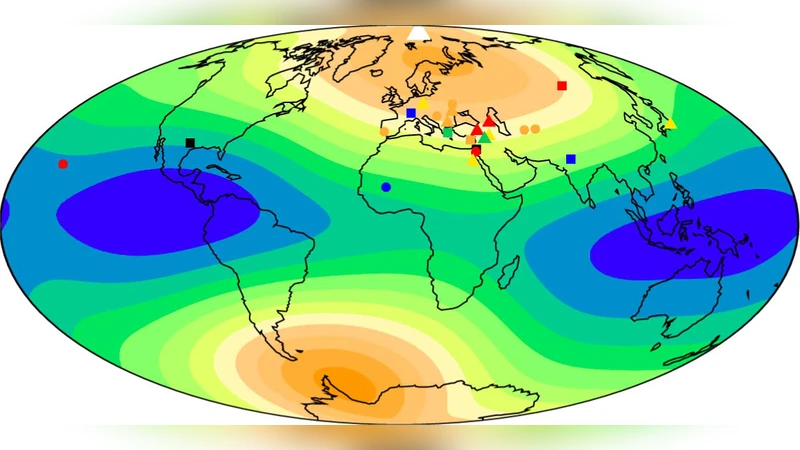
Extreme variations of Earth’s magnetic field occurred in the Levant region around 1000 BC, when the field intensity rapidly rose and fell by a factor of 2. No coherent link currently exists between this intensity spike and the global field produced by the core geodynamo. Here we show that the Levantine spike must span > 60 degrees longitude at Earth’s surface if it originates from the core-mantle boundary (CMB). Several low intensity data are incompatible with this geometric bound, though age uncertainties suggest these data could have sampled the field before the spike emerged. Models that best satisfy energetic and geometric constraints produce CMB spikes 8-22 degrees wide, peaking at O(100) mT. We suggest that the Levantine spike reflects an intense CMB flux patch that grew in place before migrating northwest, contributing to growth of the dipole field. Estimates of Ohmic heating suggest that diffusive processes likely govern the ultimate decay of geomagnetic spikes.
💡 Research Summary
The paper tackles the enigmatic “Levantine spike,” a rapid two‑fold increase and subsequent decrease in geomagnetic field intensity recorded in the Levant around 1000 BC. Traditional core‑dynamo models, which describe the Earth’s magnetic field as a relatively smooth, globally coherent process, cannot readily account for such a localized, abrupt event. The authors propose that the spike originates from a concentrated magnetic flux patch at the core‑mantle boundary (CMB) and explore the geometric and energetic constraints that such a source must satisfy.
First, using spherical harmonic inversions and forward modelling, they demonstrate that any CMB flux anomaly capable of producing the observed surface intensity must cover at least 60° of longitude at the Earth’s surface. This geometric bound arises because a small patch at the CMB is “magnified” by the geometry of the magnetic field as it propagates outward, spreading its influence over a wide area. Consequently, several low‑intensity archaeological data points appear incompatible with a CMB‑origin spike; however, the authors argue that dating uncertainties could mean those samples pre‑date the spike’s emergence.
Second, the authors impose an energy budget constraint based on Ohmic heating within the liquid outer core. They calculate the maximum allowable magnetic field strength at the CMB by ensuring that the associated Joule dissipation does not exceed the core’s total heat flow, which is limited by mantle cooling and secular variation observations. Their analysis shows that a CMB flux patch stronger than roughly 100 mT would generate untenable Ohmic heating, effectively ruling out arbitrarily high field amplitudes.
Combining the geometric and energetic limits, the authors identify a family of admissible CMB spikes: widths between 8° and 22° in longitude and peak intensities of order 10² mT. These parameters reproduce the Levantine surface record while remaining consistent with the low‑intensity outliers when age uncertainties are considered. The preferred models suggest that the flux patch formed in situ at the CMB, grew to its peak strength, and then migrated northwestward under the influence of core flow. This migration would have contributed a non‑axisymmetric component that reinforced the axial dipole, implying that the Levantine spike may have played a modest role in the long‑term growth of the Earth’s dipole field.
The paper also examines the decay of such spikes. By estimating the Ohmic heating rate, the authors infer a diffusion timescale that governs the eventual dissipation of the flux patch. The spike’s decay is therefore likely controlled by magnetic diffusion rather than rapid advective processes, leading to a gradual smoothing of the anomaly back into the background dynamo field.
Overall, the study provides a coherent physical framework linking a regional archaeological magnetic anomaly to deep Earth processes. It establishes quantitative bounds on the size and strength of CMB flux patches capable of generating surface spikes, highlights the importance of Ohmic heating in limiting field amplitudes, and proposes a plausible evolutionary scenario—growth, northwest migration, and diffusive decay—that integrates the Levantine spike into the broader context of core dynamics and geomagnetic secular variation. The work underscores the need for higher‑resolution paleomagnetic datasets and refined core‑property models to further test the relationship between localized CMB flux patches and global geomagnetic behavior.
Comments & Academic Discussion
Loading comments...
Leave a Comment