An algorithm to simulate alternating Turing machine in signal machine
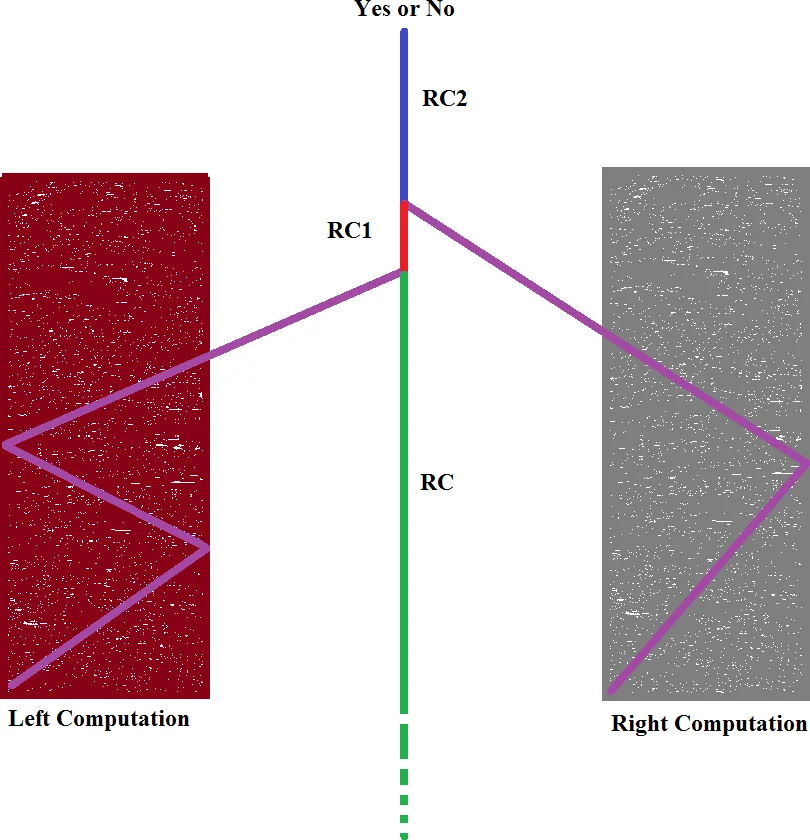
Geometrical Computation as a new model of computation is the counterpart of Cellular Automata that has Turing computing ability. In this paper we provide an algorithm to simulate Alternating Turing Machine in the context of Signal Machine using techniques adopted from the features of Signal Machine to set up and manage the copies/branches of Alternating Turing Machine. We show that our algorithm can simulate Alternating Turing Machine in Signal Machine as same functionality as classic family of Turing Machines. Time complexity of the algorithm is linear as ordinary simulated Turing Machines. Depending on the computation tree space complexity is exponential order of d, where d is the depth of the computation tree.
💡 Research Summary
**
The paper presents an algorithm that simulates an Alternating Turing Machine (ATM) within the framework of Signal Machines (SM), a continuous-space‑time computational model belonging to Abstract Geometric Computation (AGC). After a brief introduction to cellular automata and AGC, the authors define a Signal Machine as a triple (M, S, R) consisting of a finite set of meta‑signals, a speed mapping, and collision rules that dictate how signals (dimension‑less particles moving along straight lines) interact. They recall that ordinary Turing Machines can be simulated in SM by encoding tape symbols as stationary signals and using moving signals to represent the head and state transitions.
Three SM techniques are central to the construction: (1) Middle‑point computation, which uses three signals of speeds +3x, –3x, and +x to locate the exact midpoint of a region; (2) Freezing/Unfreezing, where a high‑speed “freezer” signal collides with computation signals to temporarily halt them, and a slower “unfreezer” later restores their motion; (3) Scaling, which combines freezing with additional redirecting signals to compress or expand the spatial extent of a computation. These operations allow the authors to control the geometry of the simulation precisely.
An ATM differs from a deterministic TM by introducing existential (∃) and universal (∀) states. In an ∃ state the machine accepts if at least one successor accepts; in a ∀ state it accepts only if all successors accept. The paper illustrates the concept with a concrete ATM that decides whether the number of zeros in a binary string is divisible by both 2 and 3. The machine’s computation tree has a universal branching point that spawns two sub‑computations, one checking divisibility by 2 and the other by 3.
To embed this behavior in SM, the algorithm proceeds as follows:
- Copy Initialization – Using the middle‑point technique, the current computation region is split into two symmetric halves. Two “copy” signals are emitted leftward and rightward, each carrying a full replica of the TM’s tape and state.
- Freezing – A dedicated freezer signal (with speed greater than any computation signal) collides with the newly created copies, converting them into frozen, low‑speed signals. This isolates the two branches so they cannot interfere.
- Unfreezing and Scaling – Two unfreeze signals, placed at the left and right extremes, travel toward the frozen copies. Upon collision they restore the original speeds, allowing each branch to resume its TM simulation independently. Simultaneously, a scaling signal can be applied to shrink the spatial footprint of the branches, mitigating the exponential blow‑up in space.
- Result Collection – When a branch reaches a halting state, it emits a result signal (accept or reject). These result signals collide with a “collector” signal that implements the logical AND (for ∀) or OR (for ∃) required by the ATM’s quantifiers. The final outcome is then sent back to the root signal, completing the simulation.
The authors analyze complexity: the time overhead of the SM simulation remains linear in the length of the input, because each TM step corresponds to a constant number of signal collisions, and the additional freezing/unfreezing steps are bounded. However, the space usage grows exponentially with the depth d of the ATM’s computation tree, yielding O(2^d) space in the worst case. This matches the inherent branching nature of ATMs.
Critically, while the high‑level design is clear, the paper lacks a concrete specification of the meta‑signal set and the full collision rule table, making reproducibility difficult. The choice of speeds for freezer and unfreezer signals is described qualitatively but not quantitatively, and the handling of “blank collisions” (where no rule exists) is not fully formalized. Moreover, the authors do not discuss numerical precision issues that arise when signals are placed on real‑valued coordinates, nor do they propose strategies to reuse signals or share space among branches to alleviate the exponential space growth.
Despite these gaps, the work contributes a novel mapping of a non‑deterministic, quantifier‑rich computational model onto a continuous, physics‑inspired substrate. By combining freezing, unfreezing, and scaling, the authors demonstrate that Signal Machines can orchestrate complex branching computations while preserving linear time. This opens avenues for further research into analog‑style parallelism, resource‑aware signal scheduling, and the exploration of other high‑level computational paradigms within AGC. Future work should focus on detailed implementations, robustness against geometric errors, and optimization techniques that reduce the space blow‑up inherent in ATM simulations.
Comments & Academic Discussion
Loading comments...
Leave a Comment