Designing Strassens algorithm
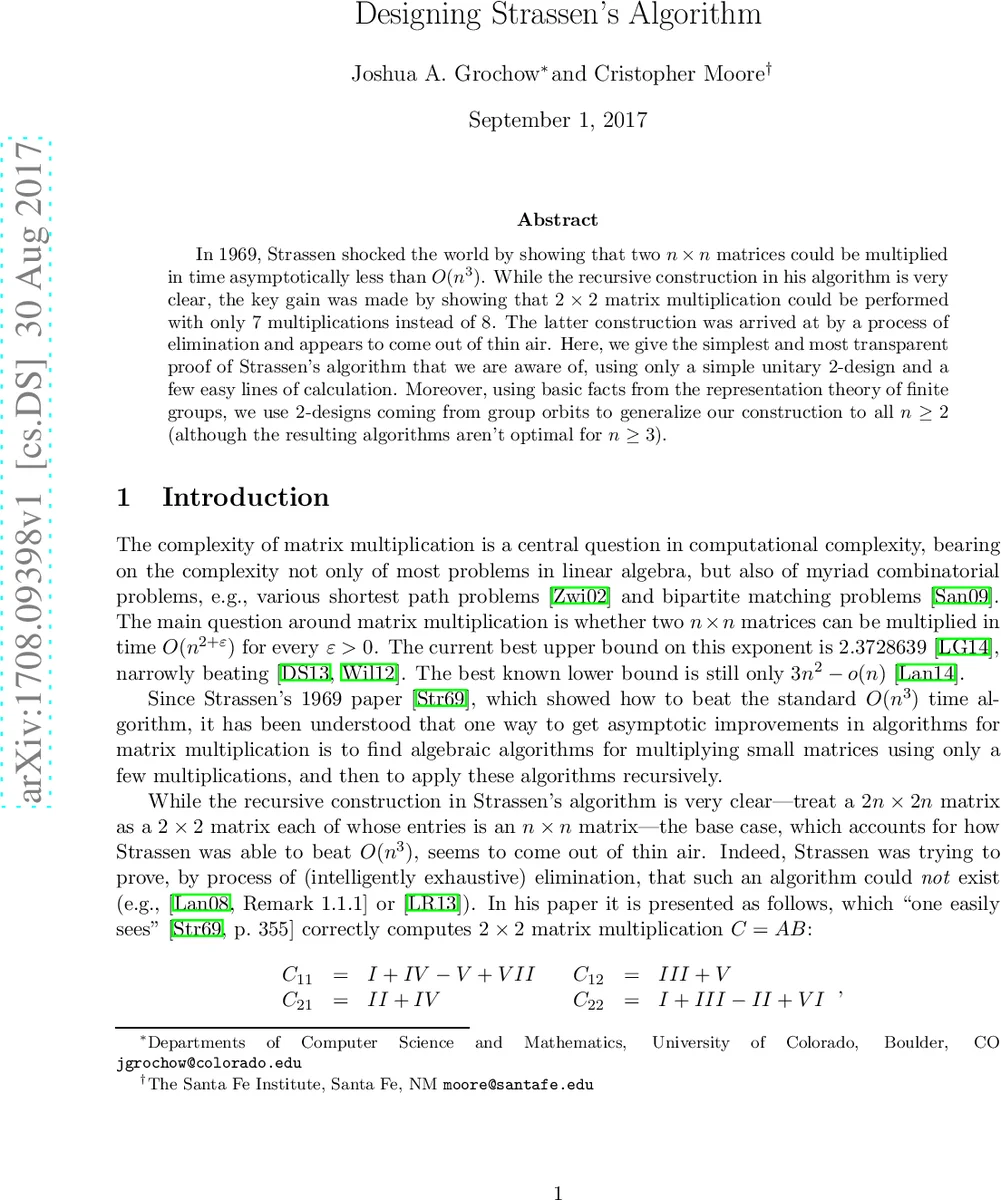
In 1969, Strassen shocked the world by showing that two n x n matrices could be multiplied in time asymptotically less than $O(n^3)$. While the recursive construction in his algorithm is very clear, the key gain was made by showing that 2 x 2 matrix multiplication could be performed with only 7 multiplications instead of 8. The latter construction was arrived at by a process of elimination and appears to come out of thin air. Here, we give the simplest and most transparent proof of Strassen’s algorithm that we are aware of, using only a simple unitary 2-design and a few easy lines of calculation. Moreover, using basic facts from the representation theory of finite groups, we use 2-designs coming from group orbits to generalize our construction to all n (although the resulting algorithms aren’t optimal for n at least 3).
💡 Research Summary
The paper revisits Strassen’s breakthrough that two × two matrix multiplication can be performed with only seven scalar multiplications, thereby beating the naïve O(n³) bound. While Strassen’s original presentation relied on a somewhat opaque elimination process, the authors propose a conceptually clearer proof based on unitary 2‑designs and group orbits.
First, the authors formalize matrix multiplication as the three‑way tensor MMₙ with entries δ_{ae}δ_{bf}δ_{cd}. The rank of this tensor determines the algebraic complexity of matrix multiplication, and any decomposition into rank‑one tensors corresponds to an algorithm. They introduce the notion of a unitary 2‑design: a finite set S⊂ℂⁿ such that the vectors sum to zero and the average of the outer products |v⟩⟨v| equals (1/n)I. Theorem 2.1 shows that if S is a 2‑design of size s, then MMₙ can be expressed as a sum of s(s‑1)(s‑2)+1 rank‑one tensors. The proof uses the fact that the “twisted” product of the design vectors reproduces MMₙ, while the “untwisted” product yields the identity tensor; subtracting the two leaves exactly the claimed decomposition.
For n=2, the three vertices of an equilateral triangle form a 2‑design (s=3). Plugging into Theorem 2.1 gives a rank bound of 7, which matches Strassen’s algorithm. The authors cite de Groote’s result that any 7‑term decomposition of MM₂ is equivalent to Strassen’s construction under the GL(2)³ action, confirming that their design‑based algorithm is essentially the same algorithm expressed in a different basis.
The key insight for general n is that the orbit of any unit‑length vector in an irreducible representation of a finite group is automatically a 2‑design. This follows from Schur’s Lemma: the projector onto the span of the orbit must be proportional to the identity, and the proportionality constant is fixed by the trace condition. Consequently, any irreducible non‑trivial representation yields a 2‑design.
Applying this to the symmetric group S_{n+1} acting on ℝ^{n+1} by permuting coordinates, the representation splits into a trivial component and the standard (n‑dimensional) component consisting of vectors whose coordinates sum to zero. Choosing the unit vector w = (n,‑1,…,‑1)/√{n(n+1)} in the standard component, its orbit under S_{n+1} consists of n+1 vectors pointing to the vertices of a regular simplex. This orbit is a 2‑design with s=n+1, and Theorem 2.1 then yields the bound
rank(MMₙ) ≤ (n+1)n(n‑1)+1 = n³‑n+1.
Thus for every n≥1 there exists an algorithm that multiplies two n×n matrices using at most n³‑n+1 scalar multiplications.
The authors compare their approach with earlier explanations of Strassen’s algorithm (Clausen’s group‑orbit construction, various ad‑hoc calculations) and with the Cohn‑Umans group‑theoretic framework. While the Cohn‑Umans method cannot explain Strassen’s result using only abelian groups, the present design‑based method works with the non‑abelian symmetric group and does not require embedding the matrix multiplication tensor into a larger group algebra.
In the final sections the paper discusses future directions. Since any design must span ℂⁿ, its size satisfies s≥n+1, making the simplex designs optimal within the 2‑design framework; consequently, applying Theorem 2.1 alone cannot improve the exponent beyond ω≈3. The authors suggest exploring higher‑order t‑designs (t>2), which impose stronger averaging conditions and might lead to smaller s, as well as investigating other families of highly symmetric groups or representations. They also note practical considerations such as constant factors, memory access patterns, and parallelization that are not addressed by the purely algebraic rank analysis.
In summary, the paper provides a transparent, representation‑theoretic proof of Strassen’s algorithm via a unitary 2‑design, generalizes the construction to all matrix sizes using symmetric‑group orbits, and opens a pathway to further research on symmetric designs and group actions as tools for designing faster matrix multiplication algorithms.
Comments & Academic Discussion
Loading comments...
Leave a Comment