Dynamic interplay between tumour, stroma and immune system can drive or prevent tumour progression
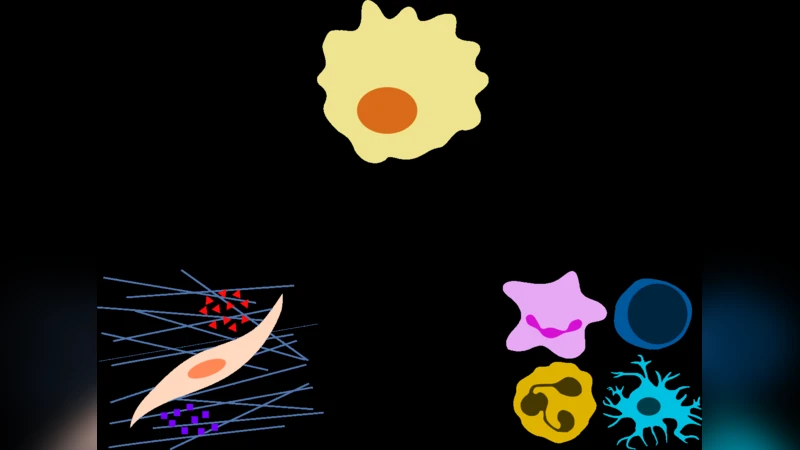
In the tumour microenvironment, cancer cells directly interact with both the immune system and the stroma. It is firmly established that the immune system, historically believed to be a major part of the body’s defence against tumour progression, can be reprogrammed by tumour cells to be ineffective, inactivated, or even acquire tumour promoting phenotypes. Likewise, stromal cells and extracellular matrix can also have pro-and anti-tumour properties. However, there is strong evidence that the stroma and immune system also directly interact, therefore creating a tripartite interaction that exists between cancer cells, immune cells and tumour stroma. This interaction contributes to the maintenance of a chronically inflamed tumour microenvironment with pro-tumorigenic immune phenotypes and facilitated metastatic dissemination. A comprehensive understanding of cancer in the context of dynamical interactions of the immune system and the tumour stroma is therefore required to truly understand the progression toward and past malignancy.
💡 Research Summary
The paper presents a comprehensive view of the tumor microenvironment (TME) as a dynamic, tripartite system composed of cancer cells, stromal components (fibroblasts, cancer‑associated fibroblasts, and extracellular matrix), and immune cells. While traditional oncology has largely focused on the binary interaction between tumor cells and the immune system, this work emphasizes that the stroma acts as a critical intermediary that both shapes and is shaped by immune responses, thereby creating feedback loops that can either promote or inhibit tumor progression.
First, the authors detail how malignant cells actively reprogram the immune compartment. Through secretion of immunosuppressive cytokines (TGF‑β, IL‑10, VEGF), checkpoint ligands (PD‑L1), and chemokines (CCL2, CCL5), cancer cells recruit regulatory T cells (Tregs), M2‑polarized macrophages, and exhausted NK cells. These recruited cells adopt phenotypes that dampen cytotoxic T‑cell activity, produce additional suppressive factors (IDO, arginase), and facilitate angiogenesis and metastasis.
Second, the paper examines the stromal side of the equation. Cancer‑associated fibroblasts (CAFs) become activated by tumor‑derived signals, up‑regulating α‑SMA, FAP, and PDGFRβ. CAFs remodel the extracellular matrix (ECM) by depositing dense collagen I/III, laminin, and fibronectin, increasing tissue stiffness and interstitial pressure. This physical barrier limits immune cell infiltration, while integrin‑FAK signaling induced by the altered ECM drives macrophage polarization toward the pro‑tumor M2 state. Moreover, CAFs secrete CXCL12/CXCL14 that attract CXCR4⁺ immune cells, yet simultaneously express PD‑L1 and indoleamine 2,3‑dioxygenase (IDO) to blunt their effector functions.
Third, the authors describe the reciprocal influence of immune cells on the stroma. Activated CD8⁺ T cells and NK cells release IFN‑γ and TNF‑α, which can suppress fibroblast activation and promote matrix‑degrading enzymes such as MMP‑9. Conversely, immunosuppressive populations (Tregs, M2 macrophages, tumor‑associated macrophages) produce MMP‑2 and MMP‑14, reshaping the ECM to create conduits for tumor cell invasion and metastasis. These interactions generate non‑linear, time‑dependent feedback loops: early immune evasion by tumor cells fuels CAF activation, and the resulting stromal changes further entrench immune suppression.
The clinical implications are explored in depth. The authors argue that monotherapy with immune‑checkpoint inhibitors (anti‑PD‑1/PD‑L1, CTLA‑4) often fails to overcome stromal barriers. They propose combinatorial strategies that simultaneously target stromal components (FAP‑CAR‑T cells, CXCR4 antagonists, TGF‑β blockers, LOX inhibitors) and reinvigorate anti‑tumor immunity. Such multi‑modal regimens aim to dismantle the physical and biochemical shield, restore immune cell trafficking, and prevent the emergence of resistant tumor clones.
Finally, the paper outlines future research directions, emphasizing the need for high‑resolution spatial single‑cell profiling, integrative mathematical modeling of tumor‑stroma‑immune dynamics, and patient‑specific therapeutic algorithms that adapt to the evolving TME. By embracing the complexity of the tripartite interaction, the authors contend that more durable and curative cancer treatments can be achieved.
Comments & Academic Discussion
Loading comments...
Leave a Comment