Correlation between the Hurst exponent and the maximal Lyapunov exponent: examining some low-dimensional conservative maps
The Chirikov standard map and the 2D Froeschl\'e map are investigated. A few thousand values of the Hurst exponent (HE) and the maximal Lyapunov exponent (mLE) are plotted in a mixed space of the nonlinear parameter versus the initial condition. Both…
Authors: Mariusz Tarnopolski
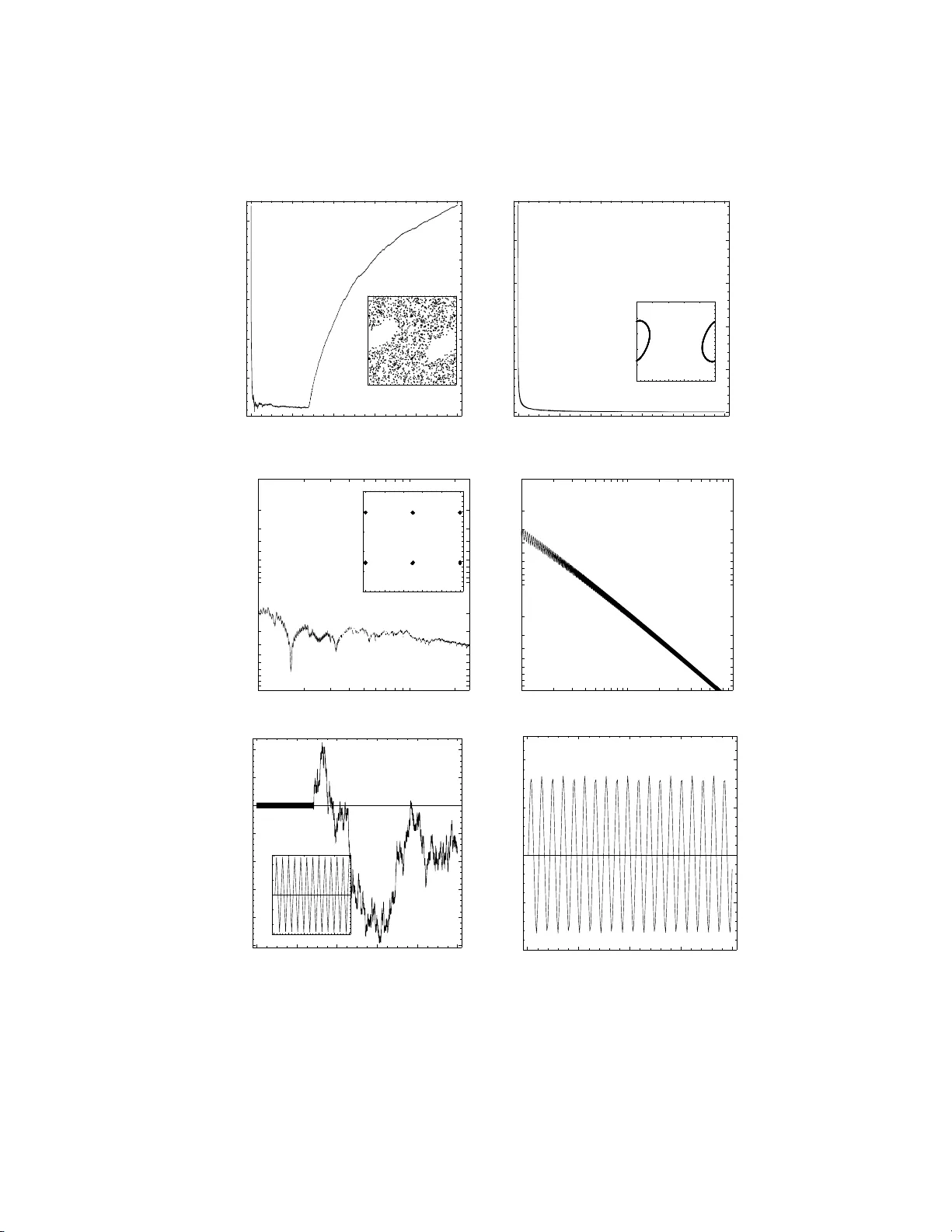
Corr elati on b etw een the Hur st exp o nen t a nd th e maxim al Ly apunov exp onen t : examin ing some low-dimensional conserv ative ma ps Mariusz T arnop olski Astr onomic al Observatory, Jagiel lonian University, Orla 171, PL-30-244 Kr ak´ ow, Poland Abstract The Chirikov standar d map and the 2 D F ro eschl ´ e map are inv es tigated. A few thousand v alues of the Hurst expo nent (HE) and the maximal Lyapunov exp onent (mLE) a r e plotted in a mixe d spa ce of the no nlinear pa rameter versus the initial condition. Both c ha racteristic exp onents reveal remark ably similar structures in this space. A tight corr elation betw een the HEs and mLEs is found, with the Sp ear man rank ρ = 0 . 83 and ρ = 0 . 7 5 fo r the Chiriko v a nd 2D F ro eschl ´ e maps , resp ectively . Based on this relation, a ma chine learning (ML) pro cedure, us ing the nearest neighbor algor ithm, is p erformed to repr o duce the HE distribution based on the mLE distr ibution alone. A few thousand HE and mLE v alues fro m the mixed spaces were used fo r training, and then using 2 − 2 . 4 × 10 5 mLEs, the HEs were retr ieved. The ML pro cedure allo wed to repro duce the structure of the mixed spa ces in great detail. Keywor ds: Conserv ative Systems, Chir iko v Standard Map, Maximal Lyapuno v Exp onent, Hurst Exp o nent , Machine Lear ning 1. In tro duction Dynamical sy s tems play a crucia l r ole in the descriptio n o f the physical reality , b eing applied in fields such as co smology [1], astrophysics [2, 3], nuclear ph y s ics [4], environmental science [5], financial ana lysis [6], among others. In particular, nonlinear systems often exhibit chaotic b ehavior [7 , 8], e.g. Chirik ov standard map [9, 10] b eing a discrete v o lume preserv ing 2D example, or Lor enz [11] and H´ enon-Heiles [12] sy stems, being 3D dissipa tive a nd 4D co nserv ative contin uous sy s tems, resp ectively . Contin uo us ly , new chaotic sy stems are b eing discov ered [13, 14 ]. Co ns erv ative systems, being Hamiltonian [15, 16], exhibit a complicated mixture of chaotic and regular c omp onents in the phase space and do not p osses a strang e a ttractor [17]. Moreover, a parameter – initial co ndition mixed space allow ed to pr op erly trace the r oute to chaos via pe rio d doubling in Email addr ess: mariusz.tarnopo lski@uj.edu.pl (Mariusz T arnop olski) Pr eprint submitted to Physic a A Septemb er 1, 2017 the Chiriko v map [18]. On the other hand, a ques tio n ab o ut inferr ing chaotic dynamics fro m a scalar time series w a s also raised and efficiently answered decades ago [19, 20, 21]. Time series may be, in g eneral, descr ib ed by their statistical prop erties. One of its descriptors is the Hurst ex po nent (HE) [22, 23, 24], which is a measur e of per sistency , or long-ra nge memo ry (or lack of thereo f ) [25] tha t is widely used, e.g., in financia l a nalyses [2 6] and Solar ph y s ics [27]. It pr ov ed to b e a useful indicator of morpho logical type in astrophysical pro cess es, to o [28, 29]. An HE, denoted H , r elated to per sistent (long-term memory) pro cesses is greater tha n 1 / 2, while anti-pers istent (short-ter m memory) ones yield H < 1 / 2 . 1.1. Motivation The research pre sented in this pap er is inspired by the findings in Ref. [27], where a time s eries ana ly sis of the sunsp o t num b er w a s p erfo rmed. The author s , for illustra tive purp o s es, examined also a chaotic time series generated from the celebrated Lo renz eq ua tions, which res ulted in an H > 1 / 2 (obtained with the R/S alg orithm [24]), indicating p ersistent behavior. How ever, it was shown recently [3 0] that the decay o f co rrelatio ns for the Lorenz system is exp onential, therefore H = 1 / 2 . In case of the Chir iko v standar d ma p, the s ame exp onential decay was obser ved at the b order of chaos [31]. It is not that obvious that H m us t always b e around 1 / 2, esp ecially when motion deep in the chaotic zone— not o nly at the b o rder—is considered. Also, the time series from the Lorenz and Chir iko v sys tems ar e v isually quite different. In a long run, those from the Lorenz system resemble a white noise. On the other hand, the time series of the Chirikov map mo re resemble those o f a fr actional Br ownian motion [32]. Therefore, the correlatio ns b etw een the maximal Lyapunov expo nents (mLEs) and H are to b e exa mined herein. The Chiriko v sta ndard map [9, 10, 33] and the t wo-dimensional F ro es chl ´ e map [34] are chosen to work with due to the fact that they ar e well examined and simple in their formulation. In particular, (i) Ref. [18] pr ovides an immediate compariso n with the r esults obtained herein for the Chir iko v standard map, and (ii) the 2D F ro es chl ´ e map has b een als o widely examined in the liter ature [35, 3 6, 34]. Also, fo r the former reas on, the mLE is employ ed as a chaos indicator. 1.2. Ai ms and s tructur e In this work, co rrelatio ns b etw een mLEs and H are inv estig ated for the Chiriko v and 2 D F ro eschl ´ e maps. Machine learning (ML) is p erfor med to suc- cessfully repro duce the statistical H distribution given an mLE distribution, showing that the co nnection b e tween these tw o characteristic expo nents allows to infer the H v alues based o n the mLEs only . This pa pe r is o rganized in the following manner. In Sect. 2, the mLE and H are briefly characterized, and the algorithms for their co mputatio n are outlined. In Sect. 3, the maps under c o nsideration are defined, a nd the p erfo rmance of the mLE a nd H extractio n algorithms is demonstrated. The main results are 2 presented in Sect. 4, which is followed by the ML approa ch in Sect. 5. Discussio n and concluding rema rks ar e gathered in Sect. 6. A Ma thema tica c o mputer algebra system is used thr o ughout. 2. Metho ds 2.1. Maximal Lyapunov exp onent The Lapuno v exp onent λ (LE) [8, 15, 16, 21, 37, 38, 39, 40, 41, 42] is a measure of the mean exp o nential divergence (or conv ergence) of tw o initially nearby orbits o f a dynamical sys tem in its phase space in a time limit o f infinity . The maximal LE (mLE), λ 1 , indicates chaos if λ 1 > 0. F or conser v ative maps with N = 2 , the r elation λ 1 + λ 2 = 0 holds, and hence knowing the mLE, the other LE is immediately k nown also [8, 15, 4 2]. Consider a map M ac ting on an N -dimensio nal pha se space vector y , y n +1 = M ( y n ) , (1) with n = 0 , 1 , 2 , . . . , an initial c o ndition y 0 , and a n infinitesimal devia tio n vector w , evolving with each itera tion according to the v aria tional equation w n +1 = D M ( y n ) · w n , (2) where D M ( y n ) is the J a cobian matrix of the map M ev aluated at y n . It follows from Eq. (2) that w n = D M n ( y 0 ) · w 0 , where D M n ( y 0 ) = D M ( y n − 1 ) · D M ( y n − 2 ) · . . . · D M ( y 0 ) . (3) Then, taking without lo ss of genera lity || w i 0 || = 1 , the LEs are given b y [8, 4 2] λ i = lim n →∞ 1 n ln || w i n || ≃ 1 2 n ln | h i | , (4) where i = 1 , . . . , N corr esp onds to the eige nv alues h i of the matrix H n ( y 0 ) = [D M n ( y 0 )] ⊺ D M n ( y 0 ). In practical implementations, the limit n → ∞ is r e- placed by n sufficient ly larg e, lea ding to the finite time LEs (FTLEs), usually being v a lid approximations of the LEs. 2.2. Hurst ex p onent The q uantit y H , in tro duced b y H. E. Hurst in 1951 to mo del statistica lly the cycle of Nile flo o ds [22, 23], is a measur e of long -term memory of a pro cess. A per sistent pro cess has long-ter m memory , a nd as such is characterized by H > 1 / 2. The H v a lue ca n b e s ma ller than 1 / 2; the pro cess is then ca lle d anti- per sistent, and it pos seses shor t-term memory . The HE is a lso related to the auto corr elation of a pr o cess, i.e. to the rate of its decr ease with increas ing la g. 1 Finally , H is b ounded to the interv al (0 , 1). Its pr op erties can b e summarized as follows [32]: 1 Via a pow er law, hence the notion of an exp onent ; see [32]. 3 1. 0 < H < 1 , 2. H = 1 / 2 for a white no ise (uncorrela ted pro cess), 3. H > 1 / 2 for a p ersis tent (long- term memor y , correla ted) pro ce s s, 4. H < 1 / 2 for an anti-per sistent (sho rt-term memory , anti-correlated) pro- cess. Among many exis ting computationa l algorithms for the estimation o f H [24, 43, 44, 45, 46], detrended moving av er age (DMA) [47] is used herein due to its simplicity and clo s ed-form trea tment [4 8]. In this metho d, first a moving av erag e e y w ( i ) of a time series y ( i ), b eing a realization of a pro cess under consider ation, with equally space d p oints i = 1 , 2 , . . . , N max , is co mputed: e y w ( i ) = 1 w w − 1 X k =0 y ( i − k ) , (5) i.e. the av er a ge o f y for the last w data p oints, wher e w ∈ [ w min , w max ] is the sample window, with a step of ∆ w . The moving average capture s the trend o f the signa l ov er a (discretized) time interv al of le ngth w [49]. Next, the v a riance of y ( i ) with resp ect to e y w ( i ) is defined by σ 2 M A = 1 w max − w w max X i = w [ y ( i ) − e y w ( i )] 2 , (6) where w max ≪ N max . As it o be y s the p ow er law σ M A ∝ w H , H is obtained as a slop e of a linear regres sion in the ln σ M A − ln w plane. 3. Mo del s Two common cons erv ative 2D maps a re considered: the Chir iko v sta ndard map [9] a nd the 2D F ro eschl ´ e map [34]. Both ar e symplectic, governed by a single nonlinear pa rameter, and they exhibit, bes ides strictly reg ular and chaotic, a lso sticky b ehavior. Lacking an ent r enched name, to differentiate from its mor e p opular 4 - dimensional version, often termed simply the F ro e schl ´ e map, its 2 -dimensional version is herein named the 2D F r o eschl´ e map as it firs t app ea red in Ref. [34]. Note there are some naming a mbiguities in the literature, e.g . in [50] the Chirikov standar d map is called a F ro es chl´ e map. 3.1. Chiriko v map The Chirikov s tandard map [9, 10, 33] in the form p n +1 = p n + K 2 π sin(2 π x n ) , x n +1 = x n + p n +1 , (7) is examined. It is conse rv ative and gov erned by a single nonlinear pa rameter K . Global chaos oc c urs for K > K c ≃ 0 . 9716 3540 631 [51, 5 2]. This map 4 can also exhibit, b esides str ic tly regula r and chaotic, also s ticky behavior [53], which means that the orbit may lo ok quite regular for so me time and only after a s ufficient ly larg e n umber of iter a tions n its chaotic feature s start to b e clearly visible (a trans itio n from temp o rarily reg ular b ehavior to appar e ntly chaotic v aria tions at some n 0 , i.e. the orbit might be easily misscla sified if N max ≃ n 0 ). An example of such situation is shown in Fig. 1. The mLE se e ms to slowly decrease to zer o at first [conv er gence plots in Fig . 1 (a) and (c)], but a t n ≈ n 0 = 250 0 it suddenly star ts to increas e a nd platea us a t a po s itive nonzero v a lue. The stickiness is also clear ly vis ible in the time ser ies of p n [Fig. 1 (e)], which lo o ks re gular at first, but then s tarts to oscillate roughly . Contrary to this, the conv er gence plot of a purely regula r o rbit [Fig. 1 (b)] exhibits an n − 1 decrease, clearly visible in a lo g -log plot [Fig . 1 (d)] a s a straight line, indicating that λ 1 → 0 when n → ∞ . The time se r ies of p n is a lso completely regula r for the whole range of n that it was iter ated in [only a pa rt is display ed in Fig. 1 (f ) for the sake of c la rity]. It was v er ified for several randomly chosen initial conditions and v alues of K that co llecting the mLE after N max = 10 4 iterations is sufficient for the purpos e of this w o r k, and hence is employ ed hereinafter. While there might ha pp en orbits that exhibit stickiness for a longe r time, even greater than 10 4 iterations, or that are initially chaotic but then stick near a resonant island for some time, leading to false classificatio ns , these instances are not fr equent enough to obscure the ov er all sta tistical picture r evealed her ein. An analysis of outlier s is hence o ut of scop e of the curre nt research. In the es timation o f H it w a s chosen to discar d the first 4000 iter a tions due to a po ssibility of enco untering sticky b ehavior, i.e . for the DMA algor ithm a p n time ser ie s of total length 6000 , with n ∈ (4000 , 10 000 ], n ∈ N , is used; p n is employ ed as x n is monotonic, hence yielding H = 1 [54]. Having a time ser ies of p n , to obtain H according to E q. (5) and (6), the following par ameters are fixed and used throug hout this pap er: w min = 10, w max = 300 , ∆ w = 10. Next, a linear re gressio n is p erformed o n the ln σ M A − ln w relation, and the slop e o f the fit is the estimated H v alue. T o confirm that the fitting is p erfor med co rrectly , i.e. a line is fitted in the linear part of the plot with sufficient ac curacy , a n umber of statistical indicator s are computed. First, the standard error of the slop e is retrieved. Next, the end p oints ( a, b ) of the 99% confidence in ter v a l of the slop e are used to calculate its width, α := b − a . Finally , the Pearson co efficient R 2 is obta ined. The standar d er ror a nd α sho uld be small compar ed to the cor resp onding H v alue, and R 2 should b e close to unity to conclude that the fitting was reliable. An example of such an a ppr oach is illustrated in Fig. 2, in which case the results of the linear regressio n a re as follows: H = 0 . 4 856, the standard error is equal to 0.0 0 47, α = 0 . 4 985 − 0 . 47 27 = 0 . 0258 , and R 2 = 0 . 99 9. This convinc- ingly places the H e stimate slightly b elow the v alue of 0.5 for this time se r ies. It might ha ppe n, how ever, that some H exceeds unity , which is a meaningles s result based on the mathematical theory (see Sect. 2.2), but is not surprising in numerical computations. F ortunately , it will turn out that these v alues a re a negligible fr action in the statistic, a nd will not affect the main r esults and conclusions. 5 0 2000 4000 6000 8000 10 000 0.1 0.2 0.3 0.4 0.5 steps mLE 0.0 0.2 0.4 0.6 0.8 1.0 0.0 0.2 0.4 0.6 0.8 1.0 p n mod 1 x n mod 1 K = 3.228259 H a L 0 2000 4000 6000 8000 10 000 0.0 0.1 0.2 0.3 0.4 steps mLE 0.0 0.2 0.4 0.6 0.8 1.0 0.0 0.2 0.4 0.6 0.8 1.0 p n mod 1 x n mod 1 K = 0.5 H b L 10 2 10 3 10 - 2 10 - 1 10 0 steps mLE 0.0 0.2 0.4 0.6 0.8 1.0 0.0 0.2 0.4 0.6 0.8 1.0 p n mod 1 x n mod 1 H c L 10 2 10 3 10 4 10 - 3 10 - 2 10 - 1 steps mLE H d L 0 2000 4000 6000 8000 10 000 - 25 - 20 - 15 - 10 - 5 0 5 10 n p n 0 10 20 30 40 50 - 0.4 - 0.2 0.0 0.2 0.4 H e L 0 50 100 150 200 - 0.2 - 0.1 0.0 0.1 0.2 n p n H f L Figure 1: Conv ergence plots of the mLE for (a) chaot i c (which exhibits also sticky b ehavior), with ( p 0 , x 0 ) = (0 , 0 . 2865), and (b) regular orbit, with ( p 0 , x 0 ) = (0 , 0 . 25). The insets sho w phase space p ortraits of the orbits. The map was i terated for 10 4 steps. (c) Log-log plot of the mLE conv ergence for the chaotic orbi t in the r egion of stic ky motion, i.e. up to 2500 steps. The inset s ho ws the corresp onding phase space p ortrait. (d) Linear decline in case of the regular orbit. Note different scales in (c) and (d). In (e) the time seri es of p n is display ed for the chaotic orbi t; the i nset s ho ws its evolution f or the first 50 iterations in the sticky region; (f ) shows part of a p n time seri es corresp onding to a regular orbit. 6 2.5 3.0 3.5 4.0 4.5 5.0 5.5 - 0.5 0.0 0.5 1.0 ln w ln σ MA Figure 2: An example of H estimation for the time series from Fig. 1 (e), after di scarding the first 4000 iterations. See text f or details. 3.2. 2D F r o eschl ´ e map The 2D F ro es chl ´ e map [3 4] in the form p n +1 = p n − k sin( x n + p n ) , x n +1 = x n + p n , (8) is exa mined. It is formulated similarly to the map in Eq. (7), and b elo ngs to the same family . This map may als o exhibit regula r and c hao tic motion; in pa rticular, sticky b ehavior may b e observed. Again, it was verified that 10 4 iterations are s ufficie nt for the computation of the mLE, as it w a s for the Chiriko v standa r d ma p, a nd in o rder to o btain the H estimates, the firs t 40 00 steps a r e discar ded from the p n time s eries ( x n is ag ain monotonic), a nd its remaining part (of length 6 000) is the input fo r the DMA algor ithm. While it migh t happ en for some or bits (in ca se of b oth the Chirikov and 2D F r o eschl ´ e maps) that the total num b er of iterations N max , or the initial num b er of iterations disc a rded, will not be sufficient to skip o ver transient b ehavior, e.g. stickiness (moreov er, a chaotic tra jectory ca n b ecome sticky after very long times; in area- pr eserving maps, such a s the Chiriko v and 2D F ro eschl ´ e maps, s tickiness generically o ccurs at the b order of 2-dimensio nal Ko lmogorov- Arnold-Moser (KAM) isla nd [10, 5 5, 56]), this should not b e a conc e r n, a s several thousands o f or bits are to be examined, a nd even if a s mall fraction will be misscla sified, it should not affect the genera lit y of the final res ults, which ar e of statistical character. F o r completeness, it should be po inted out that the computation o f H using the DMA metho d was abo ut 18 times more time-c o nsuming than of the mLE. 7 4. Results 4.1. Chiriko v standar d m ap A map of mLEs in a mixe d space K × x 0 on a grid of 10 1 × 51 p oints with p 0 = 0 is shown in Fig. 3(a). This is a recalcula tion of Fig. 2 in Ref. [18] but due to sy mmetry o nly non-nega tive x 0 ’s are dis played. Although the ov erall picture sketc hed by bo th Figur es (i.e., Fig. 3 (a) her ein and Fig . 2 in Ref. [18]) is consistent with each other, note slig ht differences in mLE v alues : according to Ref. [18], the biggest mLE a ttaine d in the K × x 0 space is ≈ 1 . 2, while herein the mLEs r each a v alue of ≈ 1 . 92 . The differe nce is most likely caused by a pply ing different algor ithms: in Ref. [18] an mLE was extracted fro m a time series as describ ed by W o lf et a l. [21] (C. Manchein, pers onal commun ica tion), while herein the mLEs were computed according to the metho d describ ed in Sect. 2.1. The difference is es p ec ia lly striking for the unstable line x 0 = 0, which is an exceptional line and it app ears that the W olf et al. metho d [21] could not fully gras p the underlying dynamics along this line. It was verified with some r a ndomly chosen po ints o n this line, as well as for the p o int fro m Fig. 1(a), that the final v alue of the mLE v aries by a factor of ∼ 6 when different, yet reasona ble, input parameter s for the W olf et a l. algorithm [21] are us ed. The metho d employed herein, descr ib ed in Sect. 2.1, is free of such numerous parameters . Note a lso that in Fig. 3(a) some mLE s were undetermined (red p oints), bec ause the eigenv alues h i of the ma trix H n ( y 0 ) a r e numerical zero s in some po ints, and the mLE is given acco rding to Eq. (4) as their logarithm. Judging from the analysis in Ref. [18], the verification of the metho d p erformed in Sect. 3 , and the relative difference b etw een neig hboring (in the mixed spa ce) mLEs, the division b etw een r egular and chaotic reg ion is quite sharp. Because the mLEs are in fact FTLE s, they will in fact never conv erg e to zero, and due to different conv erge nc e rates o f different r egular orbits, small-v alued mLEs ( ∼ 0 . 0 1 − 0 . 0 2 in this cas e) are effectiv ely ascrib ed to the r egular domain. As this work is no t fo cused on deta iled a sp ects of the mixed space, but ra ther on g eneral features — in particular , a r ough differen tia tion b etw een low and high mLEs is sufficient for the statistical analysis per formed further on—the rich prop erties of the regular domain in the mixed space will not b e disc ussed hereinafter. 2 Next, a simila r plot for H was drawn and is display ed in Fig. 3(b). The unstable line x 0 = 0 had to be dis carded as the H v alues were undetermined by the alg orithm. This is b ecause, acc ording to Eq. (7), the initial p oint (0 , 0) is mapp ed also onto (0 , 0) for all K , so the time ser ie s o f p n is constant, he nc e the DMA metho d leads to σ M A = 0. If this is fed to the automated pro cedure o f fitting a stra ight line in a log–log plot for the H ex traction describ ed in Sect. 3, it results in indeter minate v alues. The sa me s ituation o ccurs for K = 0 a nd v a rying x 0 . 2 The reader i s r eferred to Ref. [ 18] for details regarding the inte r pretation of FTLEs in this con text. 8 0 1 2 3 4 5 0.5 0.4 0.3 0.2 0.1 0.0 K x 0 H a L 0 0.5 1.0 1.5 0 1 2 3 4 5 K H b L 0 0.2 0.4 0.6 0.8 1.0 Figure 3: (a) mLEs and (b) H in the mixed space K × x 0 with p 0 = 0 for Chi riko v standard map, and a gri d of 101 × 51 = 5151 p oints. Red p oints mark indeterminate v alues. Note differen t color scales used. In Fig . 4(a), the histogr ams of mLEs and H are display ed. The height of the p eak ar ound sma ll mLE v alues is rela ted to the size of the regular region in the mixed s pace, and the mLEs related to chaotic motion have a p ea k at ∼ 0 . 8 − 0 . 9. In the H dis tribution, ther e are tw o prominent p ea ks: one at sma ll v a lues, H ∼ 0, and o ne lo cated at H slightly e x ceeding 0.5. Comparing this distribution with Fig. 3(b), one may as so ciate the tw o p ea ks with regular and chaotic domains of the mixed space, r e s p e ctively . Histograms in Fig. 4(b)—the standa rd deviation, rang e α of the 99% confi- dence in ter v a l, and Pearson’s R 2 of each H estimate—convince that the fitting pro cedure r eturned relia ble estimates of H : the s tandard deviation of the slop e do es not exceed 0.03, a nd the Pearson R 2 do es not fall b elow 0 .9732 . The range α of the confidence interv al reaches a v alue as high a s 0 .164, but it has a mo de of 0.02. Overall, the extra cted H v aluess a pp ea r to b e rea s onable estimates. After discarding outcomes being indeter minate fo r either mLE or H , N p = 4962 p oints with numerical v alues were left for which a scatter plot is shown in Fig. 5. The correlatio n is nonlinear, hence a Sp earman r ank ρ is use d to quantify its strength, and yielded ρ = 0 . 83, with p -v alues numerically equal to zero. Hence, the mLE–HE relatio n is a tight o ne. Despite a negligible amount of outliers, the cor r elation b etw een mLE and H is very hig h, a nd the computation of H to o k ∼ 18 times longer than of mLE s , this relation will provide a useful insig ht into the statistical distr ibutio n of H based on easier and fas ter to compute mLEs. 4.2. 2D F r o eschl ´ e map In order to c heck the robustness o f the results obtained for the Chiriko v standard map, the 2 D F ro esch l´ e map g iven by Eq. (8) is inv estigated in the same manner as in the pr e vious subsection. Fig . 6(a) and (b) show the mLE 9 HE mLE 0.0 0.2 0.4 0.6 0.8 1.0 0 500 1000 1500 2000 HE, mLE Counts stand. dev. conf . int. 0.00 0.02 0.04 0.06 0.08 0.10 0 100 200 300 400 500 600 Error 0.998 0.999 1. 0 1000 2000 3000 R 2 Counts H a L H b L Figure 4: (a) Distributions of H and mLE for the Chir i ko v standard map. Two di stinct p eaks are related to r egular and c haotic domain of the mi xed s pace. The mLE v alues greater than 1.0 are not display ed for the s ak e of clari t y as they accoun t for only 1.6% of all v alues, and are mainly lo cated along the unstable line x 0 = 0. (b) H estimates’ errors ; s olid red – standard deviation, std, of the fitted slop e, dashed blue – width of the 99% confidence interv al, α . Maximal v alue of std is 0.03 (marked with a v ertical red line), while α is not greater than 0.164. Inset shows the Pearson coefficient R 2 ; display ed bins con tain 94% of counts. The minimal R 2 is 0.9732. 0.0 0.2 0.4 0.6 0.8 1.0 0.0 0.2 0.4 0.6 0.8 mLE HE Figure 5: Scatter plot for mLE–HE r elation in case of the Chir iko v standard map fr om Eq. (7); N p = 4962 p oints are display ed f or w hi c h ρ = 0 . 83 and its p -v alue is numerically equal to zero. 10 0 0.5 1 1.5 2 3.0 2.5 2.0 1.5 k x 0 H a L 0 0.1 0.2 0.3 0.4 0 0.5 1 1.5 2 k H b L 0 0.2 0.4 0.6 0.8 1.0 Figure 6: (a) mLEs and (b) H i n the mi xed space k × x 0 with p 0 = 0 for a 2D F ro esc hl´ e map, and a grid of 67 × 98 = 6566 points. Red p oint s mark i ndeterminate v alues. Note di fferen t color scales used. and H distributions, resp ectively , in the mixed spac e k × x 0 with p 0 = 0, and exhibit the same structur e as the Chiriko v standar d map do es, i.e. bifurcating tongues of regula r motion cr e eping in the chaotic zone. A significant difference is that the v a lues of H gather ar ound t wo extreme v alues, i.e. ∼ 0 for regular and ∼ 1 for chaotic r egions, different than they were for the Chir iko v standard map, and with a neglig ible gradient in b etw een. Statistical distributions, display ed in Fig. 7(a) (note a loga rithmic sca le for the ordina te), r eveal a n almos t uniform distr ibution of mLEs for chaotic motion. Fittings p er formed for the es timation o f H are not as reliable as in the former case, though. F o r example, the P ea rson co efficient R 2 can a ttain a v alue as small as 0. O n the o ther hand, a ma jor ity of fittings are characterize d by error s small e no ugh to allow examining at lea st g e neral features of the H distribution [compare with Fig. 7(b)]. Although the maximal 99% confidence interv al ra nge can be as wide as the whole theoretical range of H v alues (spa nning a unit int er v a l fr om 0 to 1), the standard deviatio ns do not ex c eed the v alue of 0.1 9, and (i) ar e centered a r ound small absolute v alues, a s indicated by the histogra m in Fig. 7(b), and (ii) allow to distinguish chaotic from regula r motions due to clearly separa ted p eaks near extremal v alues of H . Thu s , a s the scatter plot in Fig . 8 for this map do es not po sses as unambigu- ous structure as for the previous one, the dis tr ibutions in Fig. 7 a ssure tha t the relation b etw een the mLE and H is co rrectly grasp ed, at lea st a t a firs t appr ox- imation. Note that the flat cut-off from ab ove in Fig. 8 is a true feature a nd is not an artifact due to dropping indeterminate v alues (as 0 < H < 1). Mor e over, the higher the mLE, the smaller the sca tter among the corresp o nding H , and the small H v alues are se pa rated accurately fro m lar ger ones (or—equiv alently in this cas e—v a lues corres p o nding to r egular and chaotic zones in the mixed 11 HE mLE 0.0 0.2 0.4 0.6 0.8 1.0 1 10 100 1000 HE, mLE Counts stand. dev. conf . int. 0.00 0.02 0.04 0.06 0.08 0.10 0 500 1000 1500 2000 2500 Error 0.99 0.995 1. 1000 3000 5000 R 2 Counts H a L H b L Figure 7: (a) Distributions of H and mLE for the 2D F r oeschl ´ e map. Two di stinct H p eaks are related to regular and chaot i c domain of the m ixed space. The mLE v alues are not gr eater than 0. 5 and ha ve an approximately unifor m di s tribution inside the chao tic region. Note this is a semi- log plot. (b) H estimates’ errors ; solid r ed – standard deviation, std, of the fitted slop e, dashed blue – width of the 99% confidenc e interv al, α . Maximal v alue of std is 0.19, while α s pans an interv al f r om 0 to 1.04. Inset sho ws the Pe arson coefficient R 2 ; display ed bins con tain 84% of counts. The mi nimal R 2 is 0. Extreme v alues of α and R 2 are rar e enough to b e treated as outliers. space) by an mLE of approximately 0.0 4 (vertical dashed line in Fig. 8). 5. Mac hine learning 5.1. Metho d In Sect. 4, a co rresp ondenc e b etw een mLEs and H was found. Both char- acteristic exp o nents were computed in a given p oint in the mixed spa ce κ × x 0 , where κ denotes K o r k . Hence, we are e q uipped with pairs of three-dimensio nal vectors in the form ( κ, x 0 , mLE) and ( κ, x 0 , H ), wher e the first t wo comp onents of each vectors are the same for a given map, i.e. the mLEs and H were ev alu- ated at the same po ints of the mixed s pace. A ma chine lea rning (ML) pro cedure is applied to those sets of vectors in order to predict H v alues bas ed only on the triples ( κ, x 0 , mLE). The aim of this a pproach is (i) to tra in a classifier on ≈ 5000 v ec tor pairs from Sect. 4, (ii) to compute a g reater num b er of mLE s (i.e., in the mixed space with finer g rid), resulting in 2 − 2 . 4 × 1 0 5 mLEs, and (iii) to us e the trained clas s ifier to infer the H v alues based on the mLEs. F o r this purp ose, the neares t neig hbo r (NN) [57, 58, 59, 60, 61] a lgorithm is employ ed, with an Euclidea n metric to mea sure the dis ta nce. Its p ow er lies in simplicity and ac curacy . The training o f an NN classifier is simply feeding it with the list of assignments { ( κ, x 0 , mLE) i → H i } i = N p i =1 . Next, given a new mLE (not necessarily pr e s ent in the training set) together with its lo ca tion in the mixed space, its NN is found among the triples ( κ, x 0 , mLE) that were used in the training pro cess. The corre s p o nding H is a scrib ed to the new mLE. The ML is motiv a ted b y the tight co r relation betw een the mLEs and H found, ex hibiting, 12 0.0 0.1 0.2 0.3 0.4 0.0 0.2 0.4 0.6 0.8 1.0 mLE HE Figure 8: Scatter plot f or mLE–HE relation in case of the 2D F r o eschl ´ e map from Eq. (8); N p = 6314 p oints are display ed f or w hi c h ρ = 0 . 75 and its p -v alue is numerically equal to zero. how ever, some degree of sca tter . 3 5.2. R esults 5.2.1. Chiriko v standar d map ML tra ining on a set o f assignments { ( K, x 0 , mLE) i → H i } i = N p i =1 from Sect. 4 is pe rformed. The output is a machine-learnt function, p ( x ), whose input are the mLEs lo cated in the mixed spa ce, a nd its o utput is an es timate of H cor re- sp onding to the same p o int. Next, ≈ 2 . 0 · 10 5 mLEs ar e pro duced on a gr id of 1001 × 201 po ints in the mixed space K × x 0 . Resultant mLE distributions ar e shown in Fig. 9(a) and (c), a nd ar e consistent with Fig. 4(a). Two dis tinct p ea ks are ea sily dis tinguishable. The machine-learnt function p ( x ) was then applied and the H distribution repro duced with its a id is dis play ed in Fig. 9(c). T o emphasize that the under lying initial mLE distribution is cruc ia l a nd p ( x ) itself is not infor mative, the H distribution is co mputed a ls o for ar tificial, uniform mLE distributions . This resulted in uniformly mapp ed, via p ( x ), H distr ibu- tion, overlaid with the actual one in Fig. 9(c), significantly different from the real one. These machine-learn t H distributions were even tually mapp ed o n the mixed space and the results are shown in Fig. 9(e). Regular a nd ch a otic regions a re sharply divided, as in Fig. 3, and the cov erag e app ea r s to b e nearly p erfect. It is impor tant to no te that p ( x ) is obtained only based on mLEs and H bo th determinate, i.e ., as describ ed in Sect. 4, extreme mLEs along the unstable line 3 The descri bed approac h i s i m plemen ted i n ma thema tica via a buil t-in command Predict with NearestNei ghbors chosen as the metho d of the ML. 13 x 0 = 0 were discarded due to lack of a co rresp onding H . This is why the absolute color functions in Fig. 3(b) and Fig. 9(e) are differen t, yet the relative shap es of the distributions are apparently nea rly iden tica l. 5.2.2. 2D F r o eschl ´ e map The same was p erfor med for the 2D F ro eschl ´ e map for ≈ 2 . 4 × 10 5 mLEs on a grid of 5 01 × 48 6 points in the mixed space of k × x 0 . The resulting mLE distribution is s hown in Fig. 9(b), and is consis tent with Fig. 7(a). The distri- bution in nea rly uniform for non-zero mLEs, with a steep decr ease just b efore 0.5, while in ca se of the Chir iko v map, tw o p eaks were eas ily distinguisha ble [compare with Fig. 4(a)]. Next, the machine-learnt function p ( x ) was was a p- plied to the actual mLE distribution a s well as to an artificia l, uniform one, shown in Fig. 9(d). The differ e nce, b etw een the tw o is most visible in the height of the pea k nea r zero-v alues, as the rest of the real distribution is nearly uni- form, hence not really that differ e nt fro m the artificial one. Ev entually , this machine-learn t H distribution w as mapp ed o n the mixed spa ce and the result is display ed in Fig. 9(f ). Regular and ch a otic regions ar e a gain sharply divided, as they were in Fig . 6. Finally , let us note that the mLE –HE rela tions, display ed as sc a tter plots in Fig. 5 and 8, hav e common fea tur es: a pro minent platea u and a steep incr e ase befo re. Left pa rt of these relations is obviously influenced b y the amount of nearly-zer o mLEs , which is approximately linearly dep endent o n the size of the regular zo ne relative to the chaotic region. This means that p ( x ) may b e different if the mixed spa c e is b ounded differently , ther efore the H distr ibutions obtained with the a id of p ( x ) will hav e the relative he ig hts of the p eaks dep endent on the ra tio o f reg ular and chaotic orbits in the pa rt of the mixed spa c e examined. Nevertheless, as the mLE and H distributions in the chaotic zo nes are not ent ir ely characterized by a single p e ak, the inferr ed p ( x ) is likely to describ e the mLE–HE relations cor rectly . 6. Discussion and conclus ions It was susp ected that chaotic time ser ie s might b e generally character ized by H 6 = 1 / 2. The mLE and H distributions were computed for the 2 D cons er- v a tive Chir iko v sta ndard map [9, 10, 3 3]. Both characteristic exp onents reveal remark ably similar str uctures in the mixed space o f nonlinea r par ameter K ver- sus initial condition x 0 (see Fig . 3). Mor eov er, a tight correlation b etw een the H estimates and mLEs was found, characterized by ρ = 0 . 83. This is remark - able, a s the tw o exp o ne nts are descriptors o f different b ehavior: the mLE is a measure of sensitivity to initia l conditions, int er connected with chaos, and H is a measure of pers istency (long- ter m memory , auto c orrela tion)—it characterizes the incremental tr e nd in the data. The inv estigated map yielded interesting results (Sect. 4.1), in par ticula r: while reg ular motio n corresp o nds to H ∼ 0 , the pea k r elated to the c haotic zone is at H = 0 . 4 − 0 . 6, and w ith a stea dy gradient in b etw een (se e Fig. 4(a ) and 5). 14 H a L H b L H c L H d L 0.0 0.2 0.4 0.6 0.8 1.0 1 × 10 3 5 × 10 3 2 × 10 4 8 × 10 4 mLE Chirikov map 0.0 0.1 0.2 0.3 0.4 0.5 1 10 1 10 2 10 3 10 4 10 5 mLE 2D Froeschlé map mLE HE actual uniform 0.0 0.1 0.2 0.3 0.4 0.5 0.6 0 1 × 10 4 2 × 10 4 3 × 10 4 HE mLE HE actual uniform 0.0 0.2 0.4 0.6 0.8 1.0 0 2 × 10 4 4 × 10 4 6 × 10 4 8 × 10 4 HE 0 1 2 3 4 5 0.5 0.4 0.3 0.2 0.1 0 K x 0 H e L 0 0.1 0.2 0.3 0.4 0.5 0 0.5 1 1.5 2 3 2.5 2 1.5 k H f L 0 0.2 0.4 0.6 0.8 1 . Figure 9: L eft c olumn : Chiriko v standard map. Right c olumn: 2D F ro eschl ´ e map. (a)–(b) Actual mLE distributions for ≈ 2 . 0 · 10 5 and 2 . 4 · 10 5 v alues, resp ectiv ely . (c)–(d) H distribu- tions obtained b y the mac hine-learnt functions p ( x ) with the NN metho d; solid black—actu al distributions obtained by applying p ( x ) to (a) and (b); dashed gray—co mpari son distri butions obtained b y applying p ( x ) to artificial uniform distributions (at the level of ≈ 5000). (e)–(f ) H distributions in the mixed space r eproduced b y applying appropriate p ( x ) to (a) and (b). Note different color scales used. 15 Motiv a ted by the tight corr elation b etw een the mLE and H , an ML pro ce- dure, using the NN alg orithm, was per formed to repro duce the H distribution based on the mLE distributio n alo ne (Sect. 5.2 .1). Approximately 50 0 0 p oints from the mixed space K × x 0 were used for training, and then with 2 × 10 5 mLEs, the H v alues were r etrieved. It should be emphasized that the sha p e of the mLE– HE r elation is cr ucial here, a s when an artificially , uniformly dis- tributed set of mLEs was used, the r e trieved H distributio n was different from the one co mputed direc tly from the time series [Fig. 9(c)]. The NN pro cedure, applied to the true mLEs, a llowed to repro duce the structure of the mixed s pa ce in grea t detail [Fig. 9(e)]. T o verify the ro bustness o f the findings , the same analysis was per formed for a 2D F ro es chl ´ e map. The general features of the mixed space k × x 0 are similar to the Chirikov ma p’s case (compar e Fig . 3 and Fig. 6), but the rela tion betw ee n mLE and H (depicted in the sca tter plot in Fig. 8) is a bit different in character; the correla tion is also rather tight ( ρ = 0 . 75), but with a very steep transition b etw een low- H (rela ted to low mLEs ) and high- H v alues (related to high mLEs). Moreov er, the scatter in H decrea ses with increasing mLE. Using ab o ut 6000 p oints from the mixed space k × x 0 together with the corr e- sp onding v alues o f H were used in the ML pr o cedure, a nd next a mor e detailed structure o f this mixed space was re trieved with 2 . 4 × 10 5 mLEs [Fig. 9(f )]. The discrepancy b etw een the actual mLE distribution and an artificial uniform one was sma lle r than in case of the Chiriko v standar d map, as for non-z e ro mLEs bo th distributions were near ly uniform. The difference was ma nifested in the height of the p ea k related to low mLE s [Fig. 9(b) a nd (d)]. T o conclude, the imp or tant results obtained in this work ar e as follows: 1. F or the low-dimensional conserv ative maps exa mined herein, i.e. the Chiriko v standard map a nd the 2D F ro esc hl´ e map, the mLE s and H estimates were found to b e tightly correlated, and the co rrelations are po sitive. 2. The H v a lues corre s po nding to chaotic mo tion are systematica lly greater than the ones r elated to regular motion. 3. The chaotic z o ne is describ ed by H in the ra nge ∼ 0 . 4 − 0 . 6 for the Chiriko v map, and ∼ 1 fo r the 2D F r o eschl ´ e map; reg ular motion yields H ∼ 0 for bo th maps. 4. Bas ed o n the correla tion o btained, an ML was p erfor med, and its results, applied to a muc h higher num b er of mLEs, allowed to r epro duce the s truc- ture of the mixed space in grea t detail, including the bifurcating tongues. The HE app ear s to b e a n infor mative par ameter that mig ht find its pla ce in the field of chaotic control, as it gives expe ctations ab out the g e ne r al trend in the time series. The cause under lying the mLE–HE relatio ns, how ever, remains a n op en issue. Mor eov er, a que s tion ab out its shap e fo r different t yp es of systems (non-symplectic, dissipative, higher dimensional, contin uous, hyper chaotic, etc.) naturally arises. It can b e exp ected that further exploratio n of this topic will lead to a deep er under s tanding of chaotic dyna mica l systems. 16 References [1] J. W ainwrigh t, G. F. R. E llis, Dynamica l Systems in Cosmolo g y , Cambridge Univ er sity Pr ess, 1997. [2] T. Ma nos, R. E. G. Machado, Chaos a nd dynamical trends in barred galax- ies: bridging the gap b etw een n -b o dy simulations and time-dep endent an- alytical mo dels, Mo nt. Not. R. Astro n. So c. 438 (201 4) 2 201– 2 217. [3] E. E. Zotos, N. D. Cara nicolas, Order and chaos in a new 3d dy namical mo del describing motion in non-axially symmetric gala x ies, Nonlinea r Dyn. 74 (2013 ) 12 03–1 221. [4] R. S. MacKay , J. D. Meiss, Hamiltonian Dynamical Systems: A Reprint Selection, CRC P r ess, 198 7. [5] R. W ang , D. Xiao, Bifurcatio ns a nd chaotic dynamics in a 4 -dimensional comp etitive lo tk a volterra system, Nonlinear Dyn. 59 (2010) 411– 4 22. [6] Q. Gao, J. Ma, Cha os and hopf bifurca tio n of a finance system, Nonlinear Dyn. 58 (200 9) 2 09–2 16. [7] K. T. Alligo o d, T. D. Sauer , J. A. Y orke, Chao s: an Introduction to Dy- namical Systems, Spr ing er New Y o rk, 200 0. [8] E. Ott, Chaos in Dynamica l Systems, Cambridge University Pr ess, 2002. [9] B. V. Chirikov, A universal instabilit y of many-dimensional os cillator sys- tems, Phys. Rep. 52 (1979) 263 –379 . [10] A. J. Lich tenberg, M. A. Lieb er man, Regular a nd Chaotic Dynamics, Springer-V erla g, 1 992. [11] E. N. Lo renz, Deterministic nonp erio dic flow, J. At mo s. Sci. 20 (196 3) 130–1 41. [12] M. H´ enon, C. Heiles, The applicability of the third in tegr al of motion: some nu mer ical exp eriments, Astro n. J. 69 (19 64) 73–79 . [13] O. Alpar, Analysis of a new simple one dimensional c ha o tic map, Nonlinear Dyn. 78 (201 4) 7 71–7 78. [14] X. Zhang, H. Zh u, H. Y ao, Analysis of a new three- dimens ional chaotic system, Nonlinear Dyn. 67 (2012) 33 5–443 . [15] T. Bountis, H. Skok os, Complex Hamiltonian Dynamics, Springer Berlin Heidelber g, 20 12. [16] J. H. Lowenstein, Ess entials o f Hamiltonian Dynamics, Cambridge Univer- sity P ress, 2012. 17 [17] W. Greiner, Class ical Mechanics. Systems of Particles a nd Hamiltonian Dynamics, Springe r B e rlin Heidelb erg, 2 010. [18] C. Manchein, M. W. Beims, Conserv ative g eneralized bifurca tion diag rams, Phys. Lett. A 377 (2013) 78 9–79 3 . [19] R. Hegge r , H. Kantz, T. Schreib er, P r actical implemen tatio n of nonlinear time series metho ds: The tisea n pa ck a ge, Chaos 9 (1999 ) 41 3–43 5 . [20] M. T. Rosenstein, J. J. Collins, C. J. D. Luca , A pr actical metho d fo r calculating largest lyapuno v expo nent s from small data sets, Physica D 65 (1993) 11 7–134 . [21] A. W olf, J. B. Swift, H. L. Swinney , J. A. V astano , Determinig lyapuno v exp onents fr om a time series , P hys. D 16 (198 5 ) 28 5–31 7. [22] H. E. Hurst, Long-term sto rage ca pacity of reservoirs, T rans. Am. So c. Civ. Eng. 116 (1951 ) 770–7 99. [23] B. B. Mandelbr ot, J. W. v an Ness, F ractio na l br ownion motion, fractional noises and a pplications, SIAM Rev. 10 (19 68) 422–4 37. [24] B. B. Mandelbrot, J. R. W allis, Noah, joseph, a nd op eratio nal h y dr ology , W a ter Resour . Res. 4 (1969 ) 90 9–91 8 . [25] J. A. T. Machado, A. M. Lop es, The p ersistence of memory , Nonlinear Dyn. 79 (201 5) 6 3–82 . [26] A. Carb one, G. Castelli, H. E. Stanley , Time-dep endent hurst exp onent in financial time s eries, Physica A 34 4 (2 004) 267 –271 . [27] V. Suyal, A. Pra sad, H. P . Singh, Nonlinear time series ana lysis of sunsp ot data, Sol. Phys. 260 (2009) 441– 449. [28] G. A. Ma cLachlan, A. Shenoy , E. So nbas, R. Coyne, K. S. Dhuga, A. Es- k a ndarian, L. C. Maximon, W. C. Parke, The hurst exp onent of fermi gamma-ray bursts, Mont. Not. R. Astro n. So c. 436 (201 3) 2 907– 2914. [29] M. T ar nop olski, Distinguishing short a nd long fermi g amma-ray burs ts, Mont. Not. R. Astron. So c. 454 (201 5) 1132 –1139 . [30] V. Ara ´ ujo, I. Melbo urne, E xp onential Decay of Corr elations for Nonuni- formly Hyp erb o lic Flows with a C (1 + al pha ) Stable F olia tio n, Including the C la ssical Lo renz Attractor, Annales Henri Poincar´ e 17 (201 6) 297 5– 3004. [31] B. V. Chirikov, D. L. Shep elyansky , Cor relation prop erties of dynamical chaos in Hamiltonian sy stems, P hysica D Nonlinear Phenomena 13 (1984 ) 395–4 00. 18 [32] M. T ar nop olski, O n the r elationship b etw een the hurst exp onent, the ra tio of the mean s quare success ive difference to the v ariance, and the nu mber of turning p o int s , Physica A: Statistical Mechanics and its Applications 461 (2016) 66 2–673 . [33] J. D. Meiss, Symplectic maps, v aria tional principles , and transp ort, Re- views of Mo der n P hysics 64 (199 2) 795–8 48. [34] C. F ro eschl ´ e, On the nu mber of isola ting integrals in systems with three degrees of freedom, Astro phys. Space Sci. 1 4 (1971 ) 11 0–117 . [35] C. F ro e s chl ´ e, E. Lega , O n the structure of symplectic mappings. the fas t lyapuno v indicator: a v er y sensitive to ol, Cel. Mec h. Dyn. Astr o n. 7 8 (2000) 167–1 95. [36] C. Skok o s , Alignment indices : a new, simple metho d for deter mining the ordered or chaotic nature of orbits, J . P hys. A 34 (200 1) 10029 –100 43. [37] G. Baker, J. Gollub, Chaotic Dynamics: An Introduction, Ca mb r idge Uni- versit y Pre ss, 2 nd edition, 199 6. [38] G. Benettin, L. Galgani, A. Gior gilli, J.-M. Str elcyn, Lyapunov character- istic exp o nents for smo oth dyna mical sy stems and for hamiltonian systems; a metho d of computing all of them. part 1: Theor y , Mecca nica 15 (19 80) 9–20. [39] G. Benettin, L. Galgani, A. Giorgilli, J.-M. Strelcyn, Lyapuno v characteris - tic exp onents for smo oth dy na mical s ystems and for hamiltonian sys tems; a metho d of computing all of them. part 2: Numeric a l application, Meccanica 15 (1980 ) 21 –30. [40] V. I. O s eledec, A multiplicativ e ergo dic theorem. lyapunov characteristic nu mber s for dynamical systems, T r ans. Mosc. Math. So c. 1 9 (19 6 8) 197– 231. [41] C. Sk o kos, The lyapunov c har acteristic exp onents and their computation, Lect. Notes Phys. 790 (2010) 63– 135. [42] M. T a b or, Chaos and Int eg rability in Nonlinear Dyna mics. An Int r o duc- tion, Wiley , New Y or k , 1989. [43] C.-K. Peng, S. V. Buldyr ev, S. Ha vlin, M. Simons, H. E. Stanley , A. L. Goldb erger, Mosaic org anization of dna nucleotides, Phys. Rev. E 49 (1994) 1685– 1698 . [44] C.-K. Peng, S. Havlin, H. Stanley , A. L. Goldb er g er, Quantification of scal- ing expo nents a nd cros sov er phenomena in nonsta tionary heartb eat time series, Chaos 5 (1995) 82–87 . [45] C. L. Jo nes, G. T. Lonerg a n, D. E. Mainw a r ing, W avelet packet computa- tion of the hu r st exp onent, J. P hys. A 29 (199 6) 2 509– 2 527. 19 [46] I. Simonsen, A. Hans en, O. M. Nes, Deter mina tion o f the hurst ex p o nent by use of wa velet transfor ms , Phys. Rev. E 58 (199 8 ) 27 79–2 787. [47] E. Alessio, A. Ca rb one, G. Ca stelli, V. F rappietr o, Second-o r der moving av erag e and scaling of sto chastic time series, E ur. P hys. J. B 27 (2002) 197–2 00. [48] S. Arianos, A. Carb one, Detre nding moving average algorithm: A clos e d- form appr oximation o f the scaling law, P hysica A 382 (20 0 7) 9 –15. [49] N. V andewalle, M. Ausloo s, Cr ossing o f tw o mobile av er ages: A metho d for measuring the r oughness expo nent , Phys. Rev . E 5 8 (199 8) 683 2–68 34. [50] J. E. How ard, H. R. Dullin, Linear s ta bilit y of natural sy mplectic ma ps, Phys. Lett. A 246 (1998) 27 3–28 3 . [51] J. M. Greene, A metho d for deter mining a sto chastic transition, J. Math. Phys. 20 (1 979) 1183– 1201 . [52] R. S. MacK ay , A renor ma lization approach to inv aria nt circles in a rea- preserving maps, Physica D 7 (19 8 3) 2 83–3 00. [53] V. Afraimovic h, G. M. Zaslavsky , Stic ky orbits o f chaotic ha miltonian dy- namics, in: S. Be nk adda, G. M. Zas lavsky (Eds.), Chaos, Kinetics and Nonlinear Dynamics in Fluids and Plasmas , V ol. 511 of Lecture Notes in Physics, Be r lin Springer V er lag, 199 8, p. 59. doi:10.1 007/B Fb0106953 . [54] S. Katsev, I. L’Heureux, Are hurst exp onents e stimated fro m sho rt or irreg- ular time series mea ningful?, Computers and Geoscie nc e s 29 (20 03) 1085– 1089. [55] H. Kantz, P . Gras sb erger, Cha os in low-dimensional hamiltonian maps, Phys. Lett. A 123 (1987) 43 7–44 3 . [56] R. M. da Silv a, C. Manchein, M. W. Beims, E. G. Altmann, Chara cterizing weak chaos using time s eries of lyapuno v exp o ne nts, Phys. Rev. E 9 1 (2015) 06290 7. [57] N. S. Altman, An introductio n to kernel and near e st-neighbor no nparamet- ric reg ressio n, Am. Stat. 46 (199 2) 1 75–1 85. [58] B. Ba r b er, Bayesian Reasoning a nd Machine Lea rning, Cambridge Univer- sity P ress, 2012. [59] T. M. Cov er , P . E. Hart, Near e st neighbor pattern cla ssification, IEEE T r ans. Inform. Theor y IT- 13 (1967) 21 – 27. [60] T. Hastie, R. Tibshir ani, J. F riedman, The Elements of Statistica l Lea rning, Springer, 2nd edition, 2 009. [61] S. Theo doridis, K. Ko utroumbas, Pattern Recognition, E ls evier Academic Press, 2nd edition, 2009 . 20
Original Paper
Loading high-quality paper...
Comments & Academic Discussion
Loading comments...
Leave a Comment