Planar Drawings of Fixed-Mobile Bigraphs
A fixed-mobile bigraph G is a bipartite graph such that the vertices of one partition set are given with fixed positions in the plane and the mobile vertices of the other part, together with the edges, must be added to the drawing. We assume that G is planar and study the problem of finding, for a given k >= 0, a planar poly-line drawing of G with at most k bends per edge. In the most general case, we show NP-hardness. For k=0 and under additional constraints on the positions of the fixed or mobile vertices, we either prove that the problem is polynomial-time solvable or prove that it belongs to NP. Finally, we present a polynomial-time testing algorithm for a certain type of “layered” 1-bend drawings.
💡 Research Summary
The paper introduces the concept of a Fixed‑Mobile bigraph (FM‑bigraph), a planar bipartite graph G = (V_f, V_m, E) where the vertices of one partition (V_f) have predetermined distinct positions in the plane, while the vertices of the other partition (V_m) may be placed arbitrarily. The central problem is to decide, for a given non‑negative integer k, whether G admits a planar poly‑line drawing in which every edge contains at most k bends (k‑bend drawing). The authors focus mainly on the cases k = 0 (straight‑line edges) and k = 1 (one bend per edge), motivated by readability concerns in visualizations.
Main Results
-
NP‑hardness of the 0‑bend problem.
By a reduction from the 1‑bend point‑set embeddability with correspondence (1‑BPSEWC), which is known to be NP‑hard, the authors show that deciding whether an FM‑bigraph has a planar 0‑bend drawing is NP‑hard, even when each mobile vertex has degree at most two. The reduction replaces each original edge (u, v) with a new mobile vertex w_e connected to u and v; a bend on (u, v) corresponds to the placement of w_e. Consequently, for any k ≥ 0, the k‑bend FM‑bigraph problem is at least as hard as the (2k+1)‑BPSEWC problem. -
Linear‑time algorithm for collinear fixed vertices.
When all fixed vertices lie on a common line ℓ, the problem becomes tractable. By adding a cycle that connects the fixed vertices in their order along ℓ, the authors transform the instance into a standard planarity test on a graph with one extra cycle. This test can be performed in O(n) time, yielding a linear‑time decision algorithm for the collinear case. -
Convex‑hull restriction for mobile vertices.
A practically motivated restriction is that each mobile vertex must be placed inside the convex hull of its neighboring fixed vertices. Under this condition, the authors discretize the continuous placement space using the arrangement A of all lines determined by pairs of fixed points. Lemma 1 proves that any two positions of a mobile vertex lying in the same cell of A are equivalent with respect to planarity. Hence the problem reduces to assigning each mobile vertex to one of O(|V_f|⁴) cells.To handle the combinatorial explosion, the authors construct three auxiliary graphs:
- The convex‑hull intersection graph G_x, whose vertices are mobile vertices and edges indicate intersecting convex hulls.
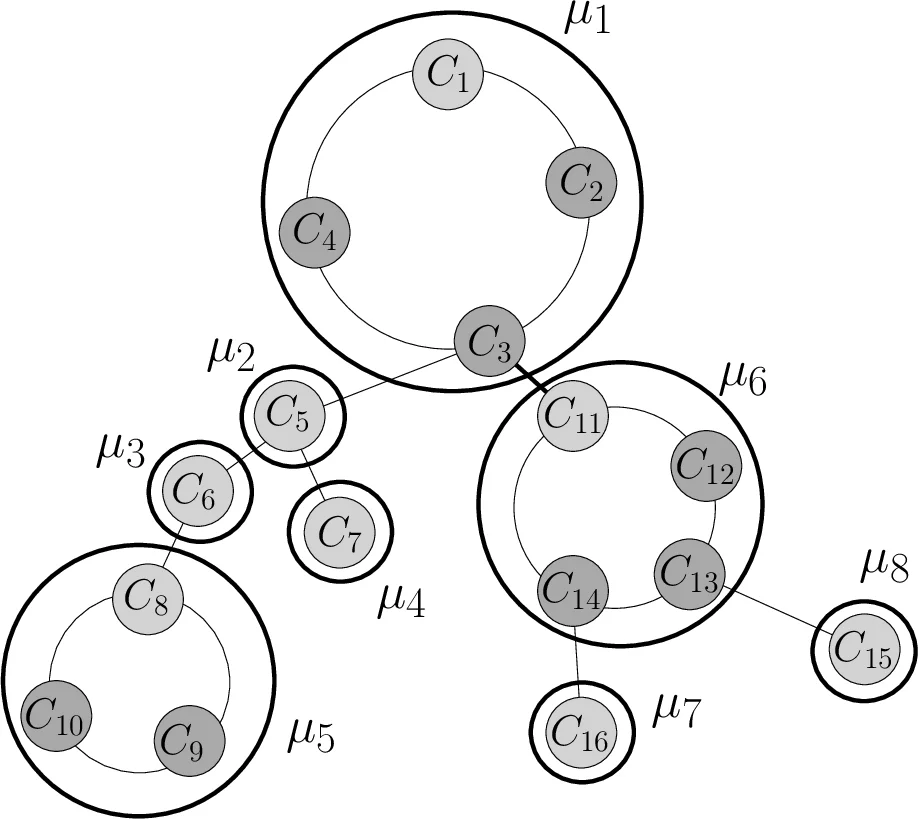
- The cell graph G_c, a clustered graph where each cluster C(u) contains a vertex for every cell intersecting CH(u). Edges between clusters encode compatibility of cell choices (i.e., no crossing would be created).
- The skeleton graph G_s, obtained by selecting exactly one cell vertex from each cluster such that the induced subgraph respects all inter‑cluster edges.
Lemma 2 shows that a planar 0‑bend convex‑hull drawing exists iff G_c admits a skeleton. While finding a skeleton is NP‑hard in general (Theorem 6), the authors give polynomial‑time algorithms when G_x is a cactus (Theorem 5). The cactus case includes paths, cycles, and trees; Lemmas 3 and 4 handle the base cases, and the general cactus algorithm recursively merges solutions along articulation points.
-
1‑bend “h‑strip” model.
The paper also studies a layered scenario inspired by labeling applications. Fixed vertices are partitioned into a finite set of horizontal strips; each mobile vertex must be placed outside all strips, and edges are forbidden to intersect a strip on both its top and bottom sides (i.e., an edge may cross a strip at most once). Under this model, the authors devise a polynomial‑time testing algorithm. The method builds a partial order among strips, reduces the problem to checking feasibility of a matching in a bipartite graph derived from the ordering, and runs in linear time with respect to the size of the input graph.
Related Work and Distinctions
The problem is related to point‑set embedding, partial drawing extension, and various constrained bipartite drawing models, yet it differs in that one partition’s vertices have fixed coordinates rather than being freely permuted or placed on a prescribed curve. Moreover, the explicit bound on bends per edge introduces a new dimension not addressed in most prior work.
Conclusions and Future Directions
The authors provide a comprehensive complexity landscape for FM‑bigraphs: the general k‑bend decision problem is NP‑hard, but several practically relevant subclasses admit efficient algorithms (collinear fixed vertices, convex‑hull restriction with cactus intersection, and the h‑strip 1‑bend model). Open questions include approximation algorithms for larger k, dynamic updates when vertices move, and experimental evaluation on real‑world geographic or network data where fixed locations represent sites and mobile vertices represent attributes or labels.
Comments & Academic Discussion
Loading comments...
Leave a Comment