Anisotropic inverse Compton scattering of photons from the circumstellar disc in PSR B1259-63
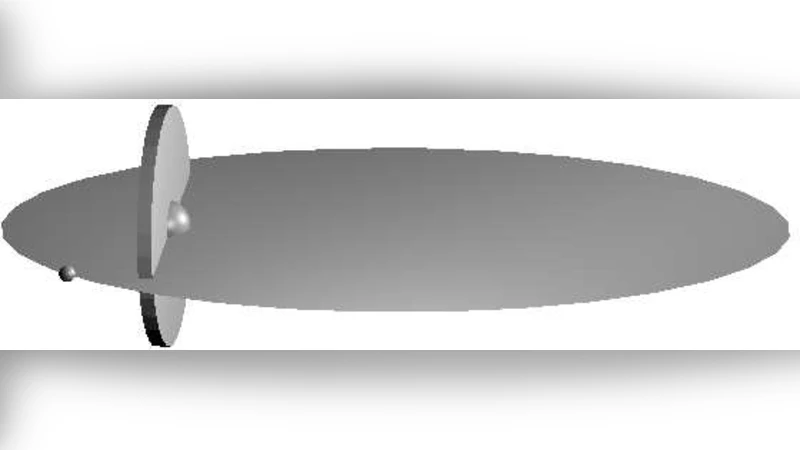
The gamma-ray binary system PSR B1259-63 consists of a 48 ms pulsar orbiting a Be star. The system is particularly interesting because it is the only gamma-ray binary system where the nature of the compact object is known. The non-thermal radiation from the system is powered by the spin-down luminosity of the pulsar and the unpulsed radiation originates from the stand-off shock front which forms between the pulsar and stellar wind. The Be star/optical companion in the system produces an excess infrared flux from the associated circumstellar disc. This infrared excess provides an additional photon source for inverse Compton scattering. We discuss the effects of the IR excess near periastron, for anisotropic inverse Compton scattering and associated gamma-ray production. We determine the infrared excess from the circumstellar disc using a modified version of a curve of growth method, which takes into account the changing optical depth through the circumstellar disc during the orbit. The model is constrained using archive data and additional mid-IR observations obtained with the VLT during January 2011. The inverse Compton scattering rate was calculated for three orientations of the circumstellar disc. The predicted gamma-ray light curves show that the disc contribution is a maximum around periastron and not around the disc crossing epoch. This is a result of the disc being brightest near the stellar surface. Additional spectroscopic and near-infrared observations were obtained of the system and these are discussed in relation to the possibility of shock heating during the disc crossing epoch.
💡 Research Summary
The paper investigates the contribution of infrared (IR) photons emitted by the circumstellar disc of the Be star in the gamma‑ray binary PSR B1259‑63/LS 2883 to the high‑energy emission observed from the system. PSR B1259‑63 is a 48 ms pulsar in a highly eccentric orbit around a massive Be star. The non‑thermal radiation is powered by the pulsar’s spin‑down luminosity, and the unpulsed emission originates at the stand‑off shock where the pulsar wind collides with the stellar wind. While most previous models have considered only the stellar photospheric photons as seed photons for inverse Compton (IC) scattering, the Be star’s disc produces a substantial IR excess that can serve as an additional seed photon field.
To quantify this effect the authors develop a modified curve‑of‑growth (COG) model that accounts for the varying optical depth through the disc as the pulsar moves along its orbit. The disc is described by a temperature law T(r) ∝ r⁻ᵠ, a density law ρ(r) ∝ r⁻ⁿ, and a finite outer radius R_d. By integrating the line‑of‑sight optical depth τ(λ, θ) for each orbital phase, the model yields the local IR photon density at the location of the pulsar. The COG parameters are constrained using archival photometry (2MASS, Spitzer, AKARI) together with new mid‑IR observations obtained with VLT/VISIR in January 2011.
The authors then calculate the anisotropic IC scattering rate for three disc orientations (inclinations of 0°, 30°, and 60° relative to the orbital plane). The electron population is assumed to follow a power‑law distribution N(γ) ∝ γ⁻ᵖ with p≈2.5, typical for shock‑accelerated particles. By integrating over the anisotropic photon field, they obtain phase‑dependent gamma‑ray light curves. The key result is that the disc contribution to the IC flux peaks near periastron, when the pulsar is closest to the star and the disc is brightest near its inner edge. In contrast, the light curves show a secondary, much weaker enhancement at the disc‑crossing epochs (≈ ±20 days from periastron), because at those times the pulsar traverses the outer, cooler parts of the disc where the IR photon density is lower.
To test whether shock heating of the disc during the crossing could increase the IR output, the authors obtained near‑infrared spectroscopy and Hα monitoring around the crossing epochs. The data reveal only modest line‑strength variations and no significant temperature rise, suggesting that shock heating does not dominate the IR excess.
The discussion emphasizes that the IR photon field from the disc must be treated as anisotropic and phase‑dependent; neglecting this leads to an incorrect association of the gamma‑ray peak with the disc crossing rather than with periastron. The work therefore refines the interpretation of the observed GeV–TeV light curves and provides a framework for incorporating disc‑generated seed photons in models of other gamma‑ray binaries with Be companions.
In conclusion, the study demonstrates that the circumstellar disc’s IR emission can substantially boost the inverse Compton gamma‑ray output of PSR B1259‑63, with the maximum effect occurring around periastron. The modified COG approach, constrained by multi‑wavelength observations, offers a robust method for predicting anisotropic IC emission in similar systems and will be valuable for interpreting future high‑sensitivity observations from CTA, H.E.S.S. II, and other gamma‑ray facilities.