Circle complexes and the discrete CKP equation
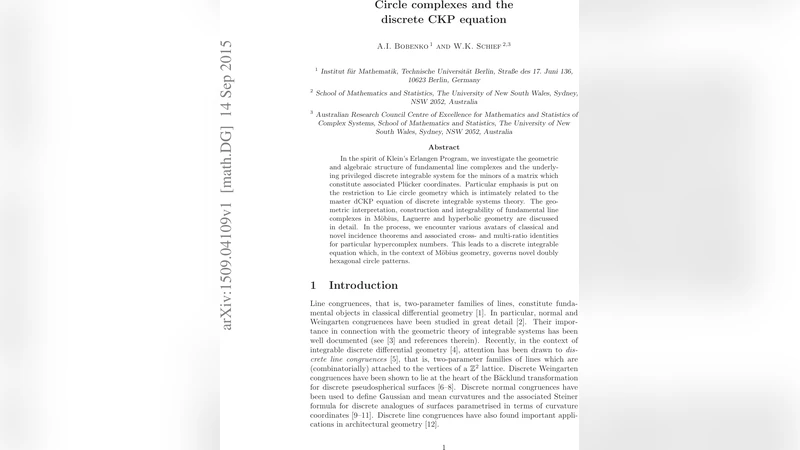
In the spirit of Klein’s Erlangen Program, we investigate the geometric and algebraic structure of fundamental line complexes and the underlying privileged discrete integrable system for the minors of a matrix which constitute associated Pl"ucker coordinates. Particular emphasis is put on the restriction to Lie circle geometry which is intimately related to the master dCKP equation of discrete integrable systems theory. The geometric interpretation, construction and integrability of fundamental line complexes in M"obius, Laguerre and hyperbolic geometry are discussed in detail. In the process, we encounter various avatars of classical and novel incidence theorems and associated cross- and multi-ratio identities for particular hypercomplex numbers. This leads to a discrete integrable equation which, in the context of M"obius geometry, governs novel doubly hexagonal circle patterns.
💡 Research Summary
The paper investigates a rich interplay between discrete line geometry, Plücker coordinates, and integrable systems, focusing on the so‑called fundamental line complexes in complex projective three‑space CP³. A fundamental line complex is a three‑parameter family of lines attached to the vertices of a Z³ lattice such that any two neighboring lines intersect and the intersection points satisfy a coplanarity (or concurrency) condition. By means of the classical Plücker correspondence, each line is represented by a point on the Plücker quadric Q₄ in CP⁵, whose homogeneous coordinates are precisely the 2×2 minors of a 5×5 matrix M.
The evolution of M is governed by the so‑called M‑system, \
Comments & Academic Discussion
Loading comments...
Leave a Comment