Grahams Tree Reconstruction Conjecture and a Waring-Type Problem on Partitions
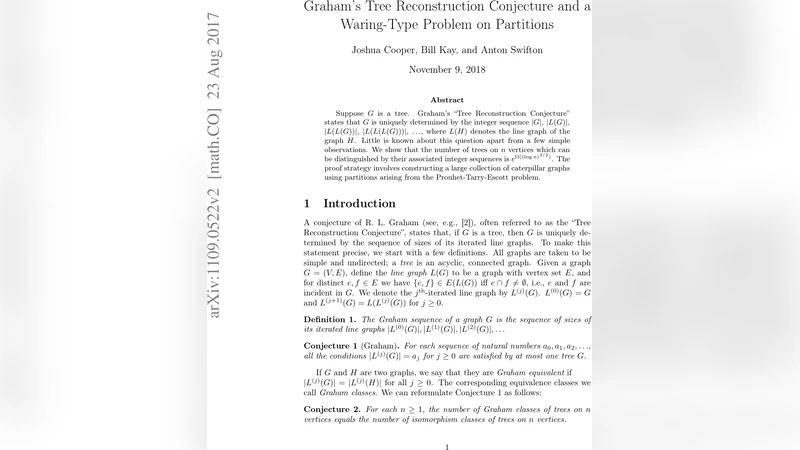
Suppose $G$ is a tree. Graham’s “Tree Reconstruction Conjecture” states that $G$ is uniquely determined by the integer sequence $|G|$, $|L(G)|$, $|L(L(G))|$, $|L(L(L(G)))|$, $\ldots$, where $L(H)$ denotes the line graph of the graph $H$. Little is known about this question apart from a few simple observations. We show that the number of trees on $n$ vertices which can be distinguished by their associated integer sequences is $e^{\Omega((\log n)^{3/2})}$. The proof strategy involves constructing a large collection of caterpillar graphs using partitions arising from the Prouhet-Tarry-Escott problem.
💡 Research Summary
The paper tackles Graham’s Tree Reconstruction Conjecture, which posits that a tree G is uniquely identified by the infinite sequence of vertex counts of its iterated line graphs |L⁰(G)|, |L¹(G)|, |L²(G)|, …. While the conjecture has been open for decades, only trivial observations were known about how many distinct sequences actually arise among all n‑vertex trees. The authors prove a substantially stronger lower bound: the number of distinct Graham sequences (i.e., Graham classes) among trees on n vertices grows at least as e^{Ω((log n)^{3/2})}. This is far above any previously established sub‑exponential bound and shows that a super‑polynomially large family of trees can be distinguished by their line‑graph size sequences.
The construction hinges on a special family of caterpillar trees. A caterpillar consists of a spine (a simple path) together with “legs” (pendant vertices) attached to selected spine vertices, called joints. The authors encode the number of legs at each joint as a tuple (d₁,…,d_t). By interpreting this tuple as a partition of an integer, they can exploit solutions to the Prouhet‑Tarry‑Escott (PTE) problem: there exist many distinct partitions whose power sums up to a given degree k coincide, i.e., ∑d_i^r is the same for all 1 ≤ r ≤ k but the multisets {d_i} are different. Using such partitions, they generate a large collection of caterpillars that all have the same total number of vertices n but differ in the distribution of leg counts.
The next technical step is to express the size of the k‑th iterated line graph of a caterpillar in terms of the joint degrees. They introduce the notion of an “antishadow” Š_i(X), the set of vertices in L^i(G) that are affected by a vertex set X in the original graph. This allows them to decompose |L^k(cat(d₁,…,d_t; m))| into contributions from the spine (which becomes a long path) and from each joint, which can be modeled as a star graph S(d_i; m,m). For a star, the size of its k‑th line graph is a polynomial f_k(d) of degree k. The authors prove that the leading coefficient of f_k(d) is either 1/k! or 2/k! and that the absolute value of any coefficient is bounded by 2·6·k². Moreover, the coefficient of the highest-degree term is positive, guaranteeing monotonic growth in d.
With these polynomial expressions in hand, the authors argue that two caterpillars built from distinct PTE partitions must differ in at least one |L^k| value. Indeed, because the power‑sum equalities hold only up to degree k, the sums ∑f_k(d_i) for the two partitions will differ when k exceeds the degree of equality. Consequently, the corresponding Graham sequences diverge at the first such k.
To obtain the claimed lower bound, they use the classic construction of PTE solutions based on binary digit parity (the T‑k and T′_k sequences). This yields 2^{k} different partitions with equal power sums up to degree k‑1. By carefully choosing the spine length m and the number of joints t as functions of n, they ensure that the total vertex count stays fixed while the number of distinct partitions grows like e^{c·(log n)^{3/2}} for some constant c > 0. Each partition gives a distinct caterpillar, and the polynomial analysis guarantees that each pair of caterpillars has a different Graham sequence. Hence the number of Graham classes is at least e^{Ω((log n)^{3/2})}.
The paper also supplies several auxiliary results that support the main argument: (1) a regularity lemma showing that the line graph of a d‑regular graph is (2kd − 2k + 1 + 2)-regular; (2) bounds on the size of iterated line graphs of complete graphs, leading to an upper bound |L^k(K_n)| ≤ n^{k+1}/2^{k^2}; (3) a corollary that the k‑th line graph of a star satisfies |L^k(S(d;a,b))| < (d + a + b)^{k^2}/k^2; (4) detailed coefficient bounds for the polynomials f_k(d). These lemmas ensure that the coefficient estimates used in the main construction are rigorous and that the distinctness of the Graham sequences is not compromised by hidden cancellations.
In summary, the authors demonstrate that a surprisingly large, super‑polynomial family of trees can be distinguished by their iterated line‑graph size sequences. Their method blends combinatorial constructions (caterpillars), number‑theoretic partition results (Prouhet‑Tarry‑Escott), and careful polynomial analysis of line‑graph growth. This work provides the first non‑trivial lower bound on the number of Graham classes and opens a new avenue for attacking the full conjecture, suggesting that the conjecture may indeed hold for all trees, given the richness of distinguishable sequences already exhibited.
Comments & Academic Discussion
Loading comments...
Leave a Comment