Penetrating Radiation at the Surface of and in Water
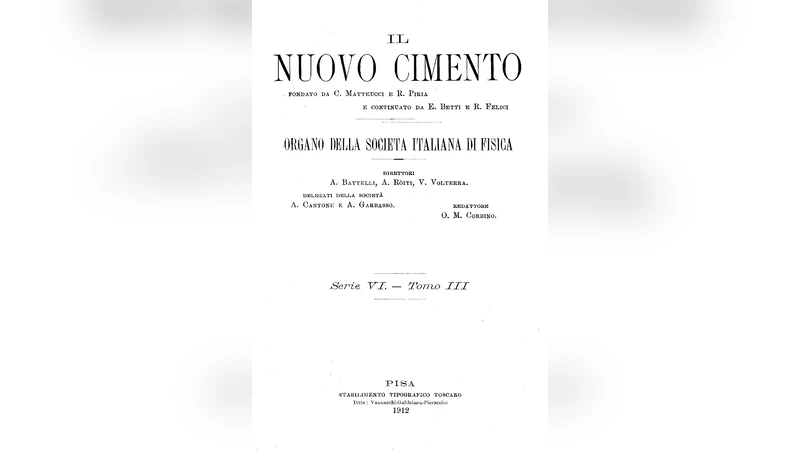
At the beginning of the twentieth century, two scientists, the Austrian Victor Hess and the Italian Domenico Pacini, developed two brilliant lines of research independently, leading to the determination of the origin of atmospheric radiation. Before their work, the origin of the radiation today called “cosmic rays” was strongly debated, as many scientists thought that these particles came from the crust of the Earth. The approach by Hess is well known: Hess measured the rate of discharge of an electroscope that flew aboard an atmospheric balloon. Because the discharge rate increased as the balloon flew at higher altitude, he concluded in 1912 that the origin could not be terrestrial. For this discovery, Hess was awarded the Nobel Prize in 1936, and his experiment became legendary. Shortly before, in 1911, Pacini, a professor at the University of Bari, made a series of measurements to determine the variation in the speed of discharge of an electroscope (and thus the intensity of the radiation) while the electroscope was immersed in a box in a sea near the Naval Academy in the Bay of Livorno (the Italian Navy supported the research). The measures are documented in his work “Penetrating radiation at the surface of and in water”. Pacini discovered that the discharge of the oscilloscope was significantly slower than at the surface. Documents testify that Pacini and Hess knew of each other’s work. Pacini died in 1934, two years before the Nobel Prize was awarded for the discovery of cosmic rays. While Hess is remembered as the discoverer of cosmic rays, the simultaneous discovery by Pacini is forgotten by most.
💡 Research Summary
The paper “Penetrating Radiation at the Surface of and in Water” by Domenico Pacini, published in 1911, reports a series of systematic measurements designed to determine whether the ionising radiation observed at the Earth’s surface originates from the Earth’s crust or from the atmosphere. Pacini’s experimental concept was simple yet ingenious: use water as a natural absorber of penetrating radiation and compare the discharge rate of an electroscope when it is placed in air at the sea surface with the rate when the same instrument is sealed in a waterproof container and immersed a few meters below the surface of the sea near Livorno.
The electroscope employed a high‑voltage source that charged two metal leaves; the time required for the leaves to collapse (the discharge time) is directly proportional to the ionisation produced by external radiation. By keeping the voltage, temperature, humidity, and the electroscope itself constant, Pacini ensured that any change in discharge time could be attributed to a change in the radiation flux reaching the detector. He performed repeated measurements at the surface and at depth, recorded the discharge times, and calculated the corresponding ionisation rates. The results showed a clear and reproducible reduction of about 20–30 % in the discharge rate when the device was submerged, indicating that water attenuates a substantial fraction of the penetrating radiation.
Pacini interpreted this attenuation as evidence that the majority of the radiation does not arise from the seabed or the Earth’s crust, because a crustal source would not be significantly screened by a few metres of water. Instead, the data implied that the radiation is largely incident from above, i.e., from the atmosphere or beyond. He further estimated an effective attenuation coefficient for seawater by relating the observed reduction to the known density and composition of the water column, and he discussed possible systematic errors such as temperature‑dependent leakage currents, variations in seawater salinity, and the limited depth of immersion.
In the discussion section Pacini explicitly compares his findings with the contemporary balloon experiments of Victor Hess. Hess had shown that the ionisation rate increases with altitude, leading him to conclude that the radiation must have an extraterrestrial origin. Pacini’s underwater measurements provide a complementary line of evidence: while Hess demonstrated a positive gradient with height, Pacini demonstrated a negative gradient with depth. Together, the two independent experiments converge on the same conclusion—that a substantial component of the observed radiation is not terrestrial.
The paper concludes with several forward‑looking remarks. Pacini suggests extending the method to fresh water, ice, and deeper oceanic sites to refine the attenuation coefficient, and he anticipates that future detectors capable of measuring the energy spectrum of the radiation would allow a more detailed separation of atmospheric, terrestrial, and possibly cosmic components. He also acknowledges that his work, while supportive of the atmospheric hypothesis, does not alone prove a cosmic origin; it merely rules out the Earth’s crust as the sole source.
Historically, Pacini’s contribution has been largely overlooked in the popular narrative of cosmic‑ray discovery, which has focused on Hess’s Nobel‑winning balloon flights. Nonetheless, Pacini’s experiment represents a landmark in experimental physics: it introduced the concept of using natural shielding (water) to probe the directionality of penetrating radiation, a technique that underlies modern underwater radiation monitoring, neutrino telescopes, and deep‑sea environmental dosimetry. His careful control of experimental variables, quantitative analysis of attenuation, and honest appraisal of uncertainties exemplify the scientific method.
In summary, Pacini’s 1911 paper provides robust experimental evidence that the ionising radiation measured at the Earth’s surface is significantly attenuated by a modest water column, thereby supporting the hypothesis that the radiation originates primarily from above the Earth’s surface. When read alongside Hess’s altitude experiments, Pacini’s work completes a two‑pronged experimental proof—altitude increase and depth decrease—that the dominant source of the “penetrating radiation” is not terrestrial but atmospheric, and ultimately cosmic in nature. This dual discovery laid the groundwork for the later identification of cosmic rays and remains a testament to the importance of parallel, independent investigations in scientific progress.
Comments & Academic Discussion
Loading comments...
Leave a Comment