Network Analysis in the Legal Domain: A complex model for European Union legal sources
Legislators, designers of legal information systems, as well as citizens face often problems due to the interdependence of the laws and the growing number of references needed to interpret them. Quantifying this complexity is not an easy task. In this paper, we introduce the “Legislation Network” as a novel approach to address related problems. We have collected an extensive data set of a more than 60-year old legislation corpus, as published in the Official Journal of the European Union, and we further analysed it as a complex network, thus gaining insight into its topological structure. Among other issues, we have performed a temporal analysis of the evolution of the Legislation Network, as well as a robust resilience test to assess its vulnerability under specific cases that may lead to possible breakdowns. Results are quite promising, showing that our approach can lead towards an enhanced explanation in respect to the structure and evolution of legislation properties.
💡 Research Summary
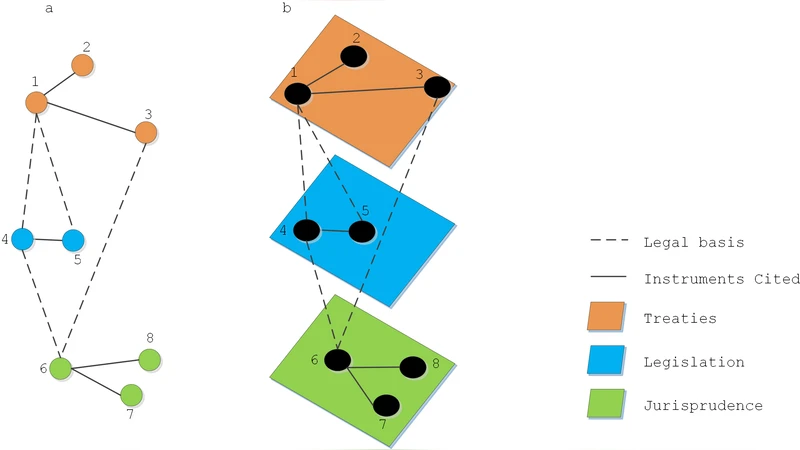
The paper introduces a novel “Legislation Network” model to capture the intricate interdependencies among European Union legal documents spanning more than six decades. Using the EUR‑Lex portal, the authors extracted 249,690 documents from six classification sectors (treaties, international agreements, secondary legislation, complementary legislation, preparatory acts, and case law) and parsed metadata fields that denote various relationships such as citations, amendments, and references. Unlike traditional citation networks that treat all edges as homogeneous references, this model assigns multiple edge labels, preserving both the hierarchical nature of EU law and the diversity of legal relations.
After constructing a directed, multi‑relational graph, the authors perform a comprehensive structural analysis. Degree distribution follows a power‑law with an exponent between 2.1 and 2.8, confirming a scale‑free topology. The average clustering coefficient (≈0.42) is markedly higher than that of comparable random graphs, while the mean shortest‑path length (~6.1) indicates small‑world characteristics. These findings suggest that EU legislation forms tightly knit clusters (e.g., thematic policy areas) that remain globally reachable through a few hops.
Temporal dynamics are examined by tracking active nodes and edges year‑by‑year. The network exhibits a densification power‑law: the number of edges grows faster than the number of nodes, reflecting that new acts frequently reference or amend many existing documents. Notable spikes correspond to major legislative events (e.g., the Maastricht Treaty), illustrating how policy breakthroughs reshape the legal fabric.
Robustness is tested through two removal strategies. Random node deletion shows that even after eliminating 30 % of the vertices, the average path length changes little, indicating resilience to stochastic disturbances. In contrast, targeted removal of high‑degree “hub” nodes (the top 5 % by degree) rapidly fragments the network, dramatically increasing path lengths and reducing the size of the giant component. This “Achilles’ heel” highlights the systemic risk posed by the loss or drastic amendment of cornerstone legal texts such as foundational treaties or key regulations.
The authors position their work against a backdrop of prior studies focused mainly on common‑law case citation networks (U.S. Supreme Court, Canadian courts, etc.). They argue that civil‑law systems like the EU require a richer representation that captures hierarchical authority and multiple relation types. By doing so, the Legislation Network offers a more faithful abstraction of legislative complexity, enabling quantitative assessments of legal evolution, identification of critical documents, and scenario‑based risk analysis.
Limitations include potential metadata gaps, ambiguous relationship labeling, and the absence of dynamic simulation of legislative processes. Future directions propose integrating semantic text analysis, extending the model to other jurisdictions, and developing predictive tools for legislative impact assessment. Overall, the study demonstrates that complex‑network theory can illuminate the structure, growth, and vulnerability of large‑scale legal corpora, providing valuable insights for policymakers, legal informatics designers, and scholars interested in the systemic properties of law.
Comments & Academic Discussion
Loading comments...
Leave a Comment