Quantization of Integrable Systems and Four Dimensional Gauge Theories
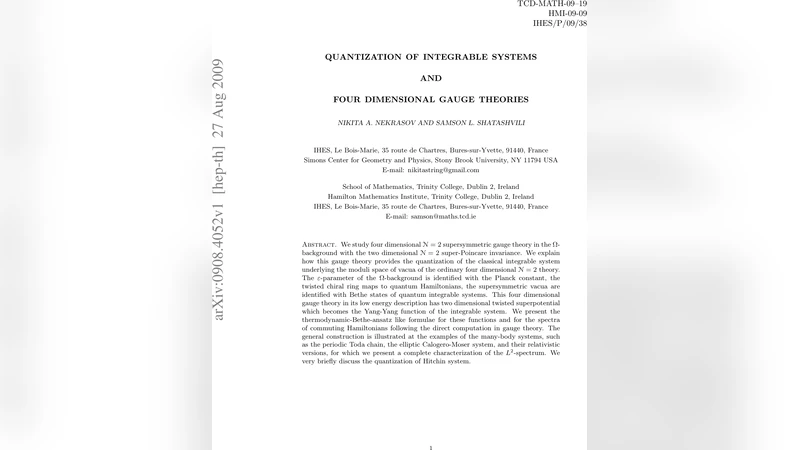
We study four dimensional N=2 supersymmetric gauge theory in the Omega-background with the two dimensional N=2 super-Poincare invariance. We explain how this gauge theory provides the quantization of the classical integrable system underlying the moduli space of vacua of the ordinary four dimensional N=2 theory. The epsilon-parameter of the Omega-background is identified with the Planck constant, the twisted chiral ring maps to quantum Hamiltonians, the supersymmetric vacua are identified with Bethe states of quantum integrable systems. This four dimensional gauge theory in its low energy description has two dimensional twisted superpotential which becomes the Yang-Yang function of the integrable system. We present the thermodynamic-Bethe-ansatz like formulae for these functions and for the spectra of commuting Hamiltonians following the direct computation in gauge theory. The general construction is illustrated at the examples of the many-body systems, such as the periodic Toda chain, the elliptic Calogero-Moser system, and their relativistic versions, for which we present a complete characterization of the L^2-spectrum. We very briefly discuss the quantization of Hitchin system.
💡 Research Summary
The paper investigates four‑dimensional 𝒩=2 supersymmetric gauge theories placed in the Ω‑background while preserving a two‑dimensional 𝒩=2 super‑Poincaré symmetry. By taking the Nekrasov–Shatashvili (NS) limit (ε₂ → 0) the background is characterized by a single deformation parameter ε≡ε₁, which the authors identify with the Planck constant ℏ. In this limit the low‑energy effective description of the gauge theory reduces to a two‑dimensional twisted chiral theory whose twisted superpotential 𝒲̃(σ) coincides with the Yang‑Yang function of a quantum integrable system.
The central claim is that the classical integrable system naturally associated with the Seiberg–Witten geometry of the undeformed 4d 𝒩=2 theory becomes quantized when the Ω‑deformation is turned on. The mapping works as follows:
-
Ω‑deformation ↔ Quantization – The deformation parameter ε plays the role of ℏ. When ε≠0 the classical phase space (the Hitchin moduli space or, more generally, the Seiberg–Witten curve) acquires a non‑commutative structure.
-
Twisted chiral ring ↔ Quantum Hamiltonians – Elements of the twisted chiral ring are identified with commuting quantum Hamiltonians of the integrable model. Their eigenvalues are encoded in the vacuum expectation values of the gauge‑invariant operators.
-
Supersymmetric vacua ↔ Bethe states – The supersymmetric vacua of the deformed gauge theory satisfy the critical point equations ∂𝒲̃/∂σ_i = 0. These equations are precisely the Bethe Ansatz equations of the quantum integrable system; the solutions (Bethe roots) label the vacua, i.e., the Bethe states.
-
Twisted superpotential ↔ Yang‑Yang function – The twisted superpotential 𝒲̃, obtained from the Nekrasov partition function Z(ε₁,ε₂;a) by taking the NS limit and performing a logarithmic derivative with respect to ε₁, reproduces the Yang‑Yang functional. Its stationary points give the Bethe equations, and its second derivatives form the Hessian that determines the norm of the Bethe states (the Gaudin determinant).
The authors then apply this general framework to several concrete many‑body systems, deriving explicit Thermodynamic Bethe Ansatz (TBA)‑type formulas for the Yang‑Yang function, the Bethe equations, and the spectra of the commuting Hamiltonians.
Periodic Toda chain – Starting from an SU(N) gauge theory with a single adjoint hypermultiplet, the authors compute the NS‑limit of the Nekrasov partition function. The resulting twisted superpotential matches the known Yang‑Yang function of the periodic Toda chain. The Bethe equations reduce to the familiar exponential Bethe Ansatz, and the L²‑spectrum is shown to consist of discrete bound states corresponding to integer‑valued Bethe roots.
Elliptic Calogero–Moser system – By considering an 𝒩=2 theory with massive adjoint matter, the partition function involves elliptic Gamma functions. In the NS limit the twisted superpotential acquires elliptic contributions, reproducing the Yang‑Yang function of the elliptic Calogero–Moser model. The Bethe equations become elliptic Bethe Ansatz equations involving the Weierstrass ζ‑function. The authors solve these equations and demonstrate that the L²‑spectrum is supported on a lattice of points on the underlying elliptic curve, providing a complete characterization of both continuous and discrete parts.
Relativistic (q‑deformed) versions – The paper extends the analysis to five‑dimensional 𝒩=1 gauge theories compactified on a circle, which generate q‑deformed integrable models such as the relativistic Toda and Ruijsenaars–Schneider systems. Here ε₁ is identified with ℏ while the compactification radius β introduces the deformation parameter q = exp(βℏ). The twisted superpotential becomes a q‑logarithmic functional, and the Bethe equations turn into q‑difference equations. The authors derive explicit q‑TBA formulas and obtain the full L²‑spectrum expressed in terms of q‑Pochhammer symbols.
Across all examples the paper presents a unified picture: the Nekrasov partition function in the NS limit encodes the full quantum integrable data. The authors also discuss the quantization of the Hitchin system. The Hitchin moduli space, which classically underlies many integrable models, acquires a quantum deformation through the Ω‑background. The resulting Yang‑Yang function coincides with the quantum Hitchin Hamiltonians, suggesting that the same machinery can be applied to more general gauge groups and higher‑genus Riemann surfaces.
In summary, the work establishes a precise dictionary between four‑dimensional 𝒩=2 supersymmetric gauge theories in an Ω‑background and quantum integrable systems. The deformation parameter ε becomes the Planck constant, the twisted chiral ring maps to commuting quantum Hamiltonians, supersymmetric vacua become Bethe states, and the twisted superpotential reproduces the Yang‑Yang functional. By explicitly working out the periodic Toda chain, the elliptic Calogero–Moser system, and their relativistic counterparts, the authors provide concrete TBA‑type formulas and a complete description of the L²‑spectra. This framework not only deepens the understanding of the interplay between supersymmetric gauge dynamics and integrability but also opens avenues for quantizing more intricate Hitchin systems, exploring quantum K‑theory, and connecting to higher‑dimensional supersymmetric theories.
Comments & Academic Discussion
Loading comments...
Leave a Comment