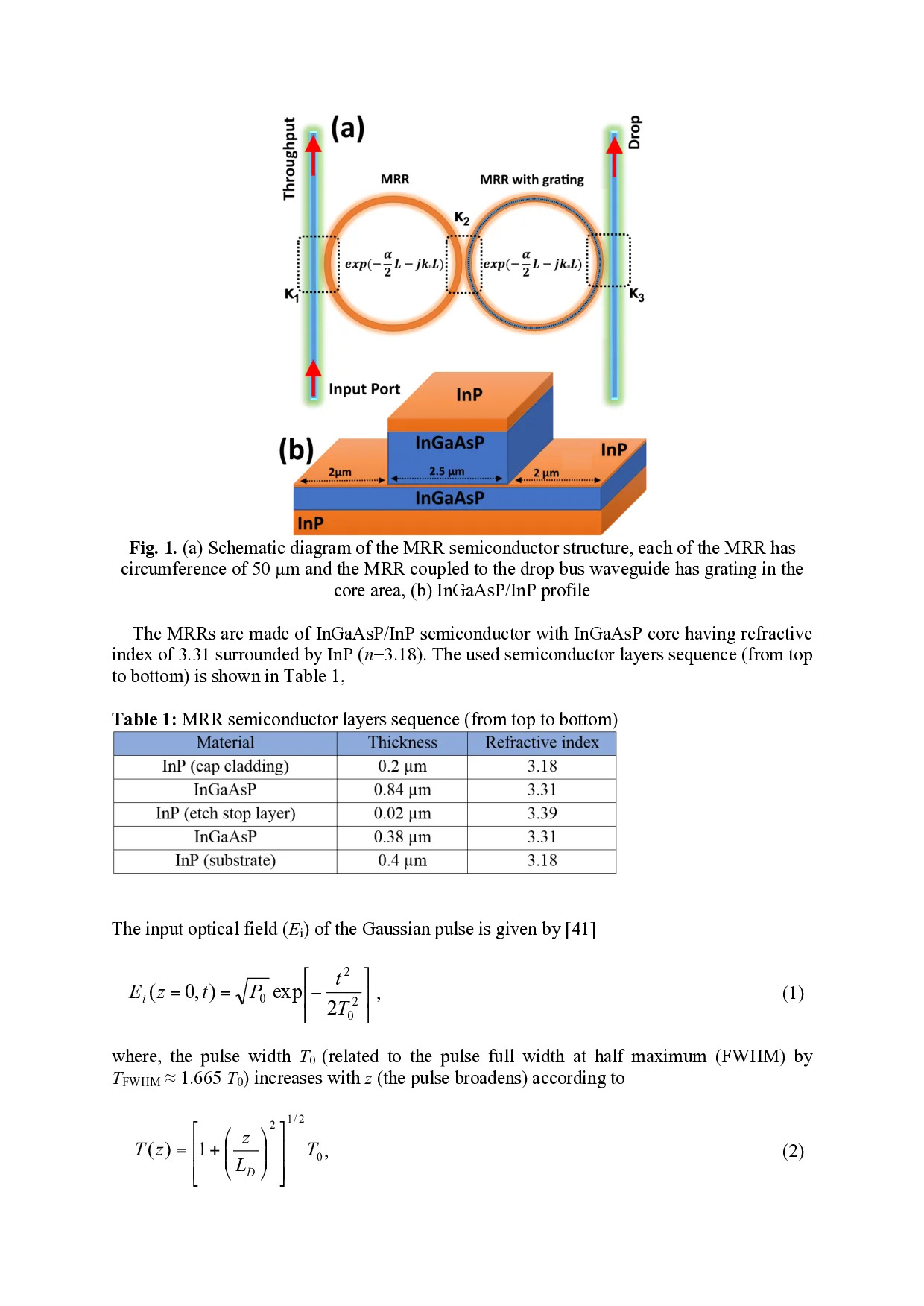
Here we show a photonic design for tunable dual-wavelength generation deploying optical nonlinear mode coupling of two coupled III-V semiconductor microring resonators (MRRs) connected to a pump and drop waveguide buses. Here one of the two rings contains a grating, while the other has a planar surface. The underling mechanism for the dual wavelength generation originates from the resonance-detuning of the spectra resulting in non-linear mode mixing. Tunability of the wavelengths is achieved by altering the grating depth of the MRR and the power coupling coefficients. For the grating design of the MRR we select a trapezoidal-profiled apodized grating to gain low reflectivity at sidelobes. A time-domain travelling wave (TDTW) analysis gives a InGaAsP core refractive index of 3.3 surrounded by a grating InP cladding with n=3.2. We further confirm that the propagation of a Gaussian pulse input with 10 mW power and bandwidth of 0.76 ps is well confined within the mode propagation of the system. Taken together our results show a 2:1 fan-out of two spectrally separate signals for compact and high functional sources on chip.
Deep Dive into Dual-wavelength generation and tuning by controlling the apodized grating depth in microring resonators.
Here we show a photonic design for tunable dual-wavelength generation deploying optical nonlinear mode coupling of two coupled III-V semiconductor microring resonators (MRRs) connected to a pump and drop waveguide buses. Here one of the two rings contains a grating, while the other has a planar surface. The underling mechanism for the dual wavelength generation originates from the resonance-detuning of the spectra resulting in non-linear mode mixing. Tunability of the wavelengths is achieved by altering the grating depth of the MRR and the power coupling coefficients. For the grating design of the MRR we select a trapezoidal-profiled apodized grating to gain low reflectivity at sidelobes. A time-domain travelling wave (TDTW) analysis gives a InGaAsP core refractive index of 3.3 surrounded by a grating InP cladding with n=3.2. We further confirm that the propagation of a Gaussian pulse input with 10 mW power and bandwidth of 0.76 ps is well confined within the mode propagation of the sy
Dual-wavelength generation and tuning by controlling the apodized grating
depth in microring resonators
IS Amiri 1,2*, Volker J. Sorger 3, MM Ariannejad 4, H Ahmad 4, P Yupapin 1,5
1 Computational Optics Research Group, Ton Duc Thang University, Ho Chi Minh City, Vietnam;
2 Faculty of Applied Sciences, Ton Duc Thang University, Ho Chi Minh City, Vietnam
- E-mail: irajsadeghamiri@tdt.edu.vn
3 Department of Electrical and Computer Engineering, The George Washington University, Washington, D.C. 20052, USA
4 Photonics Research Centre, University of Malaya, 50603 Kuala Lumpur, Malaysia
5 Faculty of Electrical & Electroniangcs Engineering, Ton Duc Thang University, District 7, Ho Chi Minh City, Vietnam
Keywords: Microring resonator (MRR), Apodized grating, InGaAsP/InP semiconductor, dual-wavelength
- Introduction
Multichannel fiber Bragg grating (FBG) filter has been widely applied in the dense
wavelength division multiplexing (DWDM) systems, owing to its powerful capacity offering
a high number of channels of identical spectral performance for wavelength filtering [1, 2].
Generation of dual-wavelength using passive and active semiconductor waveguides has
attracted many research interests recently [3, 4]. They are well known to be useful for
applications in the field of optical fiber sensors [5, 6] Zhou et al. have proposed a stable dual-
wavelength laser based on cascaded fiber Bragg gratings [7], whereby the laser wavelengths
are determined by the fiber Bragg gratings (FBG) and thus the wavelength spacing is fixed by
the center wavelengths of the FBGs pair. Another configuration of tunable dual-wavelength
is demonstrated in [8], wherein a high birefringence FBG stabilizes a dual-wavelength laser
produced when the polarization state of each wavelength is altered using a polarization
controller. A large number of researchers have investigated the distinctive properties of
photonic crystal fibers, such as wide range single mode operation, dispersion flexibility, large
mode area and its application in multi-wavelength generation [9-12]. In most cases, these
properties were proven to be wavelength dependent and equivalent to the behavior of
wavelength-selective filters [13, 14].
Microring resonator (MRR) based optical mirrors and band-limited reflectors have been
the subject of much investigations in recent years, primarily as a result of advancements in
fabrication technology and miniaturization of integrated devices [15-17]. MRRs fabricated
using planar waveguide technology are well suitable for synthesizing optical filters due to
their high-contrast spectral sensitivity, in particular when lossless materials are used [18, 19].
Abstract— Here we show a photonic design for tunable dual-wavelength generation
deploying optical nonlinear mode coupling of two coupled III-V semiconductor microring
resonators (MRRs) connected to a pump and drop waveguide buses. Here one of the two rings
contains a grating, while the other has a planar surface. The underling mechanism for the dual
wavelength generation originates from the resonance-detuning of the spectra resulting in non-
linear mode mixing. Tunability of the wavelengths is achieved by altering the grating depth of
the MRR and the power coupling coefficients. For the grating design of the MRR we select a
trapezoidal-profiled apodized grating to gain low reflectivity at sidelobes. A time-domain
travelling wave (TDTW) analysis gives a InGaAsP core refractive index of 3.3 surrounded by
a grating InP cladding with n=3.2. We further confirm that the propagation of a Gaussian
pulse input with 10 mW power and bandwidth of 0.76 ps is well confined within the mode
propagation of the system. Taken together our results show a 2:1 fan-out of two spectrally
separate signals for compact and high functional sources on chip.
Due to the resulting high quality (Q) factors and compact sizes of these waveguide
microresonators, low-loss optical add/drop channel filters can be built [20, 21]. Among the
existing biological and chemical sensors, sensors based on integrated optical waveguides
have been demonstrated to possess a promising performance. These include planar optical-
waveguide sensors [22], directional coupler sensors [23], Mach–Zehnder interferometric
sensors [24], grating-coupled waveguide sensors [25, 26], and microresonator sensors [27-
31]. In order to minimize the smallest detectable wavelength shift, high Q cavities and a low
noise detection system is required. A high Q-factor results in narrow spectral peaks. To keep
the waveguide single mode and total internal reflection guiding is required to have very small
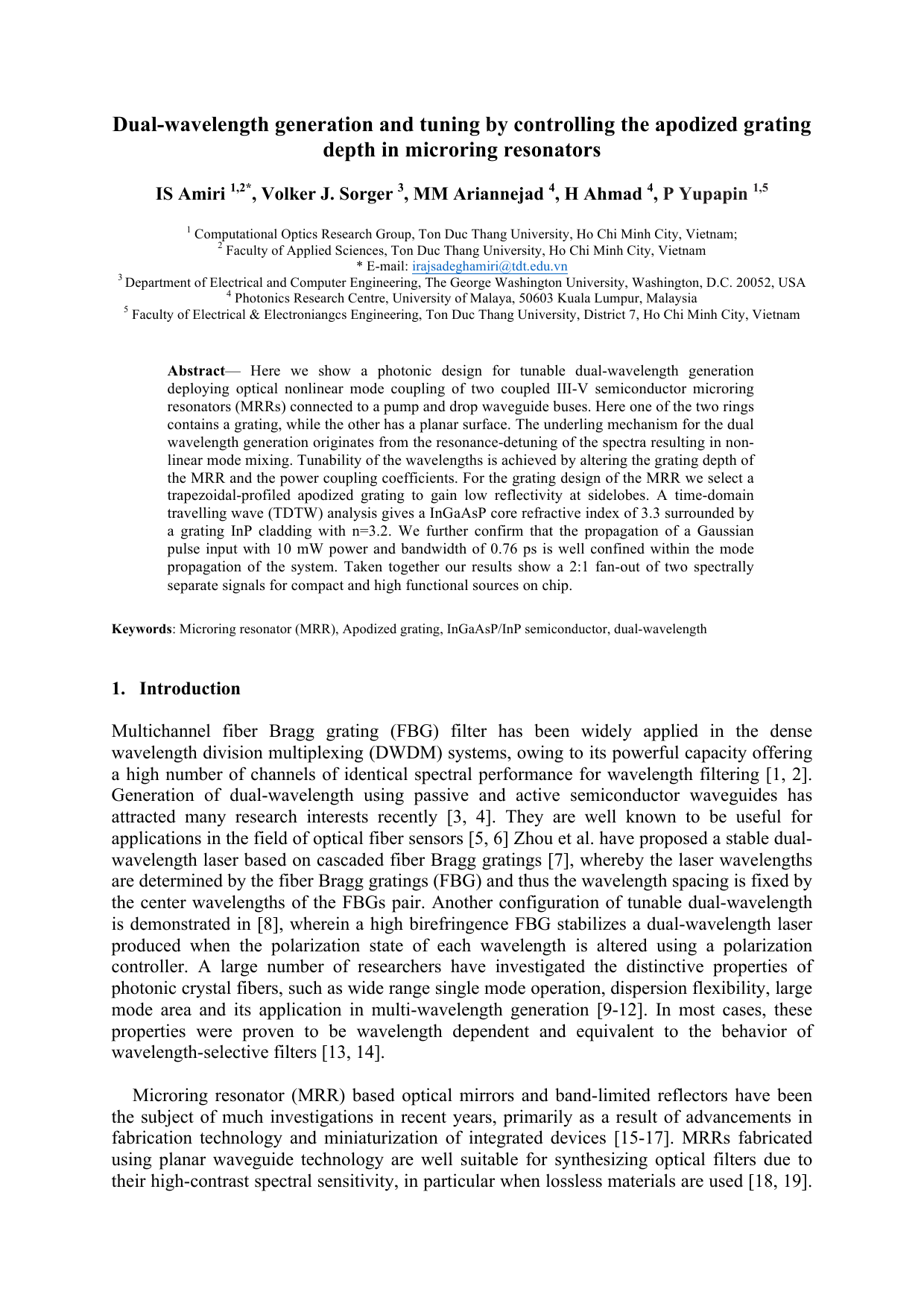
bend radii [32, 33]. In this research, we propose a coupled MRR system consisting of two
MMR resonators made of InGaAsP/InP semiconductor, where the drop bus waveguide has a
grating in the core area, while the input MRR does not (Fig. 1). To analyze this system, we
use the time-domain travelling
…(Full text truncated)…
This content is AI-processed based on ArXiv data.