Convenient Categories of Smooth Spaces
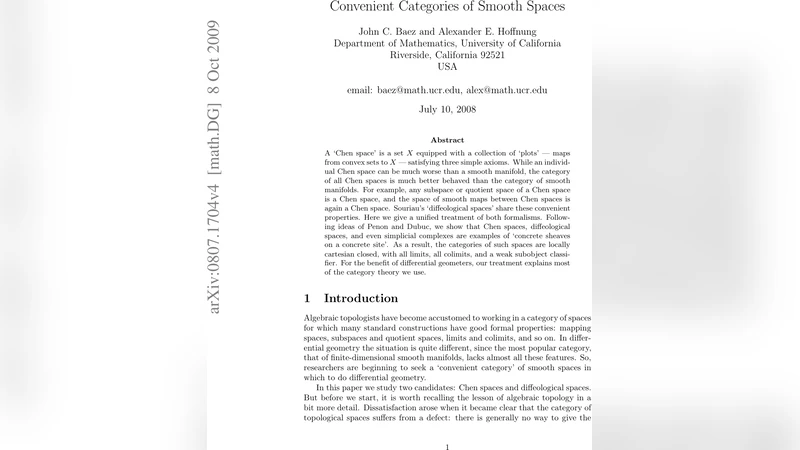
A “Chen space” is a set X equipped with a collection of “plots” - maps from convex sets to X - satisfying three simple axioms. While an individual Chen space can be much worse than a smooth manifold, the category of all Chen spaces is much better behaved than the category of smooth manifolds. For example, any subspace or quotient space of a Chen space is a Chen space, and the space of smooth maps between Chen spaces is again a Chen space. Souriau’s “diffeological spaces” share these convenient properties. Here we give a unified treatment of both formalisms. Following ideas of Dubuc, we show that Chen spaces, diffeological spaces, and even simplicial complexes are examples of “concrete sheaves on a concrete site”. As a result, the categories of such spaces are locally cartesian closed, with all limits, all colimits, and a weak subobject classifier. For the benefit of differential geometers, our treatment explains most of the category theory we use.
💡 Research Summary
The paper presents a unified categorical framework for two prominent approaches to smooth spaces—Chen spaces and Souriau’s diffeological spaces—by interpreting them as concrete sheaves on a concrete site. After recalling the definitions, the authors note that Chen spaces consist of a set equipped with a family of “plots” (smooth maps from convex subsets of Euclidean space) satisfying three axioms: closure under pre‑composition with smooth maps, locality, and inclusion of constant plots. Diffeological spaces replace convex domains with all open subsets of Euclidean spaces (or, more generally, all smooth manifolds) as sources of plots. Both notions share the idea that a space is determined by the collection of admissible parametrisations, but they differ in the class of test objects.
The central technical contribution is the construction of a concrete site 𝔖 whose objects are the test domains (convex sets for Chen spaces, open subsets or manifolds for diffeological spaces) and whose morphisms are ordinary set‑theoretic maps. A Grothendieck topology on 𝔖 is given by families of maps that are jointly surjective on underlying sets, i.e., a covering family is a set‑theoretic “cover”. A concrete sheaf on 𝔖 is then a presheaf that satisfies the usual sheaf condition with respect to this topology and, crucially, whose underlying set coincides with the set of its global sections. The authors show that Chen spaces, diffeological spaces, and even simplicial complexes can each be identified with a concrete sheaf on an appropriate concrete site. This identification follows the ideas of Dubuc, who studied algebraic theories via sheaves, but here the focus is on smooth structures.
From this identification several powerful categorical properties follow automatically. First, the category of concrete sheaves on a concrete site is complete and cocomplete: all limits and colimits exist and are computed pointwise on underlying sets. Consequently, subspaces, quotients, and disjoint unions of smooth spaces remain within the same category. Second, the category is locally cartesian closed. For any objects X and Y, the exponential object Y^X (the internal hom) exists and is again a concrete sheaf; concretely, the set of smooth maps C^∞(X, Y) carries a natural smooth‑space structure making it a Chen or diffeological space. This resolves the classical problem that the space of smooth maps between manifolds is not a manifold in general. Third, there is a weak subobject classifier, allowing one to speak of “subspaces” in an internal logical language. Although not a full topos, the category retains enough logical structure to treat monomorphisms as characteristic maps into a classifier object.
The paper proceeds to illustrate these abstract results with concrete examples. It shows how ordinary smooth manifolds embed fully faithfully, how infinite‑dimensional Lie groups become diffeological groups, and how simplicial complexes acquire a smooth‑space structure via their face maps. The authors also discuss how the categorical framework simplifies proofs of standard facts—e.g., the stability of smoothness under pullback, the existence of fiber products, and the compatibility of the smooth‑map functor with limits.
In the concluding section, the authors argue that the “convenient” nature of the resulting categories makes them suitable foundations for differential geometry, homotopy theory, and even numerical analysis where one frequently needs to pass to quotients or function spaces. By keeping the language close to the familiar notion of plots, the treatment remains accessible to geometers while providing the full power of modern category theory. The paper thus bridges the gap between concrete differential‑geometric intuition and abstract categorical machinery, offering a robust platform for future developments in smooth‑space theory.
Comments & Academic Discussion
Loading comments...
Leave a Comment