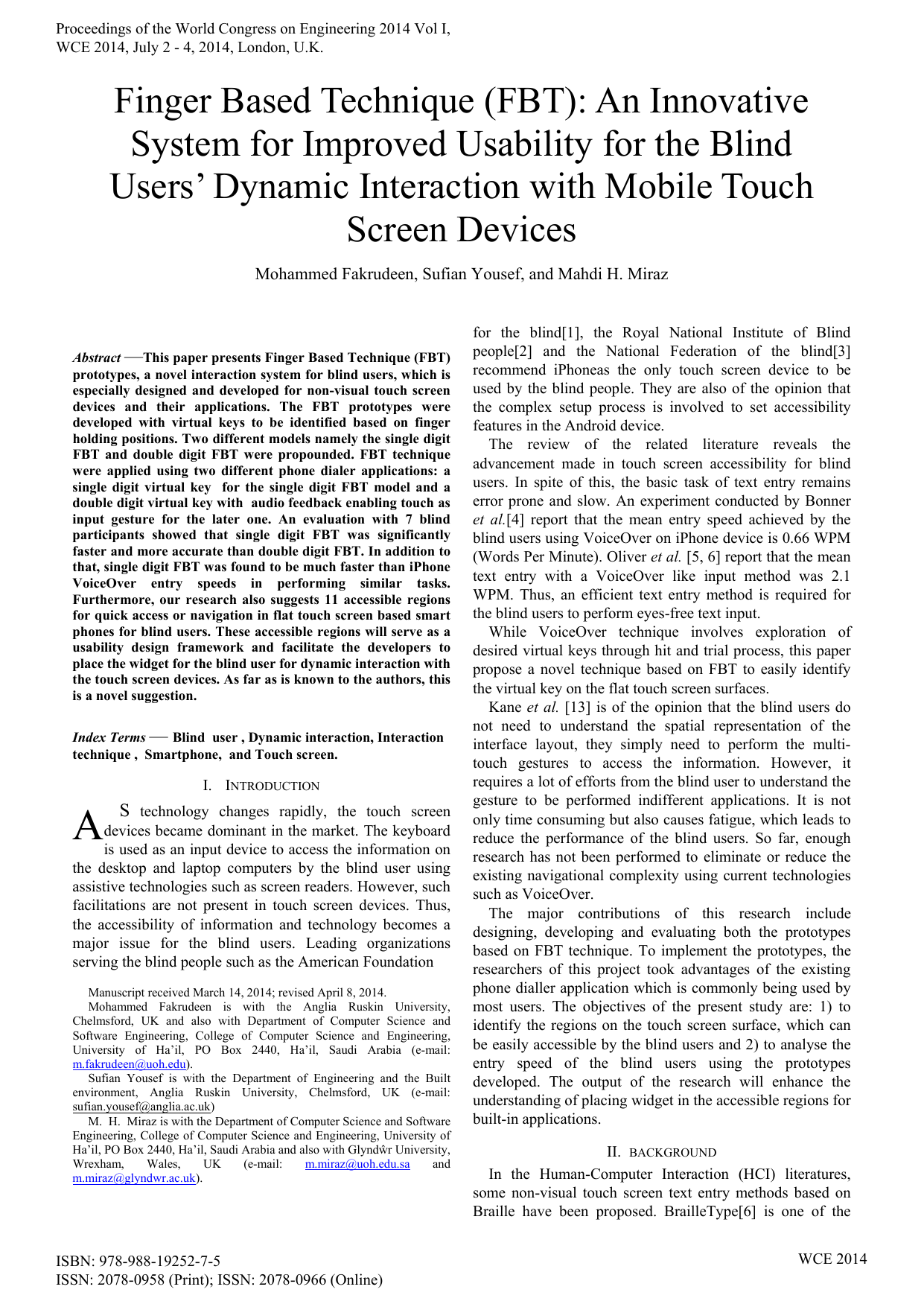
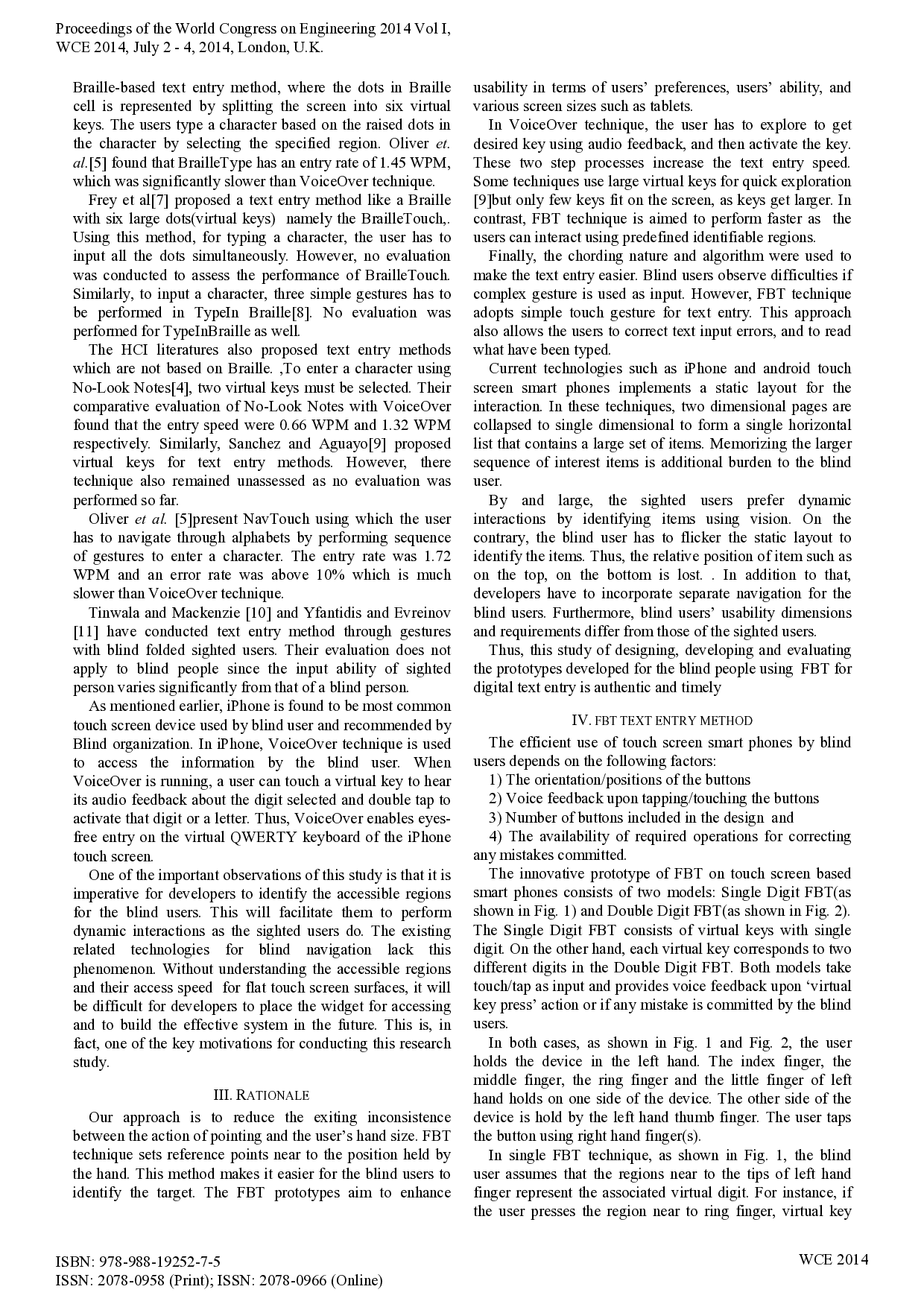
This paper presents Finger Based Technique (FBT) prototypes, a novel interaction system for blind users, which is especially designed and developed for non-visual touch screen devices and their applications. The FBT prototypes were developed with virtual keys to be identified based on finger holding positions. Two different models namely the single digit FBT and double digit FBT were propounded. FBT technique were applied using two different phone dialer applications: a single digit virtual key for the single digit FBT model and a double digit virtual key with audio feedback enabling touch as input gesture for the later one. An evaluation with 7 blind participants showed that single digit FBT was significantly faster and more accurate than double digit FBT. In addition to that, single digit FBT was found to be much faster than iPhone VoiceOver entry speeds in performing similar tasks. Furthermore, our research also suggests 11 accessible regions for quick access or navigation in flat touch screen based smart phones for blind users. These accessible regions will serve as a usability design framework and facilitate the developers to place the widget for the blind user for dynamic interaction with the touch screen devices. As far as is known to the authors, this is a novel suggestion.
Deep Dive into Finger Based Technique (FBT): An Innovative System for Improved Usability for the Blind Users Dynamic Interaction with Mobile Touch Screen Devices.
This paper presents Finger Based Technique (FBT) prototypes, a novel interaction system for blind users, which is especially designed and developed for non-visual touch screen devices and their applications. The FBT prototypes were developed with virtual keys to be identified based on finger holding positions. Two different models namely the single digit FBT and double digit FBT were propounded. FBT technique were applied using two different phone dialer applications: a single digit virtual key for the single digit FBT model and a double digit virtual key with audio feedback enabling touch as input gesture for the later one. An evaluation with 7 blind participants showed that single digit FBT was significantly faster and more accurate than double digit FBT. In addition to that, single digit FBT was found to be much faster than iPhone VoiceOver entry speeds in performing similar tasks. Furthermore, our research also suggests 11 accessible regions for quick access or navigation in flat t
Abstract —This paper presents Finger Based Technique (FBT)
prototypes, a novel interaction system for blind users, which is
especially designed and developed for non-visual touch screen
devices and their applications. The FBT prototypes were
developed with virtual keys to be identified based on finger
holding positions. Two different models namely the single digit
FBT and double digit FBT were propounded. FBT technique
were applied using two different phone dialer applications: a
single digit virtual key for the single digit FBT model and a
double digit virtual key with audio feedback enabling touch as
input gesture for the later one. An evaluation with 7 blind
participants showed that single digit FBT was significantly
faster and more accurate than double digit FBT. In addition to
that, single digit FBT was found to be much faster than iPhone
VoiceOver entry
speeds in
performing similar
tasks.
Furthermore, our research also suggests 11 accessible regions
for quick access or navigation in flat touch screen based smart
phones for blind users. These accessible regions will serve as a
usability design framework and facilitate the developers to
place the widget for the blind user for dynamic interaction with
the touch screen devices. As far as is known to the authors, this
is a novel suggestion.
Index Terms — Blind user , Dynamic interaction, Interaction
technique , Smartphone, and Touch screen.
I. INTRODUCTION
S technology changes rapidly, the touch screen
devices became dominant in the market. The keyboard
is used as an input device to access the information on
the desktop and laptop computers by the blind user using
assistive technologies such as screen readers. However, such
facilitations are not present in touch screen devices. Thus,
the accessibility of information and technology becomes a
major issue for the blind users. Leading organizations
serving the blind people such as the American Foundation
Manuscript received March 14, 2014; revised April 8, 2014.
Mohammed Fakrudeen is with the Anglia Ruskin University,
Chelmsford, UK and also with Department of Computer Science and
Software Engineering, College of Computer Science and Engineering,
University of Ha’il, PO Box 2440, Ha’il, Saudi Arabia (e-mail:
m.fakrudeen@uoh.edu).
Sufian Yousef is with the Department of Engineering and the Built
environment, Anglia Ruskin University, Chelmsford, UK (e-mail:
sufian.yousef@anglia.ac.uk)
M. H. Miraz is with the Department of Computer Science and Software
Engineering, College of Computer Science and Engineering, University of
Ha’il, PO Box 2440, Ha’il, Saudi Arabia and also with Glyndŵr University,
Wrexham,
Wales,
UK
(e-mail:
m.miraz@uoh.edu.sa
and
m.miraz@glyndwr.ac.uk).
for the blind[1], the Royal National Institute of Blind
people[2] and the National Federation of the blind[3]
recommend iPhoneas the only touch screen device to be
used by the blind people. They are also of the opinion that
the complex setup process is involved to set accessibility
features in the Android device.
The review of the related literature reveals the
advancement made in touch screen accessibility for blind
users. In spite of this, the basic task of text entry remains
error prone and slow. An experiment conducted by Bonner
et al.[4] report that the mean entry speed achieved by the
blind users using VoiceOver on iPhone device is 0.66 WPM
(Words Per Minute). Oliver et al. [5, 6] report that the mean
text entry with a VoiceOver like input method was 2.1
WPM. Thus, an efficient text entry method is required for
the blind users to perform eyes-free text input.
While VoiceOver technique involves exploration of
desired virtual keys through hit and trial process, this paper
propose a novel technique based on FBT to easily identify
the virtual key on the flat touch screen surfaces.
Kane et al. [13] is of the opinion that the blind users do
not need to understand the spatial representation of the
interface layout, they simply need to perform the multi-
touch gestures to access the information. However, it
requires a lot of efforts from the blind user to understand the
gesture to be performed indifferent applications. It is not
only time consuming but also causes fatigue, which leads to
reduce the performance of the blind users. So far, enough
research has not been performed to eliminate or reduce the
existing navigational complexity using current technologies
such as VoiceOver.
The major contributions of this research include
designing, developing and evaluating both the prototypes
based on FBT technique. To implement the prototypes, the
researchers of this project took advantages of the existing
phone dialler application which is commonly being used by
most users. The objectives of the present study are: 1) to
identify the regions on the touch screen surface, which can
be easily accessible by the blind users and 2) to analyse the
entry speed
…(Full text truncated)…
This content is AI-processed based on ArXiv data.