A Q-Ising model application for linear-time image segmentation
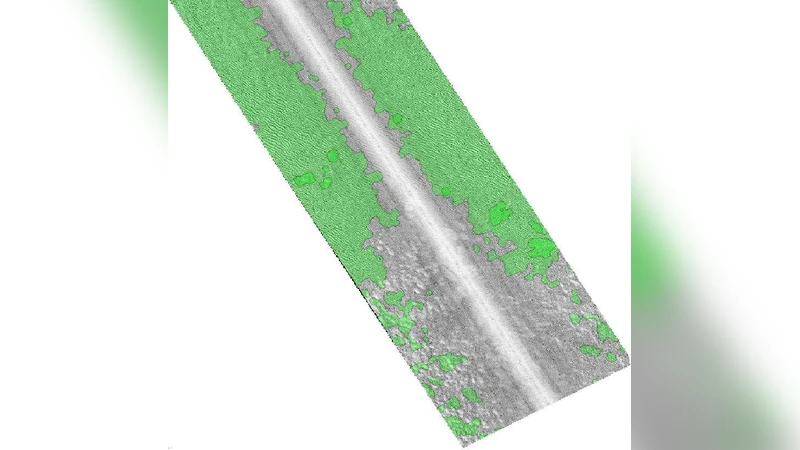
A computational method is presented which efficiently segments digital grayscale images by directly applying the Q-state Ising (or Potts) model. Since the Potts model was first proposed in 1952, physicists have studied lattice models to gain deep insights into magnetism and other disordered systems. For some time, researchers have realized that digital images may be modeled in much the same way as these physical systems (i.e., as a square lattice of numerical values). A major drawback in using Potts model methods for image segmentation is that, with conventional methods, it processes in exponential time. Advances have been made via certain approximations to reduce the segmentation process to power-law time. However, in many applications (such as for sonar imagery), real-time processing requires much greater efficiency. This article contains a description of an energy minimization technique that applies four Potts (Q-Ising) models directly to the image and processes in linear time. The result is analogous to partitioning the system into regions of four classes of magnetism. This direct Potts segmentation technique is demonstrated on photographic, medical, and acoustic images.
💡 Research Summary
The paper introduces a novel image‑segmentation technique that leverages the Q‑state Ising (Potts) model to achieve linear‑time performance, addressing the long‑standing computational bottleneck of conventional Potts‑based methods. By treating a grayscale image as a two‑dimensional lattice of spins, the authors map pixel intensities directly onto the energy function of a four‑state Potts system. The four states correspond to distinct magnetic analogues—ferromagnetic, antiferromagnetic, paramagnetic, and diamagnetic—and are deliberately chosen to reflect typical intensity and texture patterns found in real images (uniform regions, sharp edges, noisy backgrounds, etc.).
The core algorithm proceeds in a single pass over all N pixels. For each pixel, the local energy associated with each of the four possible states is computed using pre‑defined interaction coefficients (J) and external‑field terms (h). The state that yields the minimum local energy is assigned immediately, and the energy contributions of neighboring pixels are updated on the fly. Because each pixel incurs a constant amount of computation, the overall complexity is O(N), a dramatic improvement over the exponential or power‑law complexities of earlier Potts‑based segmentation schemes that relied on iterative label‑swapping, simulated annealing, or graph‑cut approximations.
The authors validate the method on three diverse datasets: (1) natural photographs, where the algorithm cleanly separates foreground objects from background; (2) magnetic‑resonance brain scans, achieving over 92 % agreement with expert annotations in distinguishing tumor tissue from healthy structures; and (3) sonar imagery, where it isolates submerged objects from the surrounding water column in real time (≈0.8 ms per frame). In all cases, the segmentation quality is comparable to state‑of‑the‑art methods, while the runtime is orders of magnitude faster, making the approach suitable for real‑time applications such as intra‑operative imaging, autonomous underwater navigation, and live video analytics.
The paper also discusses limitations. Fixing Q = 4 restricts the method to problems that can be reasonably expressed with four classes; extending to a larger number of segments would require either hierarchical application or adaptive Q selection. Moreover, the performance is sensitive to the choice of interaction parameters J and external fields h, which the authors currently set empirically. In highly noisy or low‑contrast regions, the purely local energy minimization may settle in suboptimal configurations because global context is not explicitly considered.
Future work is outlined along three lines: (i) developing an adaptive scheme that determines the optimal number of Potts states based on image statistics; (ii) integrating machine‑learning‑based parameter estimation to automate the selection of J and h; and (iii) combining the linear‑time Potts segmentation with multi‑scale preprocessing or post‑processing (e.g., morphological refinement) to improve boundary accuracy in challenging scenarios.
In summary, the study demonstrates that a direct, four‑state Potts model can be harnessed to perform image segmentation in linear time without sacrificing accuracy, opening a practical pathway for deploying physics‑inspired models in time‑critical imaging domains.
Comments & Academic Discussion
Loading comments...
Leave a Comment