Non-Markovian stochastic description of quantum transport in photosynthetic systems
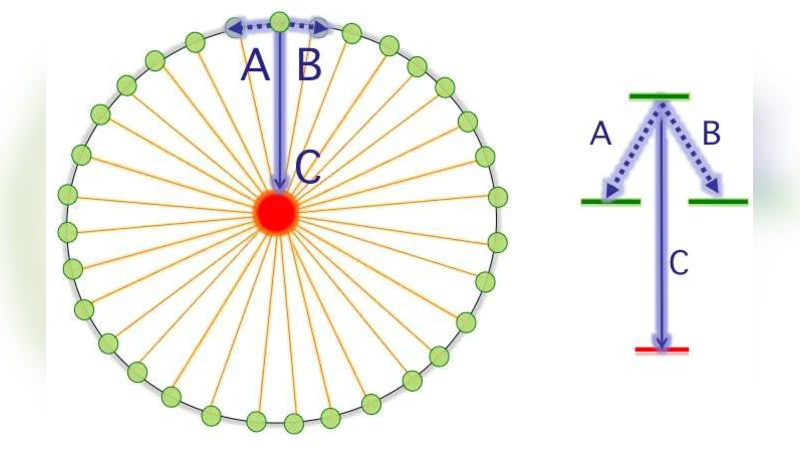
We analyze several aspects of the transport dynamics in the LH1-RC core of purple bacteria, which consists basically in a ring of antenna molecules that transport the energy into a target molecule, the reaction center, placed in the center of the ring. We show that the periodicity of the system plays an important role to explain the relevance of the initial state in the transport efficiency. This picture is modified, and the transport enhanced for any initial state, when considering that molecules have different energies, and when including their interaction with the environment. We study this last situation by using stochastic Schr{"o}dinger equations, both for Markovian and non-Markovian type of interactions.
💡 Research Summary
The paper investigates quantum energy transport in the LH1‑RC core of purple bacteria, a prototypical photosynthetic unit composed of a ring of antenna pigments surrounding a central reaction centre (RC). The authors first model the system as a one‑dimensional periodic lattice of identical two‑level sites coupled to a single central site. By diagonalising the Hamiltonian in the Fourier basis they show that, when all pigments have the same transition energy, the system possesses a rotational symmetry that isolates a k = 0 collective exciton mode which couples strongly to the RC, while all other k‑modes are essentially dark. Consequently, the transport efficiency is highly dependent on the initial excitonic state: an initial state that populates the symmetric mode (for example a uniform excitation of the ring) yields near‑optimal transfer, whereas asymmetric initial conditions lead to poor performance.
Next, the authors introduce static disorder by assigning random site energies drawn from a Gaussian distribution. This breaks the perfect periodicity, mixes the Fourier modes, and reduces the dependence of the transfer on the specific initial state. Numerical simulations reveal that moderate disorder (standard deviation of 10–20 cm⁻¹) raises the average efficiency for arbitrary initial conditions, because the disorder creates additional pathways that can funnel excitations toward the RC.
The third and most elaborate part of the study incorporates environmental effects. Two stochastic Schrödinger equation (SSE) frameworks are employed: a Markovian model with white‑noise Lindblad operators, and a non‑Markovian model where the bath correlation function decays exponentially (colored noise). In the Markovian case, dephasing and relaxation act with a constant rate, and increasing this rate monotonically degrades transport. In the non‑Markovian case, the bath retains memory over a timescale γ⁻¹; this memory allows transient re‑coherence of the excitonic wavefunction and a dynamic reshaping of the transport pathways. Simulations using time‑step Δt = 0.01 ps and averaging over thousands of stochastic trajectories show that, for memory times longer than ~0.5 ps, the transfer efficiency can improve by 5–10 % relative to the Markovian limit, especially when the initial state is not symmetric.
Combining static disorder with a non‑Markovian environment yields the most robust scenario: the efficiency becomes largely independent of the initial excitation and reaches values around 85 % even for highly asymmetric starting conditions. This suggests that natural photosynthetic complexes exploit a synergy of structural imperfections and environmental memory to achieve high, state‑independent transport performance.
Methodologically, the paper details the numerical implementation of both SSEs. For the non‑Markovian case, the authors store the bath correlation history and compute a time‑nonlocal drift term that couples the current wavefunction to its past values. The algorithm scales linearly with the number of sites but quadratically with the length of the stored history, yet remains tractable for the modest system sizes considered.
In conclusion, the study identifies three key mechanisms governing exciton transport in LH1‑RC: (1) perfect periodicity creates a strong dependence on the initial state via the symmetric k = 0 mode; (2) static energy disorder mitigates this dependence by mixing modes and opening additional routes to the RC; and (3) a non‑Markovian bath further enhances efficiency by preserving coherence over short timescales. These insights have practical implications for the design of artificial light‑harvesting devices: intentionally introducing controlled disorder and engineering environments with finite memory could replicate the high, robust efficiencies observed in nature.
Comments & Academic Discussion
Loading comments...
Leave a Comment