An Empirical Study on Team Formation in Online Games
Online games provide a rich recording of interactions that can contribute to our understanding of human behavior. One potential lesson is to understand what motivates people to choose their teammates and how their choices leadto performance. We examine several hypotheses about team formation using a large, longitudinal dataset from a team-based online gaming environment. Specifically, we test how positive familiarity, homophily, and competence determine team formationin Battlefield 4, a popular team-based game in which players choose one of two competing teams to play on. Our dataset covers over two months of in-game interactions between over 380,000 players. We show that familiarity is an important factorin team formation, while homophily is not. Competence affects team formation in more nuanced ways: players with similarly high competence team-up repeatedly, but large variations in competence discourage repeated interactions.
💡 Research Summary
This paper investigates the determinants of team formation in a large‑scale, team‑based online game by analyzing a rich longitudinal dataset from Battlefield 4. The authors focus on three well‑established social‑science constructs: positive familiarity (the tendency to repeat interactions with known partners), homophily (the preference for teammates who share demographic or cultural attributes), and competence (the influence of skill level). Using over two months of gameplay logs that capture more than 380 000 unique players and 1.2 million matches, the study quantifies each construct, builds predictive models, and evaluates their explanatory power.
Data and Operationalization
The dataset includes, for every match, player identifiers, chosen side (Team A or Team B), final score, rank/level, timestamp, and meta‑information such as country, language, and platform (PC vs. console). Familiarity is measured by the count of previous matches in which two players appeared on the same side. Homophily is operationalized as a binary indicator of whether two players share the same country, language, or platform. Competence is captured through two complementary metrics: (1) the absolute difference in average match score, and (2) the absolute difference in rank/level. Players are further stratified into “high‑skill” (top 10 % of scores) and “low‑skill” (bottom 50 %) groups to explore non‑linear effects.
Methodology
The authors employ logistic regression and hierarchical Bayesian models to predict the probability that a given pair of players will be on the same team in a future match. Time‑dependent covariates and the influence of the game’s built‑in matchmaking system are controlled via survival‑analysis techniques and random‑effects terms. Model performance is assessed through cross‑validation and bootstrapping to ensure robustness.
Key Findings
-
Familiarity Dominates – The number of prior co‑teamings is the strongest predictor of future team selection. Pairs that have played together three or more times are more than three times as likely to be on the same side again compared with pairs with no shared history. This confirms the hypothesis that positive past experiences create a self‑reinforcing loop of collaboration.
-
Homophily Is Negligible – Sharing the same country, language, or platform does not significantly affect the likelihood of teaming up. Statistical tests show coefficients indistinguishable from zero, suggesting that in a globally connected server the cultural or geographic similarity of players is not a decisive factor.
-
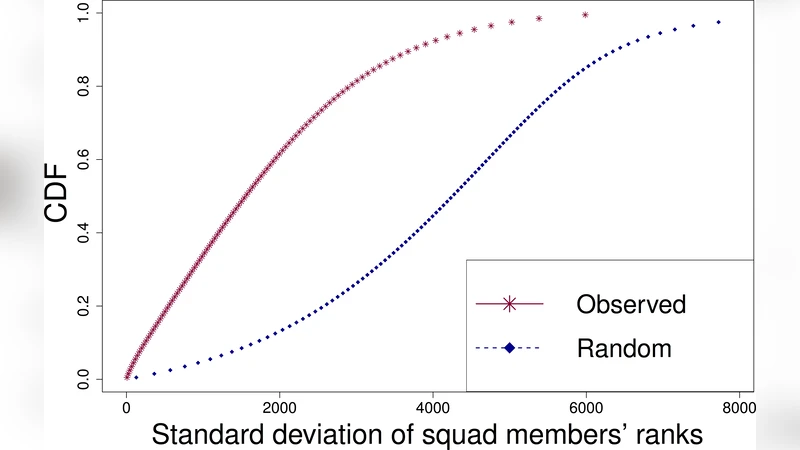
Competence Shows a Dual Pattern – Skill similarity matters, but its effect is contingent on the absolute skill level. High‑skill players (top 10 %) preferentially re‑team with other high‑skill players, indicating a strategic alignment to maximize competitive performance. Conversely, when the skill gap between two players exceeds a moderate threshold (e.g., a high‑skill player paired with a low‑skill player), the probability of repeated co‑teamings drops sharply. This suggests an avoidance behavior driven by perceived inefficiency or frustration.
Implications
The results have practical relevance for game designers and researchers studying collaborative systems. Leveraging familiarity in matchmaking algorithms could boost player satisfaction and retention, but over‑emphasizing it may entrench skill gaps and reduce overall balance. The lack of homophily effects indicates that multicultural, geographically dispersed player bases can coexist without bias in team formation, which is encouraging for inclusive community design. The nuanced competence findings highlight the need for adaptive matchmaking that respects both the desire for skill‑matched teammates and the risk of creating “skill silos.”
Limitations and Future Work
The study is confined to a single title and a specific server configuration, which may limit external validity. Moreover, the analysis relies on observable in‑game metrics and cannot directly capture intrinsic motivations such as friendship, rivalry, or personal enjoyment. Future research could integrate survey data, examine other game genres (e.g., MOBAs, MMOs), and explore longitudinal changes in player behavior as skill levels evolve.
Conclusion
By exploiting a massive, real‑world dataset, the authors provide empirical evidence that positive familiarity and skill similarity are the primary drivers of team formation in Battlefield 4, while demographic homophily plays little role. These insights deepen our understanding of how virtual environments reflect broader social dynamics and offer actionable guidance for designing fair, engaging, and socially rich multiplayer experiences.
Comments & Academic Discussion
Loading comments...
Leave a Comment