A Logic of Interactive Proofs (Formal Theory of Knowledge Transfer)
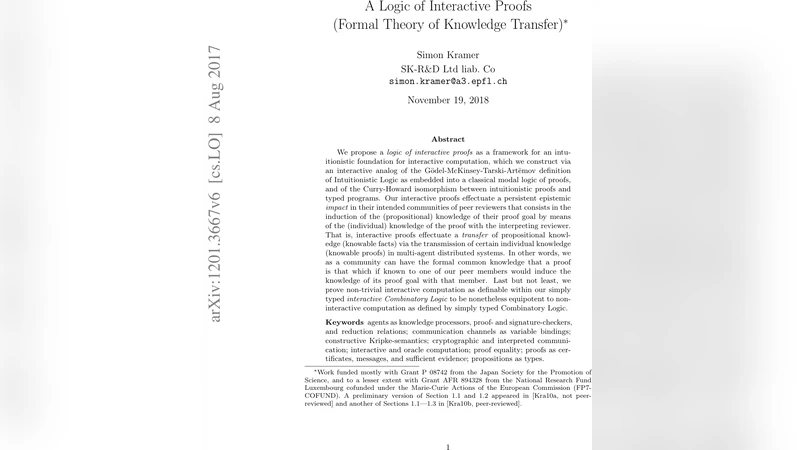
We propose a logic of interactive proofs as a framework for an intuitionistic foundation for interactive computation, which we construct via an interactive analog of the Goedel-McKinsey-Tarski-Artemov definition of Intuitionistic Logic as embedded into a classical modal logic of proofs, and of the Curry-Howard isomorphism between intuitionistic proofs and typed programs. Our interactive proofs effectuate a persistent epistemic impact in their intended communities of peer reviewers that consists in the induction of the (propositional) knowledge of their proof goal by means of the (individual) knowledge of the proof with the interpreting reviewer. That is, interactive proofs effectuate a transfer of propositional knowledge (knowable facts) via the transmission of certain individual knowledge (knowable proofs) in multi-agent distributed systems. In other words, we as a community can have the formal common knowledge that a proof is that which if known to one of our peer members would induce the knowledge of its proof goal with that member. Last but not least, we prove non-trivial interactive computation as definable within our simply typed interactive Combinatory Logic to be nonetheless equipotent to non-interactive computation as defined by simply typed Combinatory Logic.
💡 Research Summary
The paper introduces a novel logical framework called the Logic of Interactive Proofs (LIP), which extends the traditional intuitionistic and modal proof logics to capture the dynamics of knowledge transfer in multi‑agent distributed systems. Starting from the Gödel‑McKinsey‑Tarski‑Artemov (GMTA) embedding of intuitionistic logic into a classical modal setting, the authors reinterpret proofs not merely as static witnesses of truth but as communicable objects that can be transmitted between agents. In LIP, each agent a has an epistemic operator Kₐ (individual knowledge) and a proof‑transmission operator ⟨π⟩φ, meaning “if proof π is presented, agent a will come to know φ.” This operator combines intuitionistic implication (φ→ψ) with modal possibility (◇φ) and is governed by a set of axioms that ensure transferability, persistence, and reflexivity of knowledge.
Semantically, the authors enrich Kripke models with a family of transmission relations Rπ, one for each proof term π. When a world w accesses a world v via Rπ, the proof π is said to be delivered, and the truth of φ at v becomes known to the agent at w. The crucial “persistent epistemic impact” condition guarantees that once a proof has been received, the induced propositional knowledge cannot be lost, mirroring the constructive nature of intuitionistic reasoning.
On the computational side, the paper defines a Simply Typed Interactive Combinatory Logic (ITCL). ITCL extends the classic combinators S and K with a transmission combinator T₍π₎, where T₍π₎ M N denotes the application of proof π to term M, yielding term N. The authors prove an “Equipotence Theorem” showing that ITCL is computationally equivalent to the ordinary Simply Typed Combinatory Logic (STCL). In other words, adding interactive proof transmission does not increase raw computational power, but it enriches the expressive layer to model protocols such as asynchronous communication, authentication, and contract signing, where the act of sharing a proof is itself a computational step.
The paper also formalizes a notion of common knowledge within LIP: a proposition becomes common knowledge when every member of the community possesses a proof that, if known by any single member, would induce the proposition for that member. This captures the intuitive idea that a community can collectively accept a theorem once a suitable proof has been circulated.
Finally, the authors discuss applications to distributed ledger consensus, security protocol verification, and collaborative theorem proving, arguing that LIP provides a rigorous tool for reasoning about how knowledge propagates through interactive computation. They outline future work on extending the framework to probabilistic proof transmission, multi‑proof chaining, and real‑time interactive environments. The overall contribution is a unified logical and computational theory that treats proofs as first‑class communicable entities, thereby bridging the gap between constructive logic, type‑theoretic programming, and epistemic analysis of distributed systems.
Comments & Academic Discussion
Loading comments...
Leave a Comment