📝 Original Info
- Title: Network Community Detection: A Review and Visual Survey
- ArXiv ID: 1708.00977
- Date: 2017-08-04
- Authors: Researchers from original ArXiv paper
📝 Abstract
Community structure is an important area of research. It has received a considerable attention from the scientific community. Despite its importance, one of the key problems in locating information about community detection is the diverse spread of related articles across various disciplines. To the best of our knowledge, there is no current comprehensive review of recent literature which uses a scientometric analysis using complex networks analysis covering all relevant articles from the Web of Science (WoS). Here we present a visual survey of key literature using CiteSpace. The idea is to identify emerging trends besides using network techniques to examine the evolution of the domain. Towards that end, we identify the most influential, central, as well as active nodes using scientometric analyses. We examine authors, key articles, cited references, core subject categories, key journals, institutions, as well as countries. The exploration of the scientometric literature of the domain reveals that Yong Wang is a pivot node with the highest centrality. Additionally, we have observed that Mark Newman is the most highly cited author in the network. We have also identified that the journal, "Reviews of Modern Physics" has the strongest citation burst. In terms of cited documents, an article by Andrea Lancichinetti has the highest centrality score. We have also discovered that the origin of the key publications in this domain is from the United States. Whereas Scotland has the strongest and longest citation burst. Additionally, we have found that the categories of "Computer Science" and "Engineering" lead other categories based on frequency and centrality respectively.
💡 Deep Analysis
Deep Dive into Network Community Detection: A Review and Visual Survey.
Community structure is an important area of research. It has received a considerable attention from the scientific community. Despite its importance, one of the key problems in locating information about community detection is the diverse spread of related articles across various disciplines. To the best of our knowledge, there is no current comprehensive review of recent literature which uses a scientometric analysis using complex networks analysis covering all relevant articles from the Web of Science (WoS). Here we present a visual survey of key literature using CiteSpace. The idea is to identify emerging trends besides using network techniques to examine the evolution of the domain. Towards that end, we identify the most influential, central, as well as active nodes using scientometric analyses. We examine authors, key articles, cited references, core subject categories, key journals, institutions, as well as countries. The exploration of the scientometric literature of the domain
📄 Full Content
Network Community Detection: A Review and Visual Survey
Bisma S. Khan1 · Muaz A. Niazi*,1
1Department of Computer Science, COMSATS Institute of Information Technology, Islamabad, Pakistan
*Corresponding author. E-mail: muaz.niazi@gmail.com
Abstract: Community structure is an important area of research. It has received a considerable attention from
the scientific community. Despite its importance, one of the key problems in locating information about community
detection is the diverse spread of related articles across various disciplines. To the best of our knowledge, there is
no current comprehensive review of recent literature which uses a scientometric analysis using complex networks
analysis covering all relevant articles from the Web of Science (WoS). Here we present a visual survey of key
literature using CiteSpace. The idea is to identify emerging trends besides using network techniques to examine
the evolution of the domain. Towards that end, we identify the most influential, central, as well as active nodes
using scientometric analyses. We examine authors, key articles, cited references, core subject categories, key
journals, institutions, as well as countries. The exploration of the scientometric literature of the domain reveals that
Yong Wang is a pivot node with the highest centrality. Additionally, we have observed that Mark Newman is the
most highly cited author in the network. We have also identified that the journal, “Reviews of Modern Physics”
has the strongest citation burst. In terms of cited documents, an article by Andrea Lancichinetti has the highest
centrality score. We have also discovered that the origin of the key publications in this domain is from the United
States. Whereas Scotland has the strongest and longest citation burst. Additionally, we have found that the
categories of “Computer Science” and “Engineering” lead other categories based on frequency and centrality
respectively.
Keywords Complex networks; community detection; CiteSpace; scientometric; visual survey
- Introduction
Complex networks are the extremely important area of research. With the advancement in science
and technology, a variety of research in the domain of complex networks has garnered a substantial
amount of attention from the scientific community. Complex networks are expanding at a brisk pace.
The growth of complex networks ranges from biological networks (Dunne et al. 2002; Jeong et al.
- to technological networks (Faloutsos et al. 1999; Albert et al. 1999; Amaral et al. 2000), from
social networks (Wasserman and Faust 1994; Scott and Carrington 2011) to information networks
(Newman 2004b). Complex networks are made up of interconnected nodes. With the increase in size
and complexity of complex networks, it is essential to understand the related literature and key findings.
One of the key research fronts in this domain is community structures. Community structure is the
most widely studied structural features of complex networks. Communities in a network are the dense
groups of the vertices, which are tightly coupled to each other inside the group and loosely coupled to
the rest of the vertices in the network. Community detection plays a key role in understanding the
functionality of complex networks.
Recently, community detection has attracted a huge consideration due to the growing availability of
the data sets of the large-scale networks. To provide insightful information about community detection,
much research has been conducted in the form of surveys, systematic literature reviews, and visual
studies. But, only a few of them shows how the field advanced over time. To demonstrate the sense of
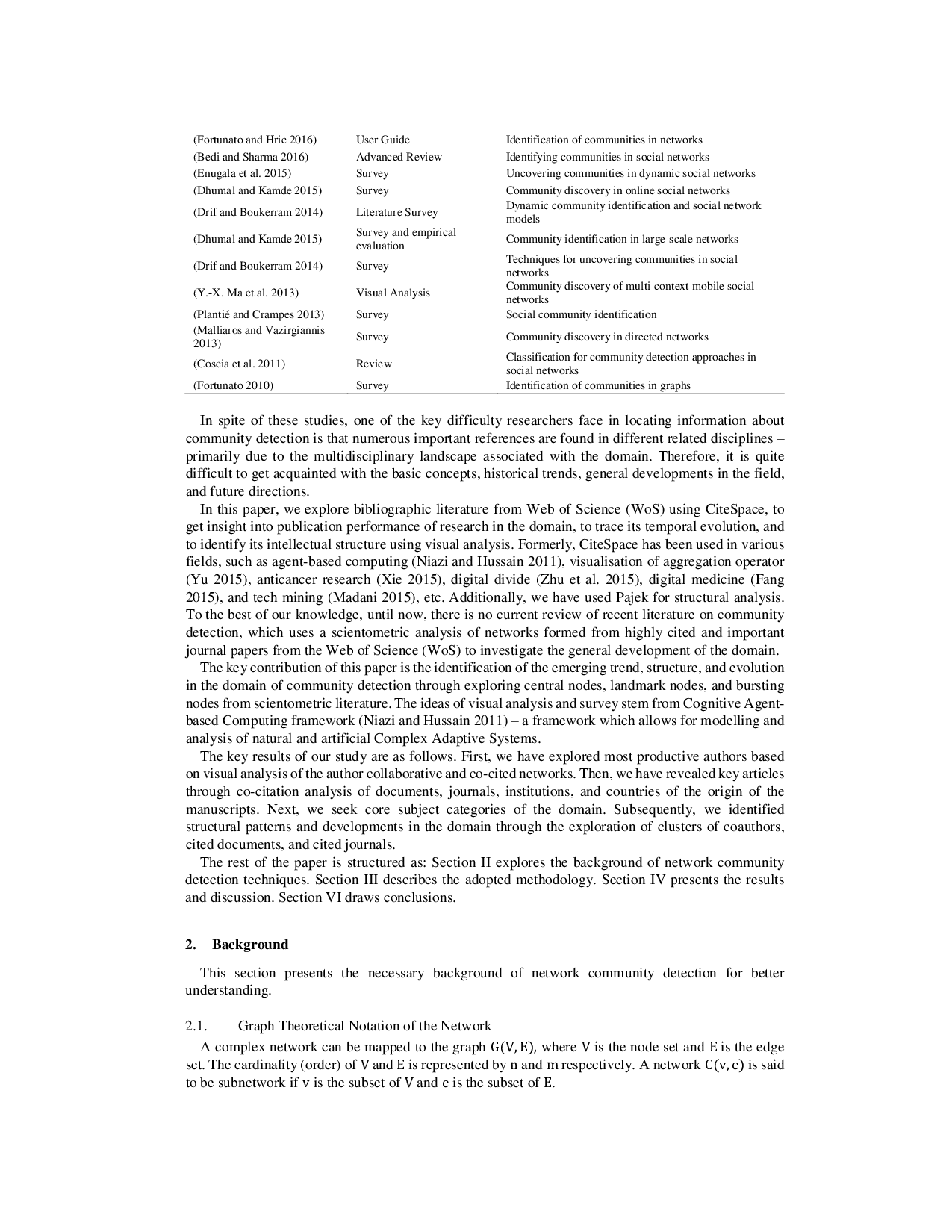
details, information about existing literature is listed in Table 1.
Table 1. The existing literature review in the domain of “Network Community Detection”
Ref.
Paper Type
Study Area
(Cai et al. 2016)
Survey
Evolutionary techniques for the identification
communities in networks
(Fortunato and Hric 2016)
User Guide
Identification of communities in networks
(Bedi and Sharma 2016)
Advanced Review
Identifying communities in social networks
(Enugala et al. 2015)
Survey
Uncovering communities in dynamic social networks
(Dhumal and Kamde 2015)
Survey
Community discovery in online social networks
(Drif and Boukerram 2014)
Literature Survey
Dynamic community identification and social network
models
(Dhumal and Kamde 2015)
Survey and empirical
evaluation
Community identification in large-scale networks
(Drif and Boukerram 2014)
Survey
Techniques for uncovering communities in social
networks
(Y.-X. Ma et al. 2013)
Visual Analysis
Community discovery of multi-context mobile social
networks
(Plantié and Crampes 2013)
Survey
Social community identification
(Malliaros and Vazirgiannis
Survey
Community discovery in directed networks
(Coscia et al. 2011)
Review
Classification for community detection approaches in
social
…(Full text truncated)…
📸 Image Gallery
Reference
This content is AI-processed based on ArXiv data.