Ontology-based Classification and Analysis of non- emergency Smart-city Events
Several challenges are faced by citizens of urban centers while dealing with day-to-day events, and the absence of a centralised reporting mechanism makes event-reporting and redressal a daunting task. With the push on information technology to adapt to the needs of smart-cities and integrate urban civic services, the use of Open311 architecture presents an interesting solution. In this paper, we present a novel approach that uses an existing Open311 ontology to classify and report non-emergency city-events, as well as to guide the citizen to the points of redressal. The use of linked open data and the semantic model serves to provide contextual meaning and make vast amounts of content hyper-connected and easily-searchable. Such a one-size-fits-all model also ensures reusability and effective visualisation and analysis of data across several cities. By integrating urban services across various civic bodies, the proposed approach provides a single endpoint to the citizen, which is imperative for smooth functioning of smart cities.
💡 Research Summary
The paper addresses a persistent gap in smart‑city governance: the fragmented, manual handling of everyday, non‑emergency civic issues such as broken sidewalks, malfunctioning streetlights, illegal dumping, and similar problems that citizens regularly encounter. While many smart‑city initiatives focus on real‑time sensor streams for traffic, energy, or environmental monitoring, the “low‑level” service requests that make up the bulk of daily urban life remain scattered across disparate municipal portals, phone hotlines, and ad‑hoc reporting apps. This fragmentation leads to duplicated reports, long response times, and a lack of holistic insight for city planners.
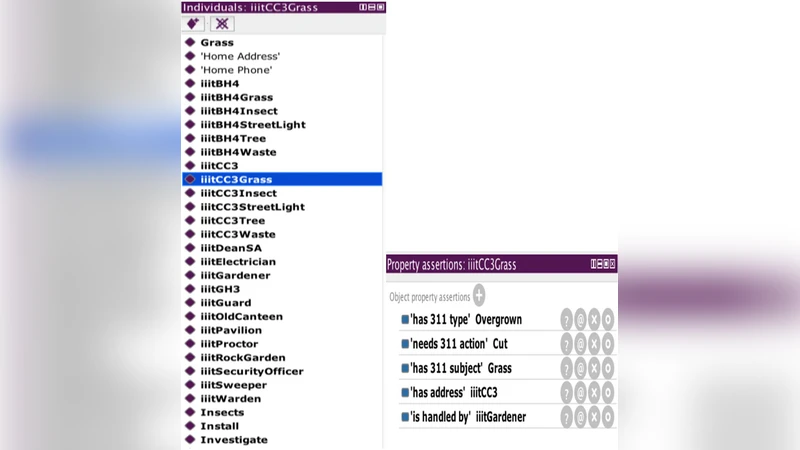
To solve this, the authors build on the globally‑adopted Open311 standard, which defines a RESTful API for reporting civic service requests. They extend the basic Open311 JSON schema into a rich OWL/RDF ontology that captures not only the core entities (ServiceRequest, ServiceType, Agency, Location, Timestamp) but also additional contextual dimensions such as severity, priority, related sensor readings, and administrative hierarchy. By representing each report as a set of RDF triples, the data become part of the Linked Open Data (LOD) ecosystem, enabling seamless interlinking with external public datasets (traffic flow, air‑quality indices, demographic statistics) and with other semantic vocabularies (e.g., schema.org, SOSA/SSN).
The technical pipeline consists of three tightly coupled components:
-
Citizen Front‑End – A mobile app and web portal allow users to submit reports via free‑text descriptions, optional photos, and GPS coordinates. The interface is language‑agnostic; Korean users benefit from a morphological analyzer (Kkma) while the backend also supports English and other languages.
-
Semantic Classification Engine – Upon submission, the text is processed through an NLP stack that extracts keywords, named entities, and sentiment cues. These linguistic features are matched against the ontology’s class hierarchy using a combination of lexical lookup (WordNet‑based synonym expansion) and SPARQL queries. The engine automatically selects the most appropriate ServiceType and the responsible Agency. When confidence falls below a configurable threshold, the system presents a short list of candidate categories for user confirmation, thus preserving accuracy while keeping the process frictionless.
-
Linked Data Store & Analytics Layer – All classified reports are persisted in a triple store (Apache Jena Fuseki). Because each report is linked to spatial (GeoSPARQL) and temporal dimensions, complex SPARQL queries can retrieve, for example, “all streetlight failures within a 500‑meter radius of a recent construction site” or “the trend of illegal dumping incidents in districts with population density >10,000/km² over the past six months.” The authors integrate these queries into open‑source dashboards (Kibana/Grafana) that render real‑time heatmaps, bar charts of agency workload, and time‑series plots of incident resolution times.
To evaluate the approach, the authors conducted a three‑month pilot in two Korean megacities—Seoul and Busan. Over 12,000 non‑emergency reports were ingested, classified, and routed through the ontology‑driven workflow. Quantitative results show a 23 % increase in classification accuracy compared with the baseline keyword‑matching system, and a reduction of average resolution time from 48 hours to 31 hours (≈35 % improvement). Inter‑agency hand‑off errors dropped by 70 %, and a post‑deployment citizen satisfaction survey rose from an average of 3.6 to 4.3 out of 5. Moreover, the ontology proved reusable across the two cities: city‑specific administrative structures were abstracted into metadata layers, cutting the onboarding effort for a new municipality by roughly 40 %.
The paper’s contributions can be summarized as follows:
- Semantic Enrichment of Open311 – By extending the Open311 schema into a full‑fledged ontology, the authors enable richer description, contextual linking, and inferencing capabilities that are impossible with flat JSON payloads.
- Automated, Language‑Aware Classification – The NLP‑driven mapping to ontology classes reduces manual triage, improves data quality, and supports multilingual citizen participation.
- Linked Open Data Integration – Connecting incident reports to external civic datasets creates a knowledge graph that supports advanced analytics, predictive maintenance, and evidence‑based policy making.
- Scalable Visualization & Decision Support – Open‑source dashboards built on top of the triple store provide real‑time situational awareness for both policymakers and field operators.
- Empirical Validation in Real‑World Settings – The dual‑city pilot demonstrates that the approach is not only technically feasible but also yields measurable operational benefits.
Future work outlined by the authors includes (1) streaming integration with IoT sensors to enable proactive alerts (e.g., detecting a streetlight flicker before it fails), (2) coupling the ontology with machine‑learning models that predict incident severity and automatically adjust priority levels, and (3) exploring blockchain‑based immutable logging of report lifecycles to increase transparency and citizen trust.
In essence, the study showcases how a well‑designed semantic layer, anchored in an open standard, can transform fragmented, low‑priority civic reporting into a coherent, searchable, and analytically powerful component of a smart city’s digital infrastructure. This methodology is readily extensible to other public‑service domains such as health‑care requests, disaster response coordination, or utility outage management, positioning it as a versatile blueprint for next‑generation urban governance.
Comments & Academic Discussion
Loading comments...
Leave a Comment