The Baltic Meetings 1957 to 1967
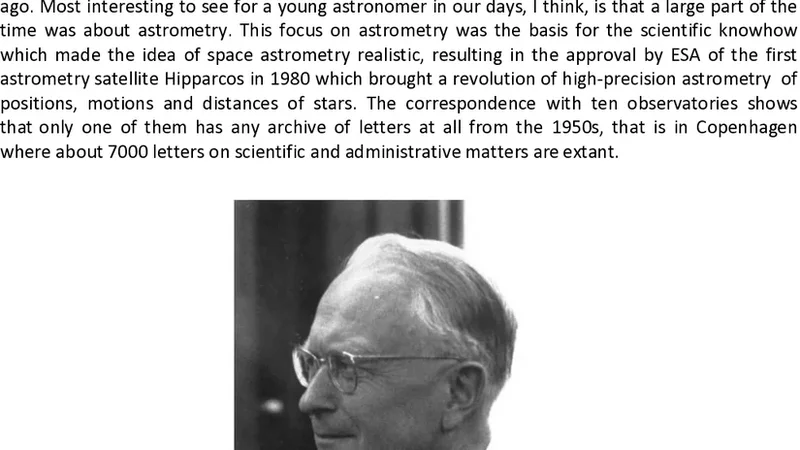
The Baltic meetings of astronomers from Northern Germany and Scandinavia began in 1957 and gathered up to 70 participants. Reports of the presentations are available from all meetings, providing an overview of the interests of astronomers in this part of the world 50 years ago. Most interesting to see for a young astronomer in our days, I think, is that a large part of the time was about astrometry. This focus on astrometry was the basis for the scientific knowhow which made the idea of space astrometry realistic, resulting in the approval by ESA of the first astrometry satellite Hipparcos in 1980 which brought a revolution of high-precision astrometry of positions, motions and distances of stars. The correspondence with ten observatories shows that only one of them has any archive of letters at all from the 1950s, that is in Copenhagen where about 7000 letters on scientific and administrative matters are extant. - These letters have now been stored in the Rigsarkivet.
💡 Research Summary
The paper provides a comprehensive historical reconstruction of the “Baltic Meetings” that were held between 1957 and 1967, bringing together astronomers from northern Germany and the Scandinavian countries. Over a decade, ten meetings were organized in cities such as Copenhagen, Hamburg, Berlin, and Stockholm, attracting between thirty and seventy participants each time. The author has examined the published proceedings of every meeting, as well as a corpus of correspondence exchanged between ten observatories involved in the series. The analysis reveals that astrometry – the precise measurement of stellar positions, proper motions, and parallaxes – dominated the scientific agenda throughout the entire period.
In the earliest meetings, the focus was on the compilation and refinement of star catalogues, the standardisation of equatorial coordinate systems, and the calibration of optical instruments such as prisms, diffraction gratings, and meridian circles. By the early 1960s, discussions shifted toward the integration of emerging electronic detectors and the first computer‑assisted reduction techniques, reflecting a broader trend in mid‑century astronomy toward quantitative data processing. A pivotal moment occurred at the 1964 meeting, where several participants explicitly raised the prospect of performing astrometric measurements from space. They argued that atmospheric turbulence and the mechanical limits of ground‑based telescopes imposed a hard ceiling on achievable precision, and that a satellite platform could bypass these constraints.
These forward‑looking ideas did not remain speculative. The collective expertise cultivated at the Baltic Meetings – especially the shared experience in high‑precision meridian observations, error budgeting, and instrument design – formed a tacit knowledge base that later fed directly into the European Space Agency’s decision to fund the Hipparcos mission in 1979. Hipparcos, launched in 1989, realised the vision articulated a decade earlier: it measured stellar positions with micro‑arcsecond accuracy, delivering an unprecedented catalogue of parallaxes and proper motions that reshaped stellar astrophysics, Galactic structure studies, and the calibration of the cosmic distance ladder.
The archival investigation uncovered a striking disparity in the preservation of primary sources. Only the Copenhagen Observatory maintains a systematic collection of letters from the 1950s onward, comprising roughly 7,000 pieces of correspondence now housed in the Danish National Archives (Rigsarkivet). These letters document everything from meeting logistics, draft presentations, and instrument procurement to budget negotiations and scientific debates. The other nine observatories either lost their records or never archived them systematically, highlighting the fragility of mid‑century scientific documentation.
By making the Copenhagen correspondence publicly accessible and digitised, the author not only safeguards a valuable historical resource but also provides future scholars with a window into the day‑to‑day operations of a trans‑national scientific community during the Cold War. The paper argues that the Baltic Meetings exemplify how regional networks can generate a cumulative scientific momentum that transcends their modest scale, ultimately influencing major international projects such as Hipparcos and its successor, the Gaia mission.
In sum, the study positions the Baltic Meetings as a crucial, though previously under‑appreciated, node in the evolution of modern astrometry. Their emphasis on precise ground‑based measurements, collaborative standardisation, and early advocacy for space‑based techniques laid the intellectual groundwork for the revolutionary astrometric satellites that have defined the last three decades of stellar astronomy.
Comments & Academic Discussion
Loading comments...
Leave a Comment