Emerging Topics in Internet Technology: A Complex Networks Approach
Communication networks, in general, and internet technology, in particular, is a fast-evolving area of research. While it is important to keep track of emerging trends in this domain, it is such a fast-growing area that it can be very difficult to keep track of literature. The problem is compounded by the fast-growing number of citation databases. While other databases are gradually indexing a large set of reliable content, currently the Web of Science represents one of the most highly valued databases. Research indexed in this database is known to highlight key advancements in any domain. In this paper, we present a Complex Network-based analytical approach to analyze recent data from the Web of Science in communication networks. Taking bibliographic records from the recent period of 2014 to 2017, we model and analyze complex scientometric networks. Using bibliometric coupling applied over complex citation data we present answers to co-citation patterns of documents, co-occurrence patterns of terms, as well as the most influential articles, among others, We also present key pivot points and intellectual turning points. Complex network analysis of the data demonstrates a considerably high level of interest in two key clusters labeled descriptively as “social networks” and “computer networks”. In addition, key themes in highly cited literature were clearly identified as “communication networks,” “social networks,” and “complex networks”.
💡 Research Summary
The paper presents a scientometric study of emerging topics in communication and Internet technology using a complex‑network approach. The authors retrieved bibliographic records from Clarivate Analytics’ Web of Science (WoS) covering the period 2014‑2017 with a comprehensive query that combined the terms “Communication”, “Telecommunication”, “Network*”, and “Complex* Network*”. After filtering for English language and excluding biology, psychology and chemistry categories, the final dataset comprised 22,944 records across the four WoS indices (SCI‑Expanded, SSCI, A&HCI, ESCI).
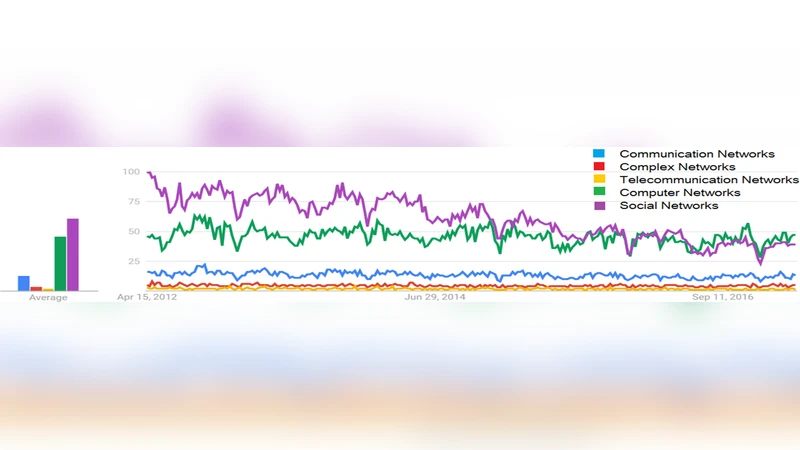
The analysis was performed with CiteSpace, a visual analytics tool for mapping scientific literature. Three complementary perspectives were explored: (1) public interest trends via Google Trends and a CarrotSearch Foamtree visualization of 200 web‑search results; (2) a co‑citation network built from bibliographic coupling of cited references; and (3) a term co‑occurrence network derived from titles, abstracts and author keywords.
Google Trends showed that “Social Networks” maintained the highest long‑term search volume, while “Computer Networks” experienced a sharp rise after mid‑2016. The Foamtree map identified “Communication Networks” as the dominant cluster, followed by “Social Networks” and “Complex Networks”.
The co‑citation network consisted of 112 cited references and 320 links. Its largest connected component (LCC) contained 78 nodes (≈69 % of the whole network) and exhibited a modularity of 0.718, indicating a fairly dense community structure. Six clusters (labeled #0, #1, #2, #4, #5, #7) were detected, with silhouette scores ranging from 0.51 to 0.94, suggesting moderate to high intra‑cluster homogeneity. Cluster #0 (25 nodes, silhouette 0.70) grouped works on “Normal Plasma Vasopressin”, “Pulmonary Artery Complex Network”, and related complex‑network applications. Cluster #1 (15 nodes, silhouette 0.94) gathered papers on community detection, systems biology, and complex‑network theory.
Citation‑frequency analysis highlighted Mark J. Newman’s 2010 book as the most cited item (542 citations, half‑life ≈5 years). Betweenness centrality identified Alex Arenas (2008) as the most central node (0.46), acting as a pivot that connects clusters #0 and #7. Olfati‑Saber (2006) and Zhou (2008) also displayed high betweenness, serving as bridges between distinct thematic groups. Citation‑burst detection revealed Santo Fortunato’s 2007 paper as experiencing the strongest burst (strength 8.73) during 2014‑2015, indicating a rapid surge of attention.
The term co‑occurrence network comprised 89 nodes and 299 edges. “Complex Networks” emerged as the most frequent term (2,154 occurrences) and the most central (centrality 0.31). “Cognitive Radio” showed a pronounced burst (strength 14.4) in 2014‑2015, reflecting a temporary but intense research focus. Other notable terms with sustained activity included “Wireless Sensor Networks”, “Energy Efficiency”, and “Community Structure”.
Overall, the study demonstrates that complex‑network scientometrics can effectively uncover structural patterns, pivotal works, and temporal dynamics in the rapidly evolving field of Internet technology. The authors conclude that “Complex Networks” is the core conceptual backbone, while “Social Networks” and “Computer Networks” represent two major research clusters. They also note that the methodology, while robust, is limited by reliance on a single database (WoS) and English‑only records, and by the automatic labeling of clusters. Future work is suggested to integrate multiple citation sources, apply deeper natural‑language processing for more accurate topic labeling, and develop real‑time monitoring dashboards to support researchers, funding agencies, and industry stakeholders in tracking emerging trends.
Comments & Academic Discussion
Loading comments...
Leave a Comment