Validation of Collaborative Business Processes using Goals Model
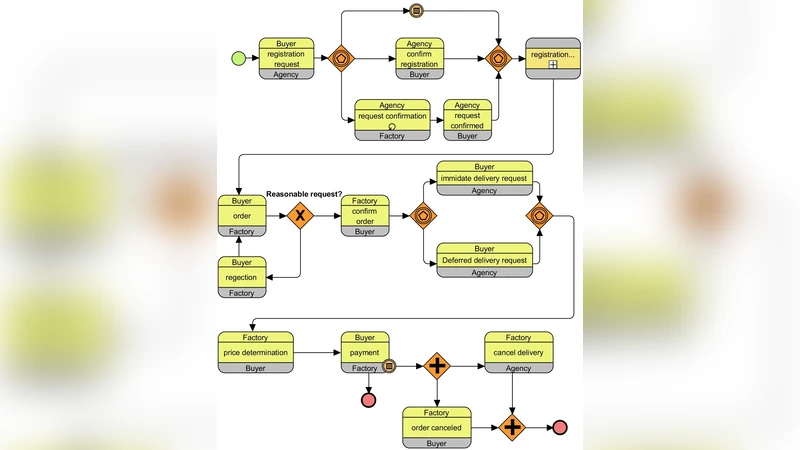
Validating process model against corresponding requirements is one of the most important problems in domain of collaborative processes. In this paper collaborative processes are modeled using the interaction view of BPMN 2.0 standard. Then, requirements are extracted with a goal modeling technique. Different scenarios of each requirement show possible paths for the system. These paths are modeled by sequence diagram and collaborative processes are validated according to the corresponding requirements using Savara tool.
💡 Research Summary
The paper addresses the critical challenge of ensuring that collaborative business process models faithfully satisfy their underlying requirements. To achieve this, the authors adopt a two‑layered modeling and verification approach. First, they model collaborative processes using the interaction view of the BPMN 2.0 standard. This view emphasizes message exchanges among participants, representing each partner as a pool and drawing explicit message flows that capture the dynamic nature of inter‑organizational work. By focusing on interactions rather than internal activities, the BPMN model remains clear even for complex multi‑party scenarios.
Second, the authors extract system requirements through a goal‑modeling technique. High‑level business goals are decomposed into sub‑goals, each linked to functional and non‑functional requirements. For every requirement, possible execution paths are identified and expressed as UML sequence diagrams. Sequence diagrams detail the chronological order of messages between participants, timing constraints, and error‑handling behavior, thereby providing a concrete scenario that can be directly compared with the BPMN interaction view.
The verification phase leverages the Savara tool, which accepts the goal model and its associated sequence diagrams as input and automatically maps them onto the BPMN interaction model. Savara checks that every message in a sequence diagram corresponds to a message flow in the BPMN diagram and that all temporal or ordering constraints defined in the requirements are respected. When mismatches are detected, Savara produces traceable reports indicating the exact nature of the violation—such as missing messages, incorrect sequencing, or deadline breaches. This feedback enables designers to iteratively refine the process model or adjust the requirements.
To demonstrate the practicality of the approach, the authors apply it to two real‑world case studies: an e‑commerce order‑fulfillment collaboration and an insurance claim processing scenario. For each case, they derive five to seven requirement‑driven scenarios, model them as sequence diagrams, and run Savara verification against the initial BPMN models. The initial verification uncovered an average of 2.3 requirement violations per case. After model adjustments guided by Savara’s reports, all violations were eliminated, confirming that the combined goal‑model/sequence‑diagram methodology can effectively detect and resolve requirement gaps early in the design lifecycle.
In conclusion, the study presents a systematic framework that bridges high‑level business goals and low‑level process specifications through formalized goal models and executable sequence diagrams. By integrating these artifacts with BPMN’s interaction view and automating the conformance check with Savara, the approach provides traceability, reduces manual validation effort, and improves overall model quality. The authors suggest future work on extending the framework to cover more complex non‑functional properties such as security and reliability, as well as dynamic participant configurations, thereby broadening its applicability to a wider range of collaborative enterprise systems.
Comments & Academic Discussion
Loading comments...
Leave a Comment