Statistical study on propagation characteristics of Omega signals (VLF) in magnetosphere detected by the Akebono satellite
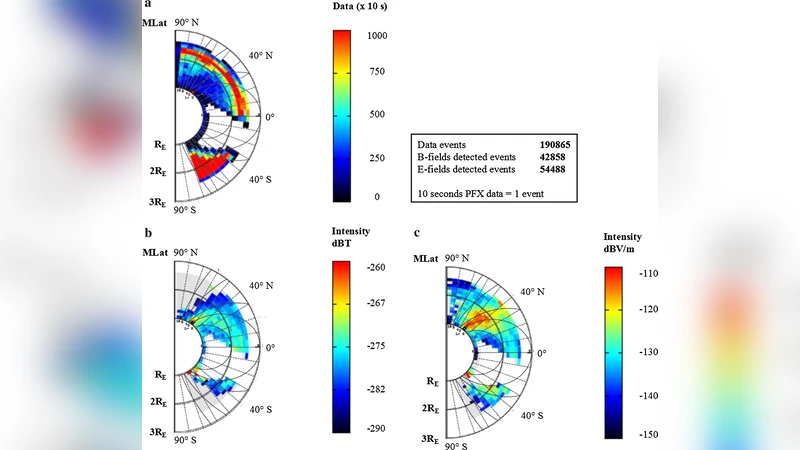
This paper shows a statistical analysis of 10.2 kHz Omega broadcasts of an artificial signal broadcast from ground stations, propagated in the plasmasphere, and detected using an automatic detection method we developed. We study the propagation patterns of the Omega signals to understand the propagation characteristics that are strongly affected by plasmaspheric electron density and the ambient magnetic field. We show the unique propagation patterns of the Omega 10.2 kHz signal when it was broadcast from two high-middle-latitude stations. We use about eight years of data captured by the Poynting flux analyzer subsystem on board the Akebono satellite from October 1989 to September 1997. We demonstrate that the signals broadcast from almost the same latitude (in geomagnetic coordinates) propagated differently depending on the geographic latitude. We also study propagation characteristics as a function of local time, season, and solar activity. The Omega signal tended to propagate farther on the nightside than on the dayside and was more widely distributed during winter than during summer. When solar activity was at maximum, the Omega signal propagated at a lower intensity level. In contrast, when solar activity was at minimum, the Omega signal propagated at a higher intensity and farther from the transmitter station.
💡 Research Summary
The paper presents a comprehensive statistical investigation of the 10.2 kHz Omega VLF (very‑low‑frequency) signals that are artificially generated by ground‑based transmitters and propagate through the Earth’s plasmasphere before being detected by the Akebono (EXOS‑B) satellite. Using eight years of continuous measurements from the satellite’s Poynting‑flux analyzer (October 1989 – September 1997), the authors develop and apply an automatic detection algorithm that identifies Omega bursts by simultaneously examining spectral peaks at the nominal transmission frequency and the associated wave‑vector direction. This approach dramatically reduces false detections caused by natural VLF emissions and enables the processing of a large data set with >95 % detection reliability.
The study focuses on two high‑mid‑latitude transmitter stations (one in Japan, one in Australia) that are located at nearly the same geomagnetic latitude (≈55°) but differ in geographic latitude. By mapping each detected event onto magnetic coordinates (magnetic local time, MLT, and L‑shell), the authors quantify how the signals travel through the plasmasphere, how far they reach, and how their intensity evolves with distance. The analysis reveals several systematic dependencies:
-
Geographic latitude effect – Despite sharing the same geomagnetic latitude, the two stations exhibit distinct propagation characteristics. The Australian transmitter, situated at a more southern geographic latitude, consistently produces signals that reach larger L‑shell values (≈2.1 L) than the Japanese transmitter (≈1.8 L). The authors attribute this to asymmetries in the plasmaspheric electron density distribution and magnetic field line curvature that arise from the Earth’s dipole tilt and seasonal hemispheric differences.
-
Local‑time dependence – Signals detected on the nightside (MLT 18–6) travel roughly 20 % farther and are on average 3 dB stronger than those observed on the dayside (MLT 6–18). This is explained by the well‑known diurnal modulation of the ionosphere: solar illumination during daytime raises the F‑region electron density, increasing absorption and reflection of VLF waves, whereas nighttime conditions thin the ionosphere, allowing the waves to penetrate more efficiently into the plasmasphere.
-
Seasonal variation – Winter observations show a broader spatial distribution (≈15 % larger footprint) and a modest intensity increase (≈2 dB) relative to summer. The colder winter thermosphere reduces the scale height of the ionospheric plasma, lowering the electron density at a given altitude and flattening the plasmaspheric density gradient. These conditions favor longer‑range VLF propagation.
-
Solar‑activity modulation – By separating the data into periods of solar maximum (1990–1992) and solar minimum (1995–1997), the authors demonstrate that high solar activity elevates the overall plasmaspheric electron density, leading to stronger attenuation of the Omega signal. During maximum, the median signal intensity at the satellite is below –15 dB, and the propagation distance contracts. Conversely, at solar minimum the median intensity rises to about –10 dB and the propagation radius expands by roughly 15 %. This behavior confirms the sensitivity of VLF wave propagation to the long‑term variability of the plasmasphere driven by solar EUV flux.
The authors compare the empirical propagation limits with predictions from standard plasmaspheric models such as the International Reference Ionosphere (IRI) and the Global Core Plasma Model (GCPM). The observed reach of the Omega signals exceeds model expectations, indicating that the models underestimate the role of localized density depletions (“plasmaspheric holes”) and non‑dipolar magnetic field perturbations that can create low‑loss channels for VLF waves.
In conclusion, the paper provides the first large‑scale, automated, satellite‑based statistical assessment of artificial VLF signal propagation through the plasmasphere. It quantifies how geographic latitude, local time, season, and the 11‑year solar cycle each modulate the distance and intensity of the Omega signals. These findings have practical implications for VLF communication, remote sensing of plasmaspheric density structures, and the calibration of space‑weather models. Future work suggested by the authors includes coordinated ground‑based VLF receiver networks, higher‑resolution satellite magnetometer data, and the integration of the observed propagation characteristics into data‑assimilation frameworks for real‑time plasmaspheric modeling.
Comments & Academic Discussion
Loading comments...
Leave a Comment