Effect of compressibility and aspect ratio on performance of long elastic seals
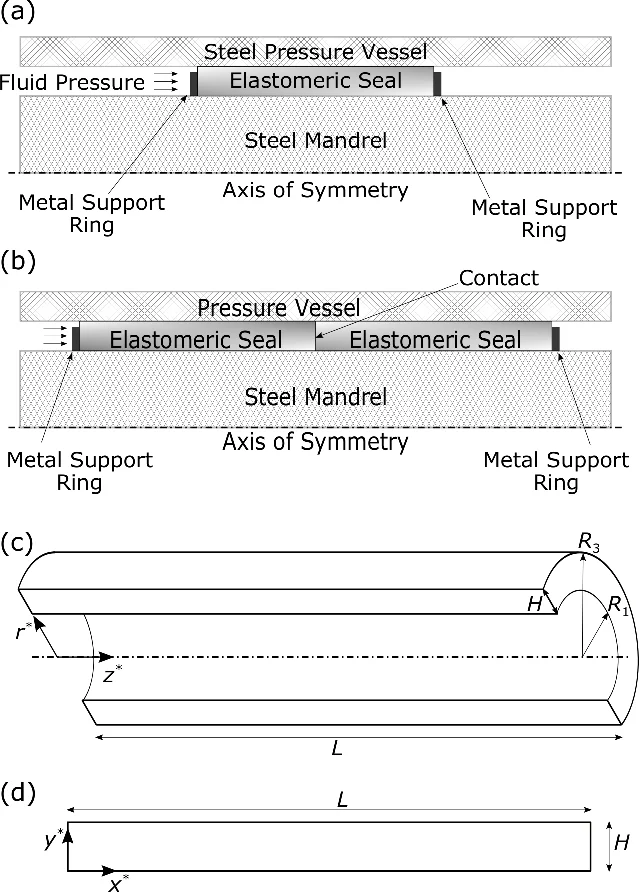
Recent experiments show no statistical impact of seal length on the performance of long elastomeric seals in relatively smooth test fixtures. Motivated by these results, we analytically and computationally investigate the combined effects of seal length and compressibility on the maximum differential pressure a seal can support. We present a Saint-Venant type analytic shear lag solution for slightly compressible seals with large aspect ratios, which compares well with nonlinear finite element simulations in regions far from the ends of the seal. However, at the high- and low-pressure ends, where fracture is observed experimentally, the analytic solution is in poor agreement with detailed finite element calculations. Nevertheless, we show that the analytic solution provides far-field stress measures that correlate, over a range of aspect ratios and bulk moduli, the calculated energy release rates for the growth of small cracks at the two ends of the seal. Thus a single finite element simulation coupled with the analytic solution can be used to determine tendencies for fracture at the two ends of the seal over a wide range of geometry and compressibility. Finally, using a hypothetical critical energy release rate, predictions for whether a crack on the high-pressure end will begin to grow before or after a crack on the low-pressure end begins to grow are made using the analytic solution and compared with finite element simulations for finite deformation, hyperelastic seals.
💡 Research Summary
The paper investigates how compressibility and aspect ratio jointly affect the pressure‑holding capacity of long elastic seals, a topic of practical relevance for oil‑field packers, hydraulic fracturing tools, and micro‑fluidic devices. Recent laboratory tests showed that doubling the seal length did not significantly change the critical differential pressure, contradicting the traditional engineering rule that seal strength scales linearly with length. To explain this, the authors develop an analytical shear‑lag (Saint‑Venant) model for a slightly compressible, high‑aspect‑ratio seal and validate it against fully nonlinear finite‑element (FE) simulations of a neo‑Hookean hyperelastic material.
Key assumptions and model formulation
- The material is linearly elastic with Lamé parameters λ (bulk) and μ (shear) such that μ/λ ≪ 1, i.e., the bulk modulus is much larger than the shear modulus.
- The seal geometry is characterized by a large aspect ratio L/H ≫ 1 (length L much greater than thickness H).
- The high‑pressure end (x = 0) is subjected to a uniform fluid pressure p₀, while the low‑pressure end (x = L) is modeled as an effective linear spring with stiffness k (derived from a separate FE analysis of the support ring).
- Plane‑strain or axisymmetric conditions are considered; the analysis is carried out for the plane‑strain case and the axisymmetric version is placed in an appendix.
Displacements are scaled with the bulk deformation, leading to a nondimensional pressure field p(x) that satisfies a one‑dimensional equilibrium equation. The governing parameter that captures compressibility effects is
\
Comments & Academic Discussion
Loading comments...
Leave a Comment