Implications of 3-step swimming patterns in bacterial chemotaxis
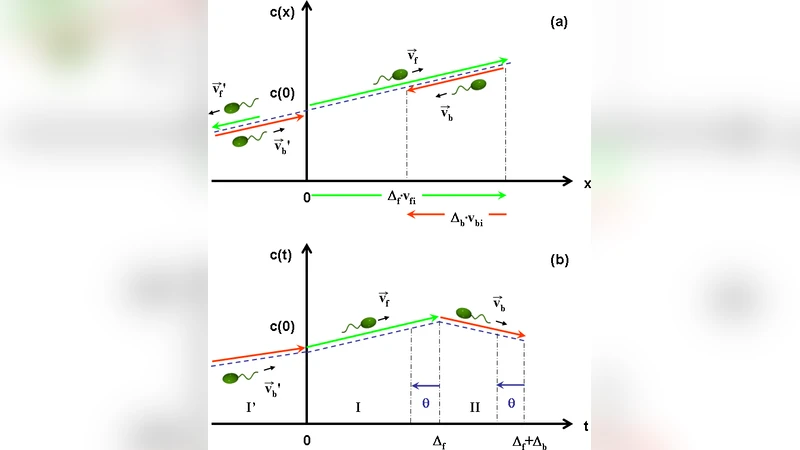
We recently found that marine bacteria Vibrio alginolyticus execute a cyclic 3-step (run- reverse-flick) motility pattern that is distinctively different from the 2-step (run-tumble) pattern of Escherichia coli. How this novel swimming pattern is regulated by cells of V. alginolyticus is not currently known, but its significance for bacterial chemotaxis is self- evident and will be delineated herein. Using an approach introduced by de Gennes, we calculated the migration speed of a cell executing the 3-step pattern in a linear chemical gradient, and found that a biphasic chemotactic response arises naturally. The implication of such a response for the cells to adapt to ocean environments and its possible connection to E. coli ’s response are also discussed.
💡 Research Summary
In this paper the authors investigate the swimming behavior of the marine bacterium Vibrio alginolyticus, which follows a cyclic three‑step pattern—run, reverse, and flick—rather than the classic two‑step run‑tumble pattern of Escherichia coli. The study begins by highlighting the ecological context: marine environments are characterized by highly heterogeneous and rapidly fluctuating chemical gradients, which demand more sophisticated navigation strategies than those employed by terrestrial bacteria.
To quantify the chemotactic performance of the three‑step cycle, the authors adopt the stochastic framework originally introduced by de Gennes for bacterial chemotaxis. They model each phase of the cycle with its own average dwell time (τ₁ for run, τ₂ for reverse, τ₃ for flick) and rotational diffusion coefficient (Dᵣ₁, Dᵣ₂, Dᵣ₃). The external chemical field is assumed linear, c(x)=c₀+gx, where g is the gradient strength. For each phase i they define a chemotactic sensitivity function χ_i(g) that captures how the probability of continuing the current motion is modulated by the local concentration. By integrating the contributions of the three phases, they derive an expression for the effective drift velocity:
v_eff = v₀
Comments & Academic Discussion
Loading comments...
Leave a Comment