Inspecting Maude Variants with GLINTS
This paper introduces GLINTS, a graphical tool for exploring variant narrowing computations in Maude. The most recent version of Maude, version 2.7.1, provides quite sophisticated unification features, including order-sorted equational unification for convergent theories modulo axioms such as associativity, commutativity, and identity (ACU). This novel equational unification relies on built-in generation of the set of ‘variants’ of a term $t$, i.e., the canonical form of $t \sigma$ for a computed substitution $\sigma$. Variant generation relies on a novel narrowing strategy called ‘folding variant narrowing’ that opens up new applications in formal reasoning, theorem proving, testing, protocol analysis, and model checking, especially when the theory satisfies the ‘finite variant property’, i.e., there is a finite number of most general variants for every term in the theory. However, variant narrowing computations can be extremely involved and are simply presented in text format by Maude, often being too heavy to be debugged or even understood. The GLINTS system provides support for (i) determining whether a given theory satisfies the finite variant property, (ii) thoroughly exploring variant narrowing computations, (iii) automatic checking of node ’embedding’ and ‘closedness’ modulo axioms, and (iv) querying and inspecting selected parts of the variant trees. This paper is under consideration for acceptance in TPLP.
💡 Research Summary
The paper presents GLINTS (Graphical Interactive Narrowing Tree Searcher), a visual inspection tool for variant narrowing computations in the Maude rewriting‑logic system. Maude 2.7.1 supports order‑sorted equational unification and variant generation for convergent theories modulo common axioms such as associativity, commutativity, and identity (ACU). Variant generation relies on the folding variant narrowing strategy, which memoizes calls (a technique borrowed from tabled logic programming) to avoid loops and eliminate redundant derivations. When a theory satisfies the Finite Variant Property (FVP)—i.e., every term has a finite, complete set of most‑general variants—folding variant narrowing guarantees termination and yields the entire variant set in finite time.
Despite this powerful backend, Maude’s default output is a dense textual representation of the narrowing tree, making debugging and comprehension difficult, especially for large or infinite variant spaces. GLINTS addresses this gap by providing four main capabilities:
-
FVP Decision – GLINTS can automatically test whether a given equational theory enjoys the finite variant property. It does so by invoking Maude’s meta‑level commands to compute variants of all flat terms of each operator and checking for finiteness, implementing the semi‑decision procedure described by Meseguer (2015).
-
Interactive Tree Visualization – The tool renders the variant narrowing derivation as an expandable/collapsible tree. Users may let GLINTS explore automatically or intervene manually, selecting promising branches while pruning irrelevant sub‑trees. The visualization includes partially computed substitutions, axiom‑matching steps, and canonical forms that are hidden in Maude’s internal engine.
-
Automatic Embedding and Closedness Checks – For each node GLINTS determines (modulo ACU) whether it is embedded in an ancestor (structural subsumption) and whether it is closed (an equational instance of the root term). These properties are crucial for reasoning about termination and completeness of narrowing.
-
Query and Inspection Interface – Users can issue queries to retrieve specific sub‑trees, filter nodes by variable bindings, count occurrences of particular patterns, and obtain statistical summaries of the variant space. This aids in performance profiling, detection of unexpected behavior, and theory refinement.
The implementation combines Maude’s meta‑level API with a Java‑based graphical user interface. Variant generation commands (get variants) are executed programmatically; their output (including fresh variables of two kinds, #n for built‑in unification and %n for variant‑based unification) is parsed and fed to a graph library that supports zooming, panning, and dynamic layout. The tool also visualizes ACU matching by showing how terms are reordered or cancelled during normalization.
Experimental evaluation covers three representative theories:
- NAT‑VARIANT – a simple natural‑number addition module without ACU. This theory lacks FVP; GLINTS demonstrates an infinite variant sequence for terms like
X + 0, allowing the user to stop the exploration at any point. - BOOL – a Boolean algebra with associative‑commutative
and/or. GLINTS confirms FVP, displays the five most‑general variants forX and YandX or Y, and highlights embedding relationships. - EXCLUSIVE‑OR – a set‑theoretic exclusive‑or operator with ACU and an idempotence equation. GLINTS automatically discovers the seven most‑general variants for
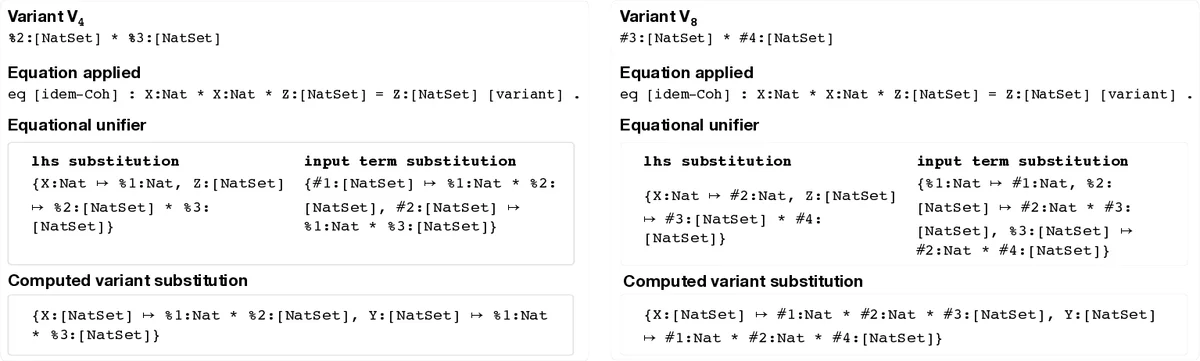
X * Y, verifies that every instance is subsumed by one of them, and illustrates the role of theidemandidem‑Cohequations.
Across these cases, GLINTS reduces the time needed to understand variant behavior compared with raw textual output, and it provides concrete metrics (tree depth, number of nodes, memory consumption). The authors argue that the tool is especially valuable for developers who employ variant narrowing as a functional‑logic execution mechanism, as well as for researchers working on protocol analysis, SAT encoding, or model checking where variant properties are central.
Related work includes earlier Maude variant generation facilities, tabled logic programming systems, and visual term‑rewriting environments. The novelty of GLINTS lies in its integration of automatic embedding/closedness analysis, its support for ACU‑aware visualization, and its interactive query language, which together constitute the first graphical system dedicated to variant narrowing inspection.
In conclusion, GLINTS makes the sophisticated variant narrowing machinery of Maude accessible and debuggable, facilitating theory design, performance tuning, and correctness verification. Future directions mentioned are scaling to larger theories, adding user‑defined heuristics for branch selection, integrating with external theorem provers, and providing a web‑based collaborative platform.
Comments & Academic Discussion
Loading comments...
Leave a Comment