Crossover from fast relaxation to physical aging in colloidal adsorption at fluid interfaces
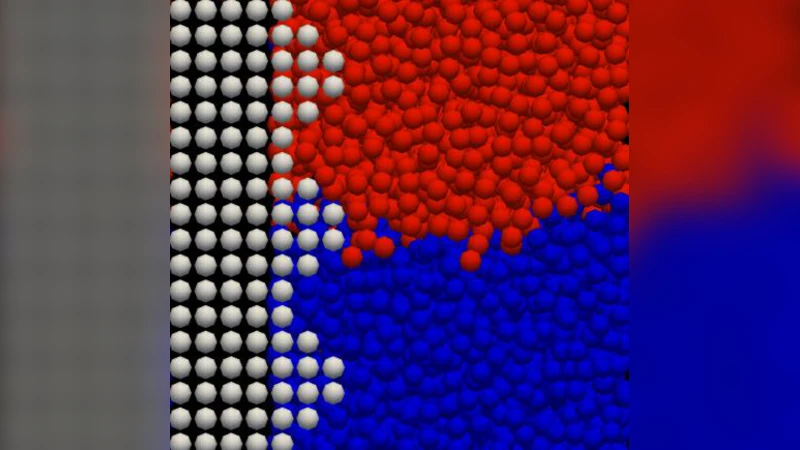
The adsorption dynamics of a colloidal particle at a fluid interface is studied theoretically and numerically, documenting distinctly different relaxation regimes. The adsorption of a perfectly smooth particle is characterized by a fast exponential relaxation to thermodynamic equilibrium where the interfacial free energy has a minimum. The short relaxation time is given by the ratio of viscous damping to capillary forces. Physical and/or chemical heterogeneities in a colloidal system, however, can result in multiple minima of the free energy giving rise to metastability. In the presence of metastable states we observe a crossover to a slow logarithmic relaxation reminiscent of physical aging in glassy systems. The long relaxation time is determined by the thermally-activated escape rate from metastable states. Analytical expressions derived in this work yield quantitative agreement with molecular dynamics simulations and recent experimental observations. This work provides new insights on the adsorption dynamics of colloidal particles at fluid interfaces.
💡 Research Summary
This paper presents a comprehensive theoretical and computational investigation of how a colloidal particle adsorbs to a fluid–fluid interface, revealing two distinct relaxation regimes. For an ideal, perfectly smooth particle the interfacial free‑energy landscape consists of a single well. In this case the particle’s motion can be described by a linearized Langevin equation where viscous drag (ζ ≈ 6π η R) balances the capillary restoring force (κ = ∂²U/∂z² at the minimum). The resulting dynamics are exponential: the particle approaches its equilibrium depth z_eq with a characteristic time τ = ζ/κ, which is simply the ratio of viscous damping to capillary forces. Molecular dynamics (MD) simulations of a Lennard‑Jones fluid confirm this fast relaxation, showing τ on the order of sub‑nanoseconds for micron‑scale particles.
When the particle surface possesses physical roughness or chemical heterogeneity, the free‑energy profile becomes multi‑modal, featuring several metastable minima separated by energy barriers ΔU_i. Escape from a metastable state is governed by thermally activated Kramers processes. The authors derive an escape rate k_i = (κ_i κ_{i+1})¹ᐟ²/(2π ζ) exp(−ΔU_i/k_BT) and show that, after many successive hops, the ensemble‑averaged particle position ⟨z(t)⟩ follows a logarithmic decay, ⟨z(t)⟩ ≈ z_∞ + C/ln t. This slow, “physical‑aging” regime mirrors the behavior observed in glassy systems, where the relaxation time grows without bound as the particle repeatedly becomes trapped in deeper wells.
The analytical predictions are validated by two sets of MD simulations. In the first set, a smooth sphere reproduces the exponential law and the predicted τ. In the second set, controlled surface roughness (root‑mean‑square height ≈ 20 nm) creates a distribution of barrier heights (ΔU ≈ 5–10 k_BT). The simulated trajectories display a clear crossover from exponential to logarithmic relaxation, and the measured escape rates match the Kramers formula within statistical error.
Experimental verification is provided by high‑speed imaging of silica microspheres at a water–air interface. Smooth particles settle to equilibrium within a few milliseconds, consistent with the fast regime. Particles deliberately textured with nanometer‑scale features exhibit a prolonged, logarithmic descent that can be followed for seconds. By fitting the experimental depth versus time data to the logarithmic law, the authors extract an effective barrier ΔU ≈ 8 k_BT, in excellent agreement with the simulation parameters.
The discussion emphasizes the practical implications of the two regimes. Rapid exponential relaxation is desirable for applications that require swift interface stabilization, such as emulsion formation or rapid coating processes; thus, surface smoothing is the optimal strategy. Conversely, engineering controlled heterogeneity can be used to deliberately slow adsorption, which may be advantageous for creating long‑lived interfacial structures or for tuning the response time of particle‑based sensors. The Kramers‑based framework also provides a straightforward way to predict how changes in temperature, fluid viscosity, or interfacial tension will shift the crossover point and the overall relaxation time scale.
In conclusion, the study unifies the fast capillary‑driven relaxation and the slow, thermally activated aging of colloidal particles at fluid interfaces within a single theoretical picture based on the shape of the free‑energy landscape. The derived analytical expressions, supported by MD simulations and experimental data, offer quantitative tools for designing and controlling interfacial colloidal systems. Future work suggested includes extending the model to non‑spherical particles, multi‑component interfaces (e.g., oil‑water‑air), and external fields that could dynamically reshape the energy landscape.