Local magnetic moments in iron and nickel at ambient and Earths core conditions
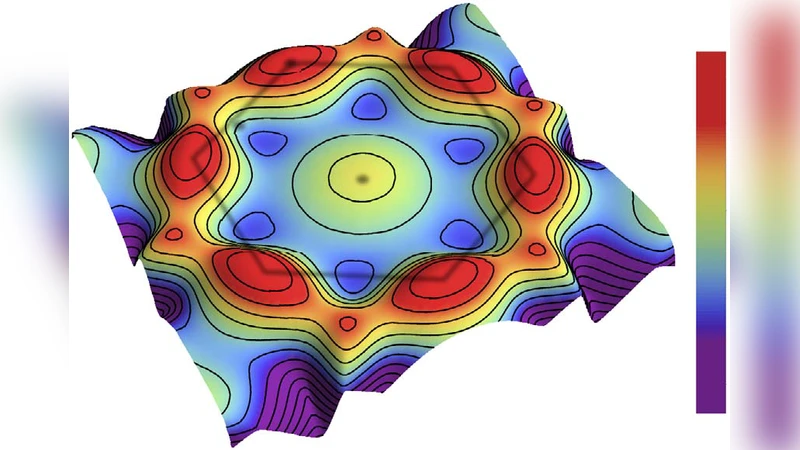
Some Bravais lattices have a particular geometry that can slow down the motion of Bloch electrons by pre-localization due to the band-structure properties. Another known source of electronic localization in solids is the Coulomb repulsion in partially filled d- or f-orbitals, which leads to the formation of local magnetic moments. The combination of these two effects is usually considered of little relevance to strongly correlated materials. Here we show that it represents, instead, the underlying physical mechanism in two of the most important ferromagnets: nickel and iron. In nickel, the van Hove singularity has an unexpected impact on the magnetism. As a result, the electron-electron scattering rate is linear in temperature, in violation of the conventional Landau theory of metals. This is true even at Earth’s core pressures, at which iron is instead a good Fermi liquid. The importance of nickel in models of geomagnetism may have therefore to be reconsidered.
💡 Research Summary
The authors investigate how the interplay between lattice‑induced band‑structure effects and strong on‑site Coulomb repulsion generates local magnetic moments in two archetypal ferromagnets, iron and nickel, under both ambient conditions and the extreme pressures found in Earth’s core. Using a state‑of‑the‑art DFT+DMFT approach, they compute the electronic density of states, magnetic moments, and electron‑electron scattering rates for Fe and Ni at pressures up to ~360 GPa and temperatures ranging from 100 K to 2000 K.
A key finding is that nickel’s face‑centered cubic lattice hosts a pronounced van Hove singularity very close to the Fermi level. This singularity causes a “pre‑localization” of Bloch electrons, dramatically enhancing their effective mass and amplifying the impact of the Hubbard‑type d‑electron correlations. As a result, Ni exhibits robust local moments that are essentially temperature‑independent, while its quasiparticle scattering rate varies linearly with temperature (τ⁻¹ ∝ T). This linear‑T behavior directly contradicts the Landau Fermi‑liquid prediction of a T² dependence and signals a non‑Fermi‑liquid regime persisting even at core pressures.
In contrast, iron lacks a comparable van Hove feature. Under ambient conditions it still forms sizable local moments, but its scattering follows the conventional T² law. When compressed to core pressures, the Fe d‑band widens, reducing electronic correlations and driving the system into a clean Fermi‑liquid state with τ⁻¹ ∝ T². Thus, Fe behaves as a good metal throughout the pressure range, whereas Ni remains anomalous.
The authors argue that this dichotomy has profound implications for geodynamo models. Conventional simulations treat the liquid outer core as an Fe‑rich, nearly free‑electron metal, neglecting any non‑Fermi‑liquid contributions. However, the Earth’s core contains a few percent nickel, and the present work shows that Ni’s linear‑T scattering and associated spin‑fluctuation dynamics could substantially modify the electrical conductivity, magnetic diffusivity, and the efficiency of magnetic field generation. Incorporating Ni’s anomalous electronic behavior may help explain observed features of the geomagnetic field, such as its long‑term variability and occasional reversals.
In summary, the paper reveals a previously underappreciated mechanism: the combination of a lattice‑driven van Hove singularity and strong d‑electron correlations creates local magnetic moments and non‑Fermi‑liquid transport in nickel, while iron remains a conventional Fermi liquid under core conditions. This insight calls for a reassessment of nickel’s role in Earth’s core physics and in models of planetary magnetism.
Comments & Academic Discussion
Loading comments...
Leave a Comment