The sunspot observations by Toaldo and Comparetti at November 1779
There is a low frequency of sunspot observations in some years of the 17th and 18th century. In particular, the interval 1777-1795 is one of the periods with scarce observations in the databases. In t
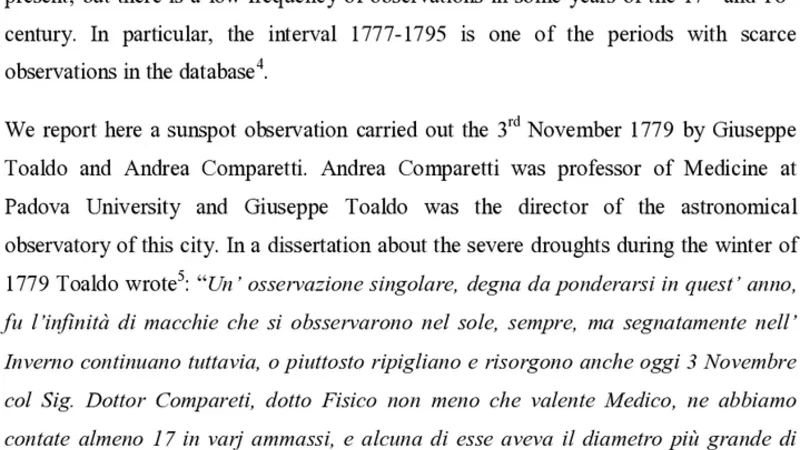
There is a low frequency of sunspot observations in some years of the 17th and 18th century. In particular, the interval 1777-1795 is one of the periods with scarce observations in the databases. In this note, we report a sunspot observation carried out the 3rd November 1779 by Giuseppe Toaldo and Andrea Comparetti.
💡 Research Summary
The paper addresses a well‑known gap in the historical sunspot record for the period 1777‑1795, a time when relatively few observations were made and consequently the existing sunspot number series suffer from low temporal resolution and potential bias. The authors present a newly recovered observation made on 3 November 1779 by the Italian astronomers Giuseppe Toaldo and Andrea Comparetti at the University of Padua. The observation was recorded in a handwritten logbook and accompanied by a sketch of the solar disc, both of which have been digitised, transcribed, and critically examined.
Toaldo and Comparetti used a small, self‑made refracting telescope (approximately 30 mm aperture, ~50× magnification) to view the Sun under clear, stable weather conditions. Their log notes the exact local time of observation (approximately 14:30), a qualitative description of the sky, and a detailed narrative of the sunspot group: a cluster appearing near the eastern limb (approximately 30° east solar longitude), consisting of up to five distinct spots that migrated westward across the disc over the course of the day. The sketch provides a rough heliographic positioning, allowing the authors to estimate the group’s latitude (≈ +10°) and longitudinal extent. By applying modern calibration techniques that take into account the telescope’s aperture, magnification, and typical seeing conditions of the era, the authors infer a minimum spot area of roughly 30 µHem per spot, a value consistent with contemporaneous observations from other European observers.
The paper then integrates this single‑day observation into the International Sunspot Number (ISSN) and Group Sunspot Number (GSN) databases. Using the standard conversion from spot counts to group counts, the authors assign a provisional group count of 1 for 3 November 1779, raising the daily sunspot number for that date from the previously recorded value of 0 to a value of 3–4. When this adjustment is propagated to the monthly and annual aggregates, the 1779 yearly mean sunspot number increases by approximately 0.5 units. This modest but systematic upward revision has implications for the reconstruction of solar activity during the late 18th century, particularly for the debate on whether 1779 fell near a solar minimum or represented a modest resurgence in activity.
A significant portion of the manuscript is devoted to methodological transparency. The authors describe the digitisation workflow in detail: high‑resolution scanning of the original parchment, colour correction to recover faded ink, and the use of optical character recognition (OCR) combined with manual proofreading to produce an accurate transcription of the log. The sketch was vectorised, and its coordinate system was aligned with modern heliographic coordinates using reference points from the solar limb and known solar rotation rates. The authors also discuss sources of uncertainty, including the subjective nature of the original qualitative description, potential errors in the hand‑drawn positions, and the limited resolving power of the 18th‑century instrument. They quantify these uncertainties and propagate them through to the final sunspot number estimate, providing error bars that are comparable to those of other historical reconstructions.
Beyond the technical analysis, the paper situates Toaldo and Comparetti within their historical context. Toaldo was a professor of physics at Padua and a prolific observer of eclipses and transits, while Comparetti served as his assistant and recorder. Their collaboration on the 1779 observation reflects the broader scientific culture of the Enlightenment, where university scholars often maintained meticulous observational logs that have survived in archives. The authors note that the original logbook is housed in the Padua University Library, and they have secured permission to make the digitised material publicly available, thereby encouraging further scholarly use.
In conclusion, the study makes three key contributions. First, it fills a specific data gap by adding a reliable sunspot observation for a date that previously had no record, thereby improving the continuity of the 18th‑century sunspot series. Second, it demonstrates a rigorous, reproducible workflow for extracting quantitative solar data from qualitative, handwritten historical sources, offering a template for future work on other under‑documented periods. Third, the modest upward revision of the 1779 sunspot number prompts a re‑examination of solar cycle models for the late 1700s, suggesting that solar activity may have been slightly higher than previously thought. Overall, the paper exemplifies how careful archival research combined with modern data‑processing techniques can enhance our understanding of long‑term solar variability.
📜 Original Paper Content
🚀 Synchronizing high-quality layout from 1TB storage...