Social contagions on weighted networks
We investigate critical behaviors of a social contagion model on weighted networks. An edge-weight compartmental approach is applied to analyze the weighted social contagion on strongly heterogenous networks with skewed degree and weight distributions. We find that degree heterogeneity can not only alter the nature of contagion transition from discontinuous to continuous but also can enhance or hamper the size of adoption, depending on the unit transmission probability. We also show that, the heterogeneity of weight distribution always hinder social contagions, and does not alter the transition type.
💡 Research Summary
This paper investigates the critical behavior of a complex contagion process on weighted networks, focusing on how heterogeneity in node degree and edge weight influences the contagion’s threshold, transition type, and final adoption size. The authors extend a generalized non‑Markovian contagion model to incorporate edge weights, defining the transmission probability across an edge (i, j) as λ₍ᵢⱼ₎ = 1 − (1 − β)^{wᵢⱼ}, where β is a unit transmission probability and wᵢⱼ is an integer weight representing the strength of the social tie. Each node can be in one of three states: susceptible (S), adopted (A), or recovered (R). A node accumulates “awareness” each time it receives a successful transmission; once its awareness reaches a preset threshold T, it becomes adopted, transmits to all its susceptible neighbors in the next step, and then recovers with probability γ (set to 1 for most of the analysis, meaning each adopted node is active for only one time step). Initially a small fraction A₀ of nodes are seeds (already at awareness T).
To capture the combined effects of degree and weight heterogeneity, the authors develop an “edge‑weight compartmental” approach. Unlike traditional heterogeneous mean‑field (HMF) theories that aggregate all edges regardless of weight, this method treats each integer weight class w separately. For a given weight w, the probability that a randomly chosen susceptible node has not been informed through an edge of weight w by time t is denoted θ_w(t). The overall non‑infection probability θ(t) is the weighted sum over all w, using the weight distribution g(w) ∝ w^{−α_w}. Node degree follows a power‑law p(k) ∝ k^{−α_k}. By writing differential equations for θ_w(t) (Eqs. 9‑13) and for the densities S(t), A(t), R(t) (Eq. 14), the authors obtain a fixed‑point equation for the steady‑state non‑infection probability θ_w(∞) (Eq. 15). This equation can have either one or three real solutions. A single solution yields a continuous increase of the final adoption size R(∞) with β, while three solutions indicate a saddle‑node bifurcation: as β crosses a critical value β_c, the system jumps abruptly from a low‑adoption to a high‑adoption branch, producing a discontinuous transition. The critical point is identified by the tangency condition d f/d θ = 0 (Eq. 17).
Numerical simulations are performed on synthetic networks generated by a generalized configuration model. Degrees are drawn from p(k) with exponent α_k, and edge weights are assigned independently from g(w) with exponent α_w. The authors explore a range of α_k (2.1 – 4.0) and α_w (2.1 – 4.0) while fixing the mean degree ⟨k⟩≈10 and mean weight ⟨w⟩≈8. Results confirm the theoretical predictions.
Key findings regarding degree heterogeneity:
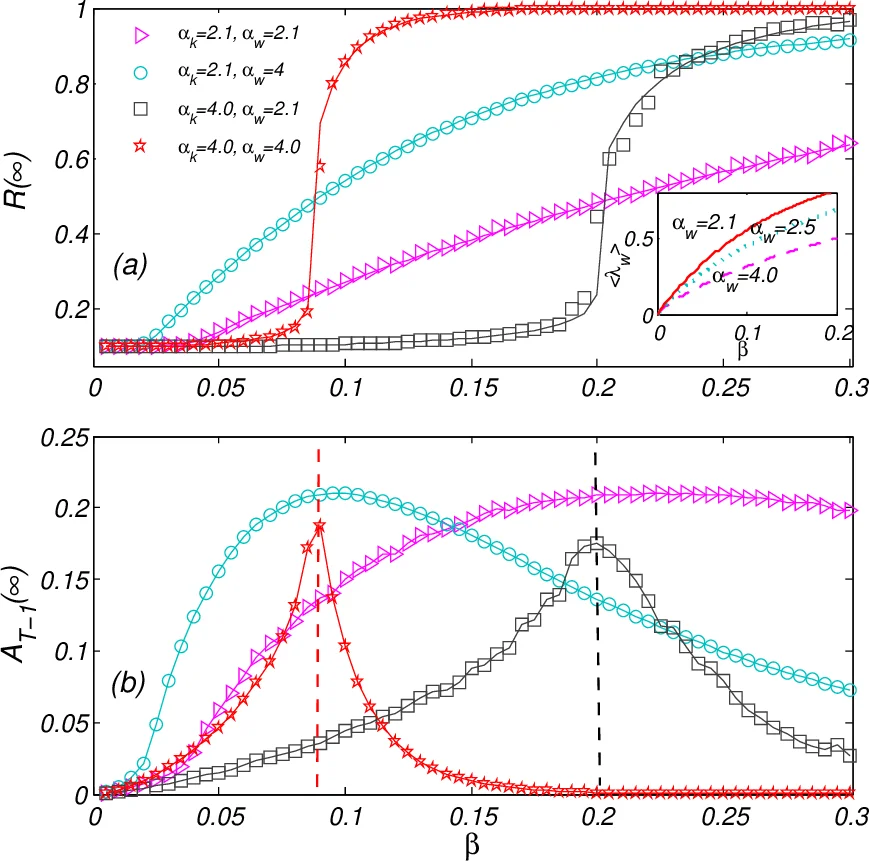
- When α_k is small (strong degree heterogeneity, e.g., α_k = 2.1), the contagion exhibits a continuous transition regardless of β; R(∞) grows smoothly as β increases.
- When α_k exceeds a critical value α_k^c ≈ 4.0, the transition becomes discontinuous. A saddle‑node bifurcation appears at β_c, leading to an abrupt jump in R(∞).
- Degree heterogeneity has a dual effect on the final adoption size: for small β, highly heterogeneous degree distributions facilitate spread (large‑degree hubs act as super‑spreaders), increasing R(∞). For large β, the same heterogeneity can suppress spread because hubs become saturated early, limiting further propagation.
Key findings regarding weight heterogeneity:
- Varying α_w does not alter the nature of the transition; the system remains either continuous or discontinuous solely based on α_k.
- Increasing weight heterogeneity (smaller α_w) consistently reduces the effective transmission rate ⟨λ⟩, thereby lowering R(∞) for any given β. In other words, a broader weight distribution hinders contagion.
- The suppression effect is monotonic: the more skewed the weight distribution, the higher the probability that many edges have low weight, which act as bottlenecks.
The authors also examine the subcritical population (nodes with awareness T − 1) and show that its peak coincides with the critical β_c in the discontinuous regime, providing an alternative empirical estimator for the transition point.
Overall, the paper demonstrates that, for complex contagions on weighted networks, degree heterogeneity governs the qualitative nature of the phase transition and can either promote or impede spread depending on the transmission strength, while weight heterogeneity uniformly dampens diffusion without changing the transition type. The edge‑weight compartmental framework offers a tractable analytical tool that accurately matches extensive simulations, filling a gap left by traditional mean‑field approaches that ignore edge weight variability.
Implications: In real social systems, both the number of contacts (degree) and the strength of each contact (weight) shape how behaviors, innovations, or misinformation propagate. Strategies aiming to accelerate diffusion should target heterogeneous degree structures (e.g., influencers) when the baseline transmission probability is low, but may need to moderate hub influence when transmission is already strong. Conversely, to curb undesirable spread, increasing the heterogeneity of tie strengths—effectively creating many weak links—can be an efficient lever, as it reduces the overall transmission probability without requiring structural changes to the degree distribution. The findings thus provide a nuanced, quantitative basis for designing interventions in social, epidemiological, and information‑diffusion contexts.
Comments & Academic Discussion
Loading comments...
Leave a Comment