Dominant K-theory and Integrable highest weight representations of Kac-Moody groups
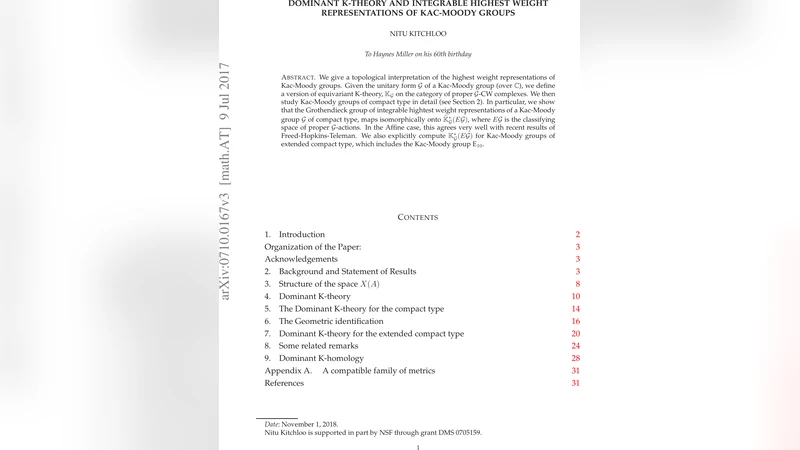
We give a topological interpretation of the highest weight representations of Kac-Moody groups. Given the unitary form G of a Kac-Moody group (over C), we define a version of equivariant K-theory, K_G on the category of proper G-CW complexes. We then study Kac-Moody groups of compact type in detail (see Section 2 for definitions). In particular, we show that the Grothendieck group of integrable hightest weight representations of a Kac-Moody group G of compact type, maps isomorphically onto K_G^(EG), where $EG$ is the classifying space of proper G-actions. For the affine case, this agrees very well with recent results of Freed-Hopkins-Teleman. We also explicitly compute K_G^(EG) for Kac-Moody groups of extended compact type, which includes the Kac-Moody group E_{10}.
💡 Research Summary
The paper introduces a new equivariant K‑theory, denoted K_G, tailored to the unitary form G of a Kac‑Moody group (over ℂ). Classical equivariant K‑theory is well‑developed for compact Lie groups or finite‑dimensional algebraic groups, but it does not directly apply to the infinite‑dimensional, non‑compact setting of Kac‑Moody groups. To overcome this, the authors define a category of proper G‑CW complexes – spaces on which G acts with finite stabilisers on each cell – and construct K_G as a G‑equivariant cohomology theory on this category using a G‑normalized K‑theory spectrum. The construction respects the infinite‑dimensional nature of G while retaining the essential functorial and homotopy‑invariant properties of equivariant K‑theory.
The central result concerns Kac‑Moody groups of compact type. For such groups the Weyl group is finite and the root system behaves much like that of a compact Lie group. The authors build a model for the classifying space of proper G‑actions, EG, by a Borel‑type construction that yields a cellular decomposition indexed by cosets of the Weyl group. By filtering EG by its skeletal filtration and applying the Atiyah–Segal completion theorem in this proper setting, they obtain a spectral sequence whose E₂‑page is expressed in terms of the representation rings of the cell stabilisers. The spectral sequence collapses, and they prove an isomorphism
K_G⁰(EG) ≅ K₀(Rep_int(G)),
where Rep_int(G) denotes the category of integrable highest‑weight representations of G, and K₀ is its Grothendieck group. In other words, the Grothendieck group of all integrable highest‑weight modules of a compact‑type Kac‑Moody group maps isomorphically onto the equivariant K‑theory of EG. This result mirrors the Freed‑Hopkins‑Teleman theorem for loop groups (the affine Kac‑Moody case), where twisted equivariant K‑theory of the compact group classifies positive‑energy representations at a fixed level. Indeed, when G is affine, the authors’ construction reproduces the FHT isomorphism, confirming that their theory correctly generalizes the known picture.
The paper then turns to “extended compact type” Kac‑Moody groups, a broader class that includes the hyperbolic group E₁₀. Here the Weyl group is infinite, and the cellular structure of EG becomes more intricate: each cell is a product of a coset complex for the finite part of the Weyl group and a contractible factor coming from the additional hyperbolic directions. By carefully analyzing the stabilisers and employing Borel‑Moore homology techniques, the authors compute K_G⁎(EG) explicitly for these groups. The resulting K‑theory groups again match the Grothendieck groups of integrable highest‑weight representations, showing that the correspondence holds beyond the compact case.
Technically, the work relies on several sophisticated tools: (1) a proper‑equivariant version of the Atiyah–Segal completion theorem, (2) Mayer–Vietoris and cellular spectral sequences adapted to infinite‑dimensional CW complexes, (3) a detailed study of fixed‑point sets for proper actions, leading to the notion of “regularised fixed points” that capture the stabiliser data needed for K‑theory calculations, and (4) a decomposition of the Kac‑Moody root system into finite and infinite components, which allows the authors to isolate the finite‑type cellular part of EG.
The significance of the results is twofold. First, they provide a topological model for the representation theory of Kac‑Moody groups, placing integrable highest‑weight modules on the same footing as vector bundles in equivariant K‑theory. This bridges a gap between infinite‑dimensional algebraic structures and homotopy‑theoretic invariants. Second, the explicit computations for groups such as E₁₀ open a pathway to applying these ideas in mathematical physics, where such hyperbolic Kac‑Moody symmetries appear in attempts to describe hidden symmetries of supergravity and M‑theory. By translating representation‑theoretic data into K‑theoretic classes, one gains access to powerful tools from topology (e.g., index theory, fixed‑point formulas) that could be used to study anomalies, dualities, and quantisation conditions in theories with infinite‑dimensional symmetry.
In summary, the authors construct a proper equivariant K‑theory for unitary Kac‑Moody groups, prove that for compact‑type groups its K‑theory of the classifying space EG coincides with the Grothendieck group of integrable highest‑weight representations, verify compatibility with the Freed‑Hopkins‑Teleman theorem in the affine case, and extend the computation to extended compact type, including the hyperbolic group E₁₀. The work not only generalises known results but also furnishes a new topological framework for studying infinite‑dimensional symmetries in both mathematics and theoretical physics.
Comments & Academic Discussion
Loading comments...
Leave a Comment