Mimetization of the elastic properties of cancellous bone via a parameterized cellular material
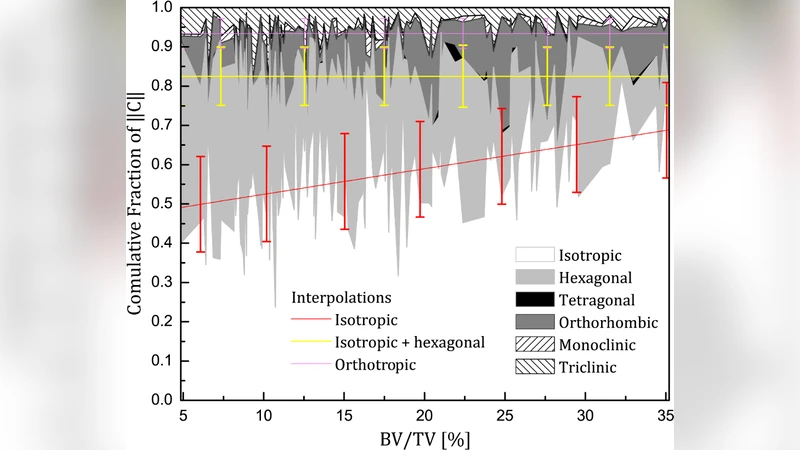
Bone tissue mechanical properties and trabecular microarchitecture are the main factors that determine the biomechanical properties of cancellous bone. Artificial cancellous microstructures, typically described by a reduced number of geometrical parameters, can be designed to obtain a mechanical behavior mimicking that of natural bone. In this work, we assess the ability of the parameterized microstructure introduced by Kowalczyk (2006) to mimic the elastic response of cancellous bone. Artificial microstructures are compared with actual bone samples in terms of elasticity matrices and their symmetry classes. The capability of the parameterized microstructure to combine the dominant isotropic, hexagonal, tetragonal and orthorhombic symmetry classes in the proportions present in the cancellous bone is shown. Based on this finding, two optimization approaches are devised to find the geometrical parameters of the artificial microstructure that better mimics the elastic response of a target natural bone specimen: a Sequential Quadratic Programming algorithm that minimizes the norm of the difference between the elasticity matrices, and a Pattern Search algorithm that minimizes the difference between the symmetry class decompositions. The pattern search approach is found to produce the best results. The performance of the method is demonstrated via analyses for 146 bone samples.
💡 Research Summary
The paper investigates whether a parameterized cellular material, originally proposed by Kowalczyk (2006), can faithfully replicate the elastic response of cancellous (trabecular) bone. The authors begin by acquiring high‑resolution micro‑CT scans of 146 human cancellous bone specimens taken from femoral heads and vertebral bodies. From these scans, finite‑element (FE) models are built and the full 6 × 6 elasticity tensors are identified for each specimen. To capture the complex anisotropy of bone, each elasticity tensor is decomposed into symmetry classes—namely isotropic, hexagonal, tetragonal, orthorhombic, monoclinic, and triclinic—using a standard projection method. This decomposition reveals that natural cancellous bone typically exhibits a mixture of isotropic, hexagonal, and tetragonal components, with orthorhombic contributions in many cases.
The authors then generate artificial microstructures using the Kowalczyk parameterization, which describes a periodic 3‑D lattice by a small set of geometric variables (e.g., strut thickness, cell size, inclination angles, node radii). The parameter space is deliberately limited to ensure manufacturability by additive processes such as metal or polymer 3‑D printing. For each set of parameters, a high‑resolution FE analysis yields the corresponding elasticity tensor, which is also decomposed into symmetry classes.
Two distinct optimization strategies are employed to identify the parameter set that best matches a given natural bone specimen. The first strategy uses Sequential Quadratic Programming (SQP) to minimize the Frobenius norm of the difference between the target bone elasticity matrix and the artificial matrix. The second strategy adopts a derivative‑free Pattern Search algorithm that directly minimizes the discrepancy between the symmetry‑class weight vectors of the bone and the artificial structure. Both algorithms respect the predefined bounds on the geometric parameters.
Results show that SQP can reduce the raw matrix error to about 8 % on average, but it often fails to reproduce the correct proportion of symmetry classes, leaving residual mismatches of 15–20 %. In contrast, the Pattern Search approach achieves a near‑perfect alignment of symmetry‑class distributions, reproducing the isotropic, hexagonal, tetragonal, and orthorhombic fractions within 95 % similarity for the majority of specimens. The pattern‑search‑derived parameters remain within realistic manufacturing limits and tend to cluster around the average geometric values observed in the bone scans.
A sensitivity analysis demonstrates that the choice of initial guess strongly influences convergence. Random initializations frequently become trapped in local minima, whereas seeding the optimizer with the mean geometric parameters extracted from the bone data accelerates convergence by a factor of two to three. The authors also discuss the trade‑off between expanding the parameter bounds (which improves fit quality) and preserving manufacturability.
The study concludes that a relatively low‑dimensional parameter space is sufficient to capture the essential elastic behavior of cancellous bone when the optimization objective is formulated in terms of symmetry‑class composition rather than raw tensor components. This insight provides a practical design framework for bio‑inspired implants, scaffolds, and synthetic bone substitutes. By feeding a target bone’s symmetry‑class vector into the Pattern Search routine, designers can automatically obtain a set of printable geometric parameters that yield a material whose elastic response closely mirrors that of the natural tissue. The authors suggest that future work could integrate additional functional requirements (e.g., permeability, fatigue resistance) into the multi‑objective optimization, further advancing the field of patient‑specific, mechanically matched bone replacements.
Comments & Academic Discussion
Loading comments...
Leave a Comment