On A New Form of Darboux-B"acklund Transformation for DNLS Equation-Mixed and Rational Type Solutions
A new form of Darboux-B"acklund transformation and its higher order form is derived for Derivative Nonlinear Schrodinger Equation(DNLS). The new form arises due to the different form of Lax pair. It is observed that by a special choice of the eigenvalue of DB transformation one can generate a mixed form of solution(containing both algebraic and exponential dependence on (x, t) can be generated. On the other hand by adopting a new methodology due to Neugebauer et. al. it is found that purely rational solution can be constructed. The two different approach yields different class of solution and are compared.
💡 Research Summary
The paper presents a novel Darboux‑Bäcklund transformation (DBT) for the derivative nonlinear Schrödinger (DNLS) equation, together with a higher‑order extension, and demonstrates how this new formulation yields both mixed exponential‑polynomial (“mixed‑rational”) and purely rational solutions.
Starting from the DNLS system
( q_t + i q_{xx} + (r q^2)x = 0,\qquad r_t - i r{xx} + (r^2 q)x = 0, )
the authors adopt a Lax pair that differs from the conventional one: the spatial and temporal matrices contain only λ² and higher powers, with no λ‑free term. This structural change forces the DBT matrix to be quadratic in the spectral parameter,
( D(\lambda)=\lambda^{2}!\begin{pmatrix}a{2}&0\0&d_{2}\end{pmatrix}+\lambda!\begin{pmatrix}0&b_{1}\c_{1}&0\end{pmatrix}+\begin{pmatrix}a_{0}&0\0&d_{0}\end{pmatrix}, )
instead of the usual linear ansatz. Imposing the compatibility condition ( D_x = M’ D - D M,; D_t = N’ D - D N ) leads to explicit expressions for the coefficients (eqs. 15‑16) in terms of two eigenvalues λ₁, λ₂ and the associated eigenfunctions ψ, φ. The transformed fields ( q’, r’ ) are then given by eqs. 17‑18, where the key factor
( \Lambda(\lambda_2,\lambda_1)=\lambda_2\psi_1\phi_2-\lambda_1\psi_2\phi_1 )
contains a combination of exponential phases and algebraic functions (Θ, eq. 19‑20). Consequently, ( q’ ) and ( r’ ) display a hybrid dependence on (x,t): polynomial factors multiplied by exp(±x±t).
The authors also construct the second‑order DBT by applying a new operator ( D_1(\lambda) ) to the already transformed eigenfunction. The resulting fields ( q’’ , r’’ ) (eq. 23) retain the mixed structure and illustrate how multi‑soliton or higher‑order breathers can be generated systematically.
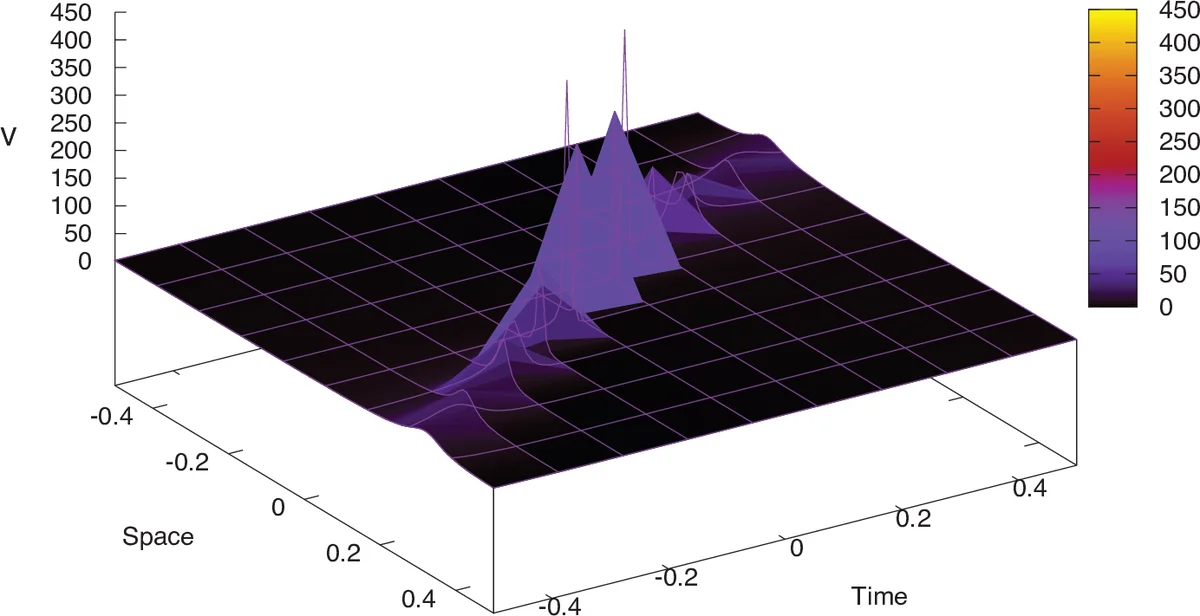
Two seed‑solution scenarios are examined. (i) Constant background ( q_0, r_0 ) with eigenvalue ( \lambda=\sqrt{q_0 r_0} ) yields a simple mixed solution (eq. 28) where the polynomial part is linear in x and t while the exponential part is a pair of traveling waves. (ii) A non‑constant background ( q = q_0 e^{-i q_0^2 x},; r = -q_0 e^{i q_0^2 x} ) together with eigenvalues ( \lambda = i q_0 \pm \tfrac12 ) produces a more intricate mixed solution (eqs. 30‑31) involving higher‑order polynomials and complex phase factors. Numerical plots (Figs. 1‑4) illustrate the spatiotemporal evolution of these mixed‑rational waves.
In parallel, the paper adopts the Neugebauer method, which rewrites the Lax operator as ( L = \lambda^2 L_2 - \lambda L_1 ) and seeks a transformation matrix ( P(\lambda) = \sum_{j=0}^{N} \lambda^j P_j ) satisfying ( L P = P_x + P L_0 ). By expanding this condition, the authors derive linear algebraic relations for the coefficients ( B_{N-1}, C_{N-1} ) (eqs. 38‑40) in terms of determinants Δ built from the eigenfunction components (eqs. 41‑44). Crucially, when the single eigenvalue is chosen as ( \lambda = \sqrt{q_0 r_0} ) or ( \lambda = i q_0 \pm \tfrac12 ), the auxiliary quantities β_i become rational functions of x and t, and the transformed fields ( q’, r’ ) turn out to be purely rational (no exponential factors). This demonstrates that the Neugebauer approach can generate rational solitons using only one eigenvalue and one eigenfunction, in contrast to the traditional DBT which requires a pair.
The paper concludes by contrasting the two methodologies. The conventional DBT, with its quadratic λ‑dependence, is capable of producing mixed exponential‑polynomial structures but involves more elaborate algebra and a delicate choice of two eigenvalues. The Neugebauer scheme is algebraically simpler, needs only a single spectral parameter, and directly yields rational solutions, making it attractive for constructing rogue‑wave‑type or algebraic solitons. Both techniques enrich the solution space of the DNLS equation, offering new families of multi‑soliton, mixed‑type, and rational waveforms that could be relevant for optical fiber communications, plasma physics, and other areas where DNLS‑type models arise.
Comments & Academic Discussion
Loading comments...
Leave a Comment