Gravitational waves 100 years after Einstein
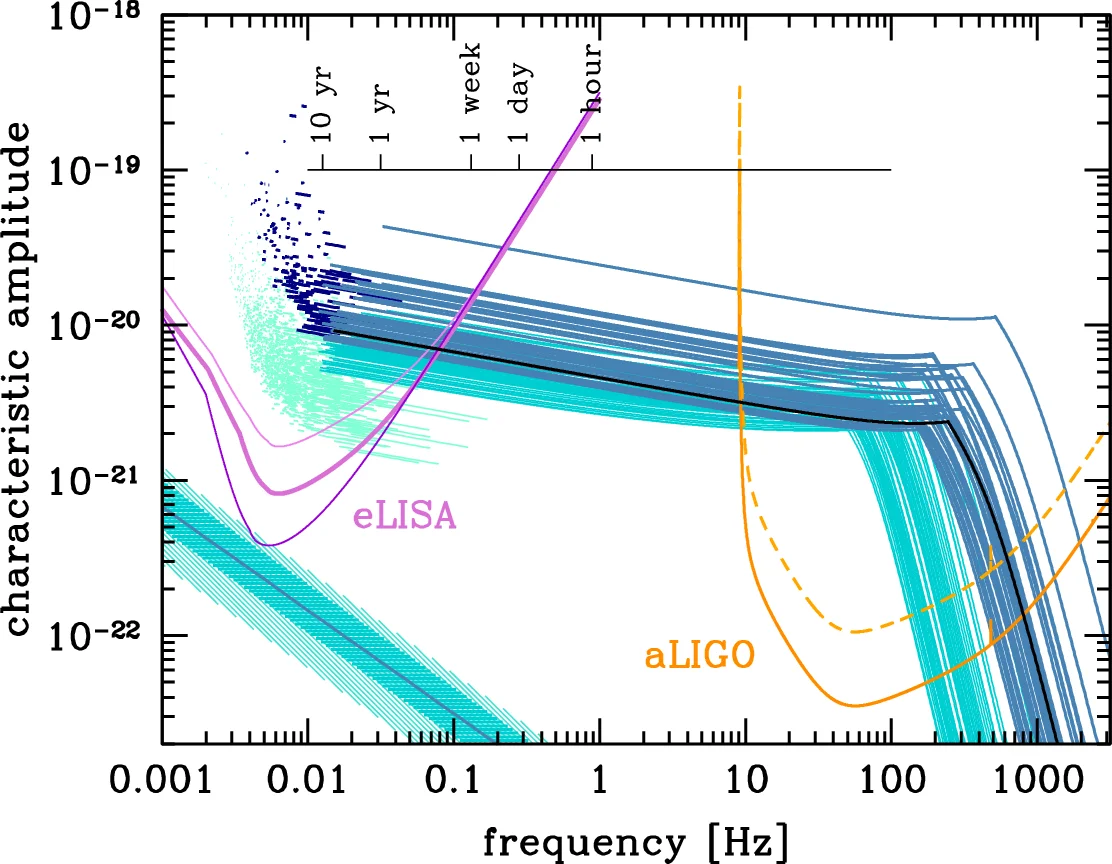
The LIGO-VIRGO collaboration has detected directly on Earth the gravitational wave signals generated by the collision and the merger of two massive black holes at astronomical distance. This major discovery opens up the way to Gravitational Astronomy, which should revolutionize our comprehension of the structure of the Universe at large scales, with notably the mechanisms of formation of black holes and their role in the evolution of the Universe, the likely emergence of a multi-messenger astronomy joint with electromagnetic radiation, and a better appraisal of the status of general relativity with respect to other fundamental interactions. The theoretical and numerical works on the two-body problem in general relativity play a very important role when deciphering and interpreting the gravitational wave signals.
💡 Research Summary
The paper provides a comprehensive review of the state of gravitational‑wave science a century after Einstein’s prediction, focusing on the landmark direct detections made by the LIGO‑VIRGO collaboration in 2015. It begins with a historical overview, reminding the reader that the concept of gravitational radiation dates back to Poincaré (1906) and was formalised by Einstein in 1916‑1918 through the quadrupole formula. The author recounts the long‑standing controversy over the physical reality of gravitational waves, noting early scepticism from Eddington and even Einstein himself, and explains how rigorous work by Bondi, Sachs, and Penrose in the 1960s finally demonstrated that gravitational waves carry energy and momentum, making detection conceivable.
The paper then moves to the first indirect evidence: the orbital decay of the binary pulsar PSR B1913+16 discovered by Hulse and Taylor in 1974, whose measured period decrease matches the quadrupole prediction to high precision. This established the first experimental confirmation of gravitational‑wave emission and set the stage for direct detection.
The core of the article describes the 14 September 2015 event GW150914 and the subsequent GW151226 detection. It explains the interferometric technique, the 7 ms time delay between the Hanford and Livingston detectors, and the strain amplitude of order 10⁻²¹. By analysing the chirp signal—frequency increasing as the binary spirals inward—the author shows how the “chirp mass” (\mathcal{M}= \mu^{3/5}M^{2/5}) can be extracted directly from the frequency evolution. For GW150914 the chirp mass is about 30 M⊙, leading to component masses of roughly 36 M⊙ and 29 M⊙, and a final black‑hole remnant of 62 M⊙. The mass deficit of ~3 M⊙ is radiated away as gravitational‑wave energy, corresponding to ~5 × 10⁴⁷ J released in a fraction of a second—a power output of ~10⁴⁹ W, comparable to the total electromagnetic output of thousands of supernovae.
A substantial portion of the paper is devoted to the theoretical problem of two compact bodies in general relativity. It outlines the post‑Newtonian (PN) expansion, which provides analytic waveforms up to 3.5 PN order for the inspiral phase, and emphasizes that higher‑order terms are essential for matching the observed phase evolution within a fraction of a radian. However, as the binary approaches merger, the PN series breaks down because the gravitational field becomes strong and highly dynamical. At this stage, numerical relativity (NR) simulations are indispensable. The author discusses the effective‑one‑body (EOB) formalism, which blends high‑order PN results with NR calibrated waveforms to produce accurate templates across the entire signal—from inspiral through merger to ringdown.
The paper also highlights the broader implications of gravitational‑wave astronomy. The detection of binary black‑hole mergers opens a new observational window that is essentially immune to dust and gas, allowing us to probe the population of massive black holes throughout cosmic history. When combined with electromagnetic, neutrino, or cosmic‑ray observations, gravitational waves enable true multi‑messenger astronomy, offering unprecedented constraints on the equation of state of neutron‑star matter, the rate of binary formation, and tests of general relativity in the strong‑field regime. The author points out that future upgrades to the current detectors and the planned third‑generation facilities (e.g., Einstein Telescope, Cosmic Explorer) will extend sensitivity to lower frequencies and greater distances, making it possible to detect mergers involving intermediate‑mass black holes, neutron‑star binaries, and possibly even primordial sources.
In conclusion, the article underscores that the direct observation of gravitational waves not only validates a century‑old prediction of general relativity but also inaugurates a transformative era for astrophysics. The synergy between sophisticated analytical methods (high‑order PN, EOB) and large‑scale numerical simulations is crucial for interpreting the rich information encoded in the waveforms. As detector sensitivity improves, gravitational‑wave astronomy will increasingly intersect with traditional electromagnetic astronomy, leading to a comprehensive, multi‑messenger view of the Universe.
Comments & Academic Discussion
Loading comments...
Leave a Comment