Improved Approximate Rips Filtrations with Shifted Integer Lattices
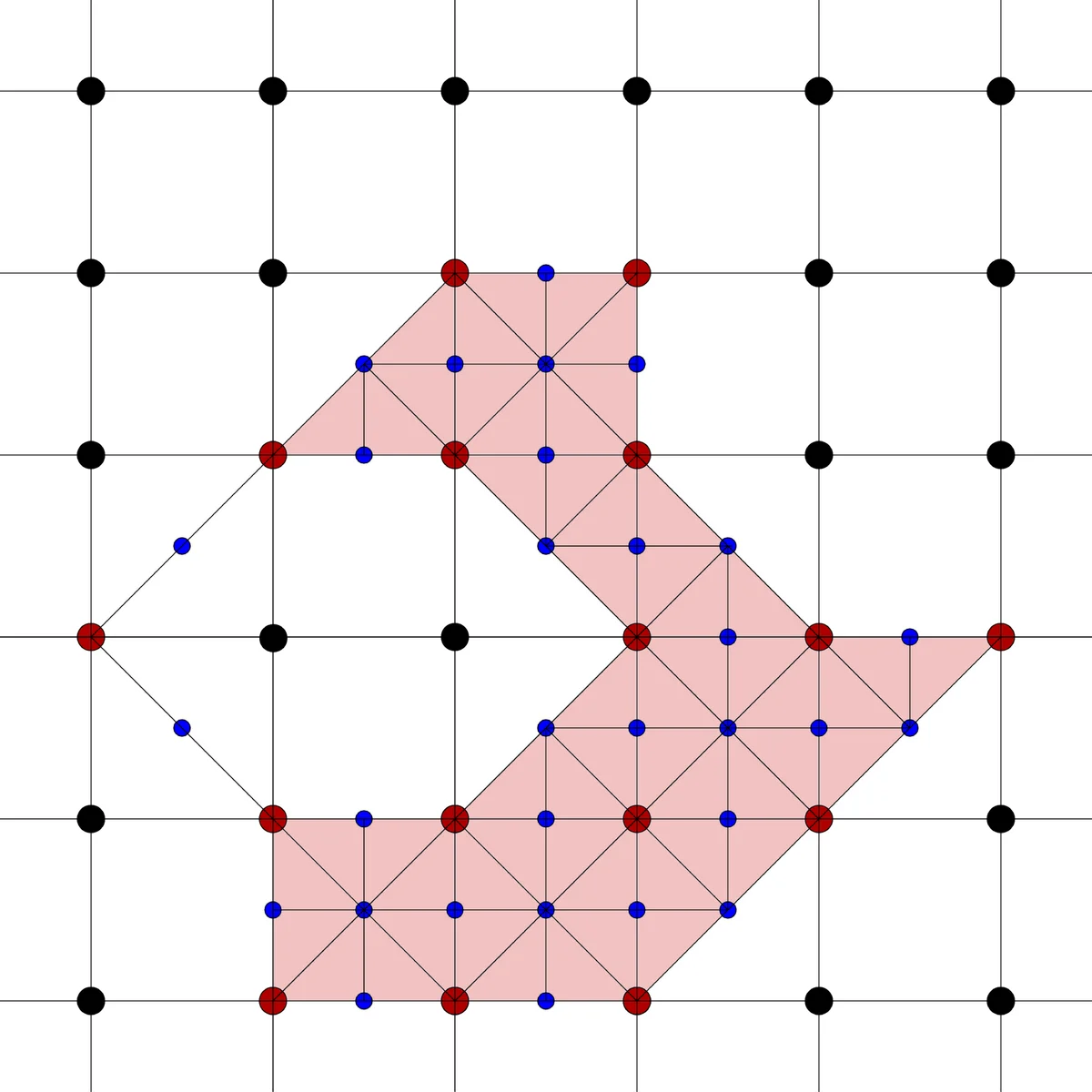
Rips complexes are important structures for analyzing topological features of metric spaces. Unfortunately, generating these complexes constitutes an expensive task because of a combinatorial explosion in the complex size. For $n$ points in $\mathbb{R}^d$, we present a scheme to construct a $3\sqrt{2}$-approximation of the multi-scale filtration of the $L_\infty$-Rips complex, which extends to a $O(d^{0.25})$-approximation of the Rips filtration for the Euclidean case. The $k$-skeleton of the resulting approximation has a total size of $n2^{O(d\log k)}$. The scheme is based on the integer lattice and on the barycentric subdivision of the $d$-cube.
💡 Research Summary
The paper addresses the well‑known combinatorial explosion of Vietoris‑Rips complexes when applied to point clouds in ℝ^d. For a set of n points, the full k‑skeleton of the Rips filtration contains Θ(n^{k+1}) simplices, making direct computation infeasible even for modest values of k. The authors propose a novel approximation scheme that leverages shifted integer lattices and the barycentric subdivision of d‑cubes to construct a compact surrogate for the multi‑scale Rips filtration.
The core construction works in the L∞ norm. A hierarchy of grids {G_s} is defined, each grid being a scaled and randomly shifted copy of the integer lattice. The shift guarantees that every point of a finer grid lies in the Voronoi cell of a unique point of the coarser grid, which in turn ensures a clean nesting of cells across scales. For each scale α_s = λ·2^{s}, the algorithm marks “active” grid points that are close to the input data. Rather than connecting all active points indiscriminately (which would re‑introduce combinatorial blow‑up), the authors restrict attention to a selected set of active faces of the cubical complex induced by the grid. The cubical complex consists of all axis‑aligned cubes whose vertices are integer lattice points; each active face is a k‑dimensional sub‑cube that contains at least one data point within a prescribed distance.
To obtain a simplicial complex from these active faces, the authors apply the barycentric subdivision of the cubical complex. This subdivision converts each active cube into a collection of simplices while preserving the homotopy type. The resulting simplicial complex X_α approximates the L∞‑Rips complex R_α at the same scale.
A major technical contribution is the use of acyclic carriers instead of explicit simplicial maps to establish interleavings between the true Rips filtration and the approximation. An acyclic carrier Φ assigns to each simplex σ of the Rips complex a non‑empty, acyclic subcomplex Φ(σ) of X_α, respecting face inclusions. By the Acyclic Carrier Theorem, such a carrier guarantees the existence of a chain map C_(R_α) → C_(X_α) that is unique up to homology. This bypasses the cumbersome construction of explicit simplicial maps required in earlier works and yields a more flexible, dimension‑independent proof of interleaving.
The interleaving obtained directly yields a multiplicative approximation factor c = 3√2 for the L∞‑Rips filtration. The authors introduce a scale‑balancing trick: by redefining the approximation complex at a rescaled parameter X′α = X{α/√c}, the interleaving maps become R_α ↔ X′_α with factor √c. Applying this to the Euclidean norm (via the well‑known equivalence between L∞ and ℓ_2 norms) reduces the approximation factor to O(d^{0.25}), a substantial improvement over their earlier O(d) result.
Size analysis shows that the number of active faces at any scale is bounded by n·2^{O(d)}; the barycentric subdivision adds a factor of 2^{O(d log k)} for the k‑skeleton. Consequently, the total number of simplices in the approximation’s k‑skeleton is n·2^{O(d log k)}. This bound holds uniformly across all scales, unlike previous methods that only guarantee size bounds for a single scale. The running time is dominated by constructing the shifted grids, locating active points, and performing the subdivision, yielding a worst‑case complexity of O(n·2^{O(d)}·log Δ + 2^{O(d)}·M), where Δ is the spread of the point set (diameter divided by the minimal inter‑point distance) and M is the size of the final approximation.
The paper also discusses how the scheme can be combined with dimensionality‑reduction techniques (e.g., Johnson‑Lindenstrauss embeddings). After reducing the ambient dimension, the same lattice‑based approximation can be applied, further decreasing the exponential dependence on d and improving practical performance.
In summary, the authors present a clean, lattice‑driven approximation pipeline for multi‑scale Rips filtrations that achieves:
- A 3√2 multiplicative guarantee for L∞‑Rips, translating to O(d^{0.25}) for Euclidean Rips.
- A k‑skeleton size of n·2^{O(d log k)} and overall complex size n·2^{O(d)}.
- An elegant interleaving proof via acyclic carriers, avoiding explicit simplicial maps.
- A scale‑balancing technique that halves the approximation exponent.
- Compatibility with standard dimensionality‑reduction methods.
These contributions collectively push the frontier of scalable topological data analysis, making persistent homology computations feasible for higher‑dimensional point clouds without sacrificing provable approximation quality.
Comments & Academic Discussion
Loading comments...
Leave a Comment