Notes on Artin-Tate motives
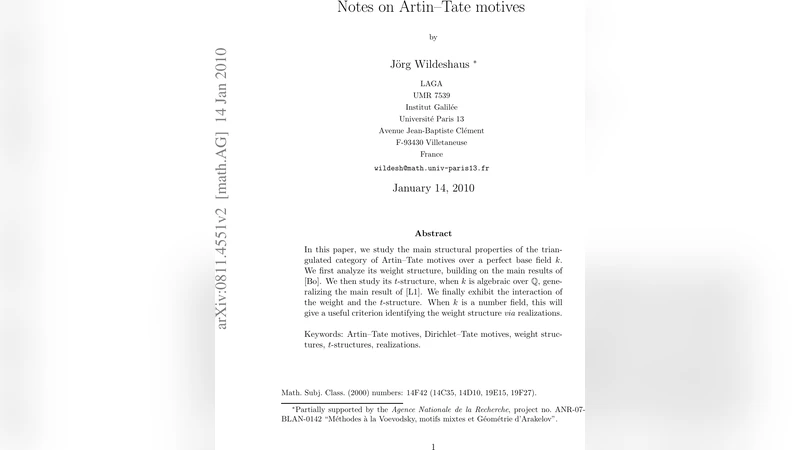
We first study the weight structure on the triangulated category of Artin-Tate motives over a perfect base field k, building on results of Bondarko’s. We then study the t-structure on the triangulated category of Artin-Tate motives, when k is algebraic over the rationals, generalizing a result of Levine’s. We finally study the interaction of the weight structure and the t-structure. When k is a number field, this will give a useful criterion identifying the weight structure via realizations.
💡 Research Summary
The paper investigates two fundamental categorical structures—weight structures and t‑structures—on the triangulated category of Artin‑Tate motives over a perfect base field k, and studies how they interact. After recalling the construction of the Artin‑Tate subcategory DM_{AT}(k) of Voevodsky’s triangulated motives (the smallest tensor‑closed subcategory generated by finite‑dimensional Artin motives and pure Tate motives), the author first adapts Bondarko’s theory of weight structures to this setting. By defining the subcategories DM_{AT}^{w≤0} and DM_{AT}^{w≥0} in terms of Tate twists and the usual dimension function, the author proves that they satisfy the axioms of a weight structure. The heart of this weight structure, denoted (\mathcal{HW}), is identified with the abelian category of finite‑dimensional Galois representations together with integral Tate twists; in other words, objects of weight zero are precisely the “integral‑weight” Artin‑Tate motives. Moreover, the weight structure is shown to be compatible with Tate twists, i.e. (\mathcal{HW}(1)=\mathcal{HW}).
The second major part of the work concerns t‑structures. When k is algebraic over (\mathbb{Q}), Levine’s construction of a t‑structure on the category of mixed Tate motives can be extended to the larger Artin‑Tate context. The author defines a pair of subcategories DM_{AT}^{≤0} and DM_{AT}^{≥0} that satisfy the t‑structure axioms and whose heart (\mathcal{HT}) consists of “integral‑weight” Artin‑Tate motives, i.e. extensions of finite‑dimensional Galois representations by integral Tate objects. This t‑structure is shown to be compatible with the previously constructed weight structure: both are weight‑exact and t‑exact, and there exists a natural tilting equivalence between the two hearts. Consequently, the weight filtration supplied by the weight structure and the cohomological filtration supplied by the t‑structure are mutually compatible, providing a richer “weight‑cohomology” picture for Artin‑Tate motives.
The interaction of the two structures is explored in depth. The author proves that the weight heart (\mathcal{HW}) embeds fully faithfully into the t‑heart (\mathcal{HT}) via a tilting functor, and that this embedding is essentially surjective after passing to the derived category. This yields a precise description of how an object of weight zero can be regarded as a complex concentrated in degree zero with respect to the t‑structure, and vice versa. The paper also discusses how this relationship mirrors the classical picture for mixed Hodge structures, where the weight filtration and the Hodge filtration are compatible.
A particularly useful contribution is the criterion for recognizing the weight structure via realizations when k is a number field. The author shows that ℓ‑adic, Betti, and Hodge realizations all preserve the weight structure: the ℓ‑adic realization functor sends the weight heart (\mathcal{HW}) to the category of integral ℓ‑adic Galois representations of weight zero, while the Betti and Hodge realizations send it to pure Hodge structures of type (0,0). Consequently, one can detect whether an object lies in (\mathcal{HW}) by checking its realizations, providing a concrete computational tool. Moreover, these realizations are also t‑exact with respect to the t‑structure, so they simultaneously respect both filtrations.
In the concluding section, the author emphasizes the significance of having both a weight structure and a t‑structure on the same triangulated category. This dual structure offers a refined framework for studying L‑functions, special values, and conjectural relations such as the Bloch‑Kato conjecture within the Artin‑Tate setting. The paper also outlines future directions, including extending the analysis to more general mixed motives beyond the Artin‑Tate case, and investigating how the interaction of weight and t‑structures behaves under various functorial operations (e.g., push‑forward, pull‑back, and tensor products). Overall, the work provides a comprehensive and technically solid foundation for further exploration of the categorical and arithmetic aspects of Artin‑Tate motives.
Comments & Academic Discussion
Loading comments...
Leave a Comment