Experiments, numerical simulations and an analytic model were developed to elucidate the effects of noise in the synchronized state of a tunnel junction based spin torque nano oscillator (STNO). It is demonstrated that in the in plane magnetized structure, while the frequency is locked, much higher reference currents are needed to reduce the noise by phase locking. Our analysis shows that it is possible to control the phase noise by the reference microwave current (IRF) and that it can be further reduced by increasing the bias current (IDC) of the oscillator, keeping the reference current in feasible limits for applications.
Deep Dive into Injection locking at 2f of spin torque oscillators under influence of thermal noise.
Experiments, numerical simulations and an analytic model were developed to elucidate the effects of noise in the synchronized state of a tunnel junction based spin torque nano oscillator (STNO). It is demonstrated that in the in plane magnetized structure, while the frequency is locked, much higher reference currents are needed to reduce the noise by phase locking. Our analysis shows that it is possible to control the phase noise by the reference microwave current (IRF) and that it can be further reduced by increasing the bias current (IDC) of the oscillator, keeping the reference current in feasible limits for applications.
1
Injection locking at 2f of spin torque oscillators under influence of thermal
noise
M. Tortarolo1*, B. Lacoste1**, J. Hem1, C. Dieudonné1, M.-C. Cyrille2, J. A. Katine3, D.
Mauri3, A. Zeltser3, L.D. Buda-Prejbeanu1, U. Ebels1
1Univ. Grenoble Alpes, CEA, INAC-SPINTEC, CNRS, SPINTEC, 38000 Grenoble, France
2Univ. Grenoble Alpes, CEA-LETI MINATEC-CAMPUS, 38000 Grenoble, France
3HGST, 3403 Yerba Buena Road, San Jose, California 95135, USA
Experiments, numerical simulations and an analytic model were
developed to elucidate the effects of noise in the synchronized state of a tunnel
junction based spin torque nano oscillator (STNO). It is demonstrated that in the in-
plane magnetized structure, while the frequency is locked, much higher reference
currents are needed to reduce the noise by phase locking. Our analysis shows that it is
possible to control the phase noise by the reference microwave current (IRF) and that
it can be further reduced by increasing the bias current (IDC) of the oscillator, keeping
the reference current in feasible limits for applications.
I. INTRODUCTION
A spin polarized current passing
through
a
magnetic
multi-layered
nanosystem can drive its magnetization into
large amplitude periodic oscillations 1,2,3
when the spin polarized current is large
enough to compensate the natural damping.
These spin transfer driven magnetization
oscillations, together with their particular
nonlinear properties4 spurred the interest in
STNO’s for several applications in current
controlled
microwave
devices5.
Nevertheless, one of the main issues that
remains to be addressed for these spin
STNO’s is their relative large linewidth. One
possibility to reduce the linewidth is to
couple either different layers within an
oscillator6, or to couple several oscillators.
For this second case, several options were
proposed, experimentally and theoretically:
current
mediated
coupling7,8,
dipolar
coupling9,10
or
spin
wave
coupled
nanocontacts11,12. In order to understand the
conditions for electric synchronization of
several oscillators by their own emitted RF
current, we studied the synchronization of an
STNO to a reference current source, with
known spectral specifications. Here we focus
on standard uniform in plane magnetized
oscillators (in-plane polarizer and in-plane
free layer, IP), for which an in-plane
precession (IPP) mode is stabilized. The
injection locking of such an STNO to a
reference current at two times the generated
frequency (2f) was demonstrated both
numerically and by experiments13. However,
the linewidth in the locked regime was
reduced only by a factor of seven, while a
reduction to the linewidth of the microwave
source (several Hz) was expected. These
large linewidths are associated to the thermal
noise that induces fluctuations which can
drive the phase from an equilibrium state to a
neighbouring one, with an associated phase
slip of 2 which can be envisaged as non-
syncronization
and
re-synchronization
events. Zhou et al14 demonstrated that the
particular way the phase approaches its
2
synchronized value has consequences in the
transients that may limit the modulation of
an STO. Recent works investigated the
mechanisms of the so called pure phase
locking state in double vortex based STNO:
Robust synchronization was experimentally
shown, with a 105 linewidth reduction15 and
the role of the phase slips in the
synchronized state was investigated16. In this
work we study the injection locking at 2f to
an external reference current of an uniform
IP magnetized STNO under the influence of
thermal
noise.
We
performed
both
experiments and numerical simulations,
together with an analytic model to describe
the transients to the locked regime in the IPP
geometry. Our results show the key features
of electric synchronization of a uniform in
plane magnetized STNO.
II. ANALYTIC MODEL
The effect of thermal fluctuations on the
transient behaviour of the synchronized state
of an STNO is analyzed in the frame of a
generic model of a non-linear auto oscillator4
that we extended for the IPP mode
synchronized by an RF current at 2f (details
in Appendix). Since STNO´s are non-linear
(non-isochronous) oscillators, the power and
the
phase
of
the
oscillator
are
not
independent, leading to a system of coupled
equations.
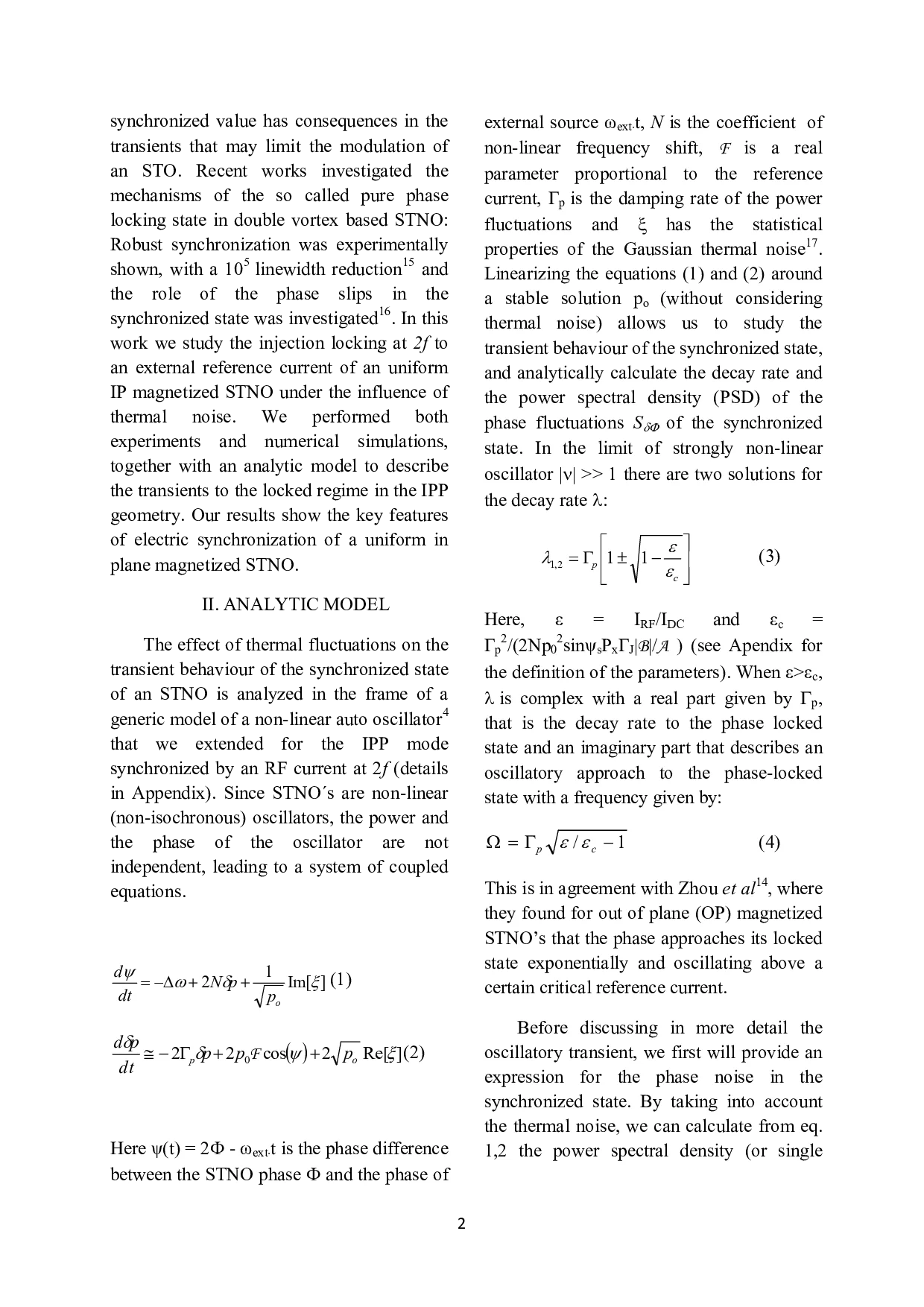
]
Im[
1
2
op
p
N
dt
d
(1)
]
Re[
2
cos
2
2
0
o
p
p
p
p
dt
p
d
F
(2)
Here ψ(t) = 2 - ωextt is the phase difference
between the STNO phase and the phase of
external source ωextt, N is the coefficient of
non-linear frequency shift, F is a real
parameter proportional to the reference
current, Γp is the damping rate of the power
fluctuations and has the statistical
properties of the Gaussian thermal noise17.
Linearizing the equations (1) and (2) around
a stable solution po (without considering
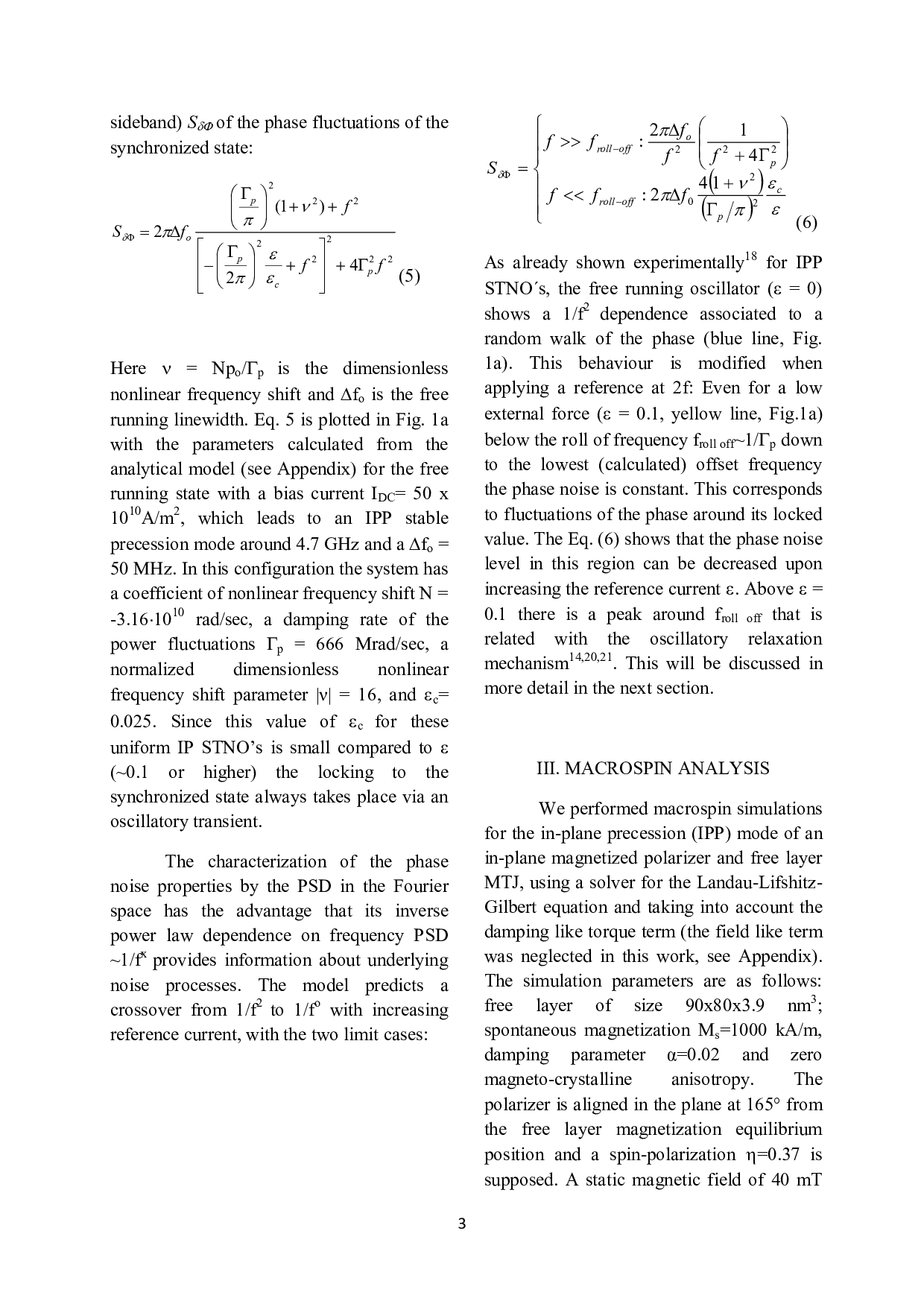
thermal noise) allows us to s
…(Full text truncated)…
This content is AI-processed based on ArXiv data.