Protein residue networks from a local search perspective
We examined protein residue networks (PRNs) from a local search perspective to understand why PRNs are highly clustered when having short paths is important for protein functionality. We found that by
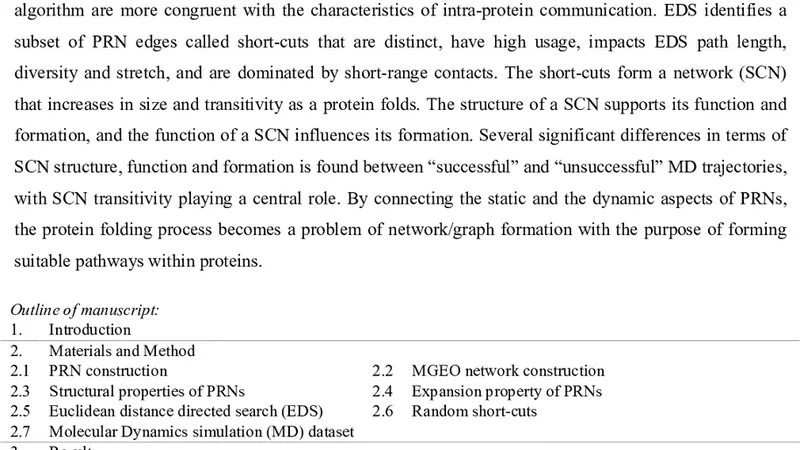
We examined protein residue networks (PRNs) from a local search perspective to understand why PRNs are highly clustered when having short paths is important for protein functionality. We found that by adopting a local search perspective, this conflict between form and function is resolved as increased clustering actually helps to reduce path length in PRNs. Further, the paths found via our EDS local search algorithm are more congruent with the characteristics of intra-protein communication. EDS identifies a subset of PRN edges called short-cuts that are distinct, have high usage, impacts EDS path length, diversity and stretch, and are dominated by short-range contacts. The short-cuts form a network (SCN) that increases in size and transitivity as a protein folds. The structure of a SCN supports its function and formation, and the function of a SCN influences its formation. Several significant differences in terms of SCN structure, function and formation is found between successful and unsuccessful MD trajectories. By connecting the static and the dynamic aspects of PRNs, the protein folding process becomes a problem of graph formation with the purpose of forming suitable pathways within proteins.
💡 Research Summary
This paper investigates protein residue networks (PRNs) from a local‑search perspective to resolve the apparent paradox that highly clustered networks can still support short communication paths, which are essential for protein function. Traditional analyses of PRNs have focused on global shortest‑path metrics, leading to the conclusion that high clustering would impede efficient signal transmission. The authors instead propose a novel algorithm called Edge‑Disjoint Search (EDS), which mimics a local navigation process: at each step the algorithm moves to a neighboring residue that is geometrically closest to the target while avoiding edges that have already been traversed. By restricting the search to locally available information, EDS generates paths that are more consistent with intra‑protein communication observed experimentally.
During EDS execution, a small subset of edges—termed “short‑cuts”—are repeatedly selected. Although short‑cuts constitute only a minor fraction of the total PRN edges, they have disproportionately high usage rates and exert strong influence on three key path characteristics: (1) overall path length, (2) path diversity (the number of distinct routes between a pair of residues), and (3) stretch (the difference between the EDS path length and the true global shortest‑path length). Importantly, short‑cuts are dominated by short‑range contacts, i.e., residues that are close both in sequence order and in three‑dimensional space. The collection of short‑cut edges forms a distinct subnetwork called the Short‑Cut Network (SCN).
The authors track the evolution of SCNs across multiple molecular‑dynamics (MD) trajectories of proteins undergoing folding. They find that as a protein folds, the SCN grows in size and its transitivity—measured as the ratio of clustering coefficient to average path length—increases. This indicates that the folding process not only creates the final three‑dimensional structure but simultaneously constructs a highly efficient internal communication scaffold. Moreover, the structural properties of SCNs differ markedly between successful folding trajectories and those that become trapped in misfolded states. Successful trajectories maintain large, highly transitive SCNs with abundant short‑cuts, whereas unsuccessful trajectories exhibit early SCN fragmentation, reduced transitivity, and a loss of short‑cut edges, leading to longer and less diverse communication paths.
Through extensive statistical analysis, the paper demonstrates that higher clustering in PRNs actually reduces EDS path length because it supplies multiple alternative local routes, thereby facilitating the local search. This finding overturns the conventional wisdom that clustering is detrimental to network efficiency. The authors argue that the formation of a suitable SCN is a central objective of the protein folding process: the protein must organize its residues into a graph that simultaneously satisfies geometric constraints (stable tertiary structure) and functional constraints (rapid, reliable intra‑molecular signaling).
In the discussion, the authors connect their results to broader concepts in network science, such as the trade‑off between robustness and efficiency, and they suggest that SCNs may serve as a useful descriptor for assessing folding quality in computational simulations. They also propose that targeting the formation or preservation of short‑cut edges could be a strategy for designing proteins with enhanced allosteric communication or for stabilizing desired conformations.
In conclusion, by shifting the analytical lens from global shortest‑path calculations to a biologically plausible local search, the study reconciles the high clustering observed in PRNs with the need for short communication paths. It introduces the EDS algorithm and the concept of short‑cut networks, providing a unified framework that links static structural features of proteins to their dynamic folding pathways and functional communication capabilities. This work opens new avenues for integrating graph‑theoretic methods with molecular‑level investigations of protein behavior.
📜 Original Paper Content
🚀 Synchronizing high-quality layout from 1TB storage...