Analysis of a Natural Gradient Algorithm on Monotonic Convex-Quadratic-Composite Functions
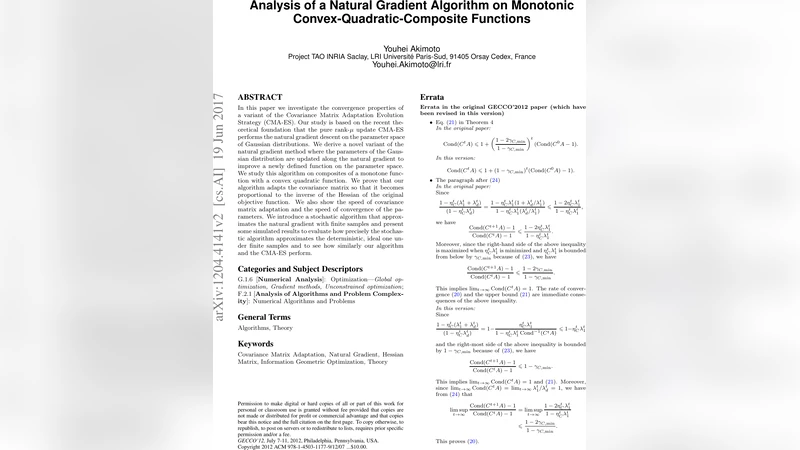
In this paper we investigate the convergence properties of a variant of the Covariance Matrix Adaptation Evolution Strategy (CMA-ES). Our study is based on the recent theoretical foundation that the pure rank-mu update CMA-ES performs the natural gradient descent on the parameter space of Gaussian distributions. We derive a novel variant of the natural gradient method where the parameters of the Gaussian distribution are updated along the natural gradient to improve a newly defined function on the parameter space. We study this algorithm on composites of a monotone function with a convex quadratic function. We prove that our algorithm adapts the covariance matrix so that it becomes proportional to the inverse of the Hessian of the original objective function. We also show the speed of covariance matrix adaptation and the speed of convergence of the parameters. We introduce a stochastic algorithm that approximates the natural gradient with finite samples and present some simulated results to evaluate how precisely the stochastic algorithm approximates the deterministic, ideal one under finite samples and to see how similarly our algorithm and the CMA-ES perform.
💡 Research Summary
This paper provides a rigorous theoretical analysis of a natural‑gradient‑based variant of the Covariance Matrix Adaptation Evolution Strategy (CMA‑ES) when applied to a class of objective functions that can be expressed as the composition of a monotone scalar function with a convex quadratic form. The work builds on the recent insight that the pure rank‑mu update version of CMA‑ES performs natural gradient descent (NGD) on the manifold of multivariate Gaussian distributions. By explicitly formulating the expected‑value objective Φ(μ,Σ)=E_{x∼N(μ,Σ)}
Comments & Academic Discussion
Loading comments...
Leave a Comment