Software Implementation And Evaluation Of Lightweight Symmetric Block Ciphers Of The Energy Perspectives And Memory
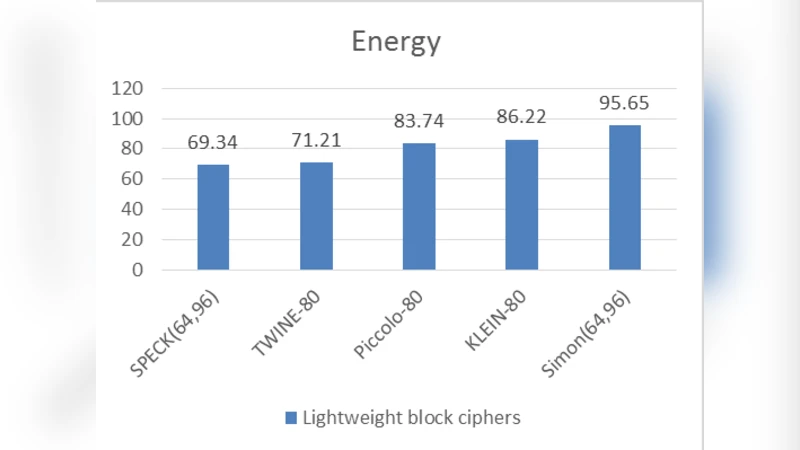
Lightweight ciphers are the form of encryption that strictly limited to devices such as tags, RFID, wireless sensor networks applications. Low-resource devices has many limitations in power, energy and memory. In this work, the lightweight block ciphers is implemented on the Atmega128 microprocessor and the results of the energy perspectives and memory were assessed. The results of the evaluation show that the SPECK(64,96) cipher has been the best value of the perspective of energy and is appropriate for wireless sensor networks with the main requirement of energy. If the measure is memory usage, the TWINE-80 is the most appropriate implemented lightweight ciphers on the Atmega128 microprocessor. The SPECK(64,96) cipher is in third place of the perspective of consumer memory. In other side, TWINE-80 cipher is In the second place of the perspective of energy. SPECK(64,96) and TWINE-80 ciphers are the most appropriate for wireless sensor networks.
💡 Research Summary
The paper presents a practical evaluation of five lightweight symmetric block ciphers—KLEIN‑80, TWINE‑80, Piccolo‑80, SPECK(64,96) and SIMON(64,96)—implemented in software on an Atmega128 microcontroller. The authors use AVR Studio 5.1 to write C code, compile it for the AVR architecture, and run the programs in the AVR simulator to collect execution metrics. Two primary criteria are examined: energy consumption and memory footprint (both FLASH program memory and RAM data memory).
Energy measurement methodology
Energy (E) is derived from the product of power (P) and execution time (t). Power is calculated as voltage (V) multiplied by current (I), using the active‑mode specifications of the Atmega128. Execution time is inferred from the number of clock cycles reported by the simulator divided by the CPU frequency. The resulting energy values are expressed in micro‑joules (µJ). Table 1 shows that SPECK(64,96) consumes the least energy (86.22 µJ), followed by TWINE‑80 (83.74 µJ) and Piccolo‑80 (95.65 µJ). KLEIN‑80 and SIMON have higher values, indicating they are less suitable when power is the dominant constraint.
Memory usage assessment
Memory consumption is split into FLASH (program storage) and RAM (runtime data). Table 2 lists the byte counts for each cipher. TWINE‑80 occupies the smallest FLASH space (1691 bytes) and modest RAM (76 bytes). KLEIN‑80 and SPECK use 1178 bytes and 1406 bytes of FLASH respectively, while Piccolo‑80 and KLEIN‑80 have the lowest RAM footprints (76 bytes and 95 bytes). Figures 2‑4 graphically combine these metrics, revealing that TWINE‑80 is the most memory‑efficient overall when FLASH and RAM are considered together.
Combined analysis
When both criteria are weighed, SPECK(64,96) emerges as the top performer for energy efficiency, whereas TWINE‑80 is the best for memory efficiency. The authors argue that in wireless sensor networks (WSNs), where battery life is critical, SPECK is the preferred choice. Conversely, in scenarios where available program memory is limited, TWINE‑80 should be selected. The paper suggests that system designers may need to balance these trade‑offs or even employ a hybrid approach depending on the specific constraints of their deployment.
Methodological contributions
The study provides a reproducible workflow: selecting the target device, writing C implementations, using the AVR debugger to set breakpoints, and extracting cycle counts. This detailed description enables other researchers to replicate the experiments on the same platform or adapt the methodology to other microcontrollers.
Limitations and future work
The energy figures are derived from simulation rather than direct hardware measurements, which may introduce discrepancies in real‑world deployments. The evaluation is confined to a single 8‑bit AVR architecture; extending the analysis to 32‑bit ARM Cortex‑M or RISC‑V cores could yield different rankings. Moreover, the paper does not assess cryptographic strength, side‑channel resistance, or throughput, all of which are important for a comprehensive security evaluation.
Conclusion
By implementing and quantitatively benchmarking five lightweight block ciphers on an Atmega128, the authors demonstrate that SPECK(64,96) offers the best energy profile while TWINE‑80 provides the smallest memory footprint. These findings give concrete guidance for designers of energy‑constrained, memory‑limited embedded systems—particularly wireless sensor networks—who must choose an appropriate lightweight cipher. The work also establishes a baseline methodology for future comparative studies across different hardware platforms and additional performance dimensions.
Comments & Academic Discussion
Loading comments...
Leave a Comment