Orientational Phase Transitions and the Assembly of Viral Capsids
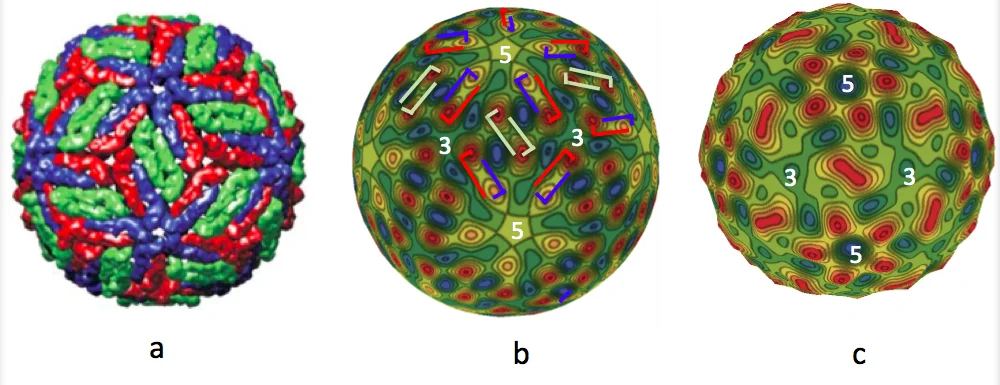
We present a generalized Landau-Brazovskii free energy for the solidification of chiral molecules on a spherical surface in the context of the assembly of viral shells. We encounter two types of icosahedral solidification transitions. The first type is a conventional first-order phase transition from the uniform to the icosahedral state. It can be described by a single icosahedral spherical harmonic of even $l$. The chiral pseudo-scalar term in the free energy creates secondary terms with chiral character but it does not affect the thermodynamics of the transition. The second type, associated with icosahedral spherical harmonics with odd $l$, is anomalous. Pure odd $l$ icosahedral states are unstable but stability is recovered if admixture with the neighboring $l+1$ icosahedral spherical harmonic is included, generated by the non-linear terms. This is in conflict with the principle of Landau theory that symmetry-breaking transitions are characterized by only a \textit{single} irreducible representation of the symmetry group of the uniform phase and we argue that this principle should be removed from Landau theory. The chiral term now directly affects the transition because it lifts the degeneracy between two isomeric mixed-$l$ icosahedral states. A direct transition is possible only over a limited range of parameters. Outside this range, non-icosahedral states intervene. For the important case of capsid assembly dominated by $l=15$, the intervening states are found to be based on octahedral symmetry.
💡 Research Summary
The paper develops a generalized Landau‑Brazovskii (LB) free‑energy framework to describe the solidification of chiral molecules on a spherical surface, with the specific aim of modeling viral capsid assembly. The authors begin by reviewing the historical context of orientational phase transitions, from Onsager’s theory of liquid crystals to modern applications in soft matter, and then argue that the mass density of capsid proteins (or protein groups) on the inner surface of an RNA condensate can be treated as a scalar field ρ(Ω) defined on a sphere of radius R.
The LB free energy employed contains a quadratic term that favors density modulations with a characteristic wave number k₀, a control parameter r, and cubic (u ρ³) and quartic (v ρ⁴) nonlinearities, with v > 0 ensuring stability. By expanding ρ(Ω) in spherical harmonics Yₗᵐ, the quadratic part selects a particular angular momentum l that minimizes an effective reduced temperature tₗ = r +
Comments & Academic Discussion
Loading comments...
Leave a Comment