Static behaviour of induced seismicity
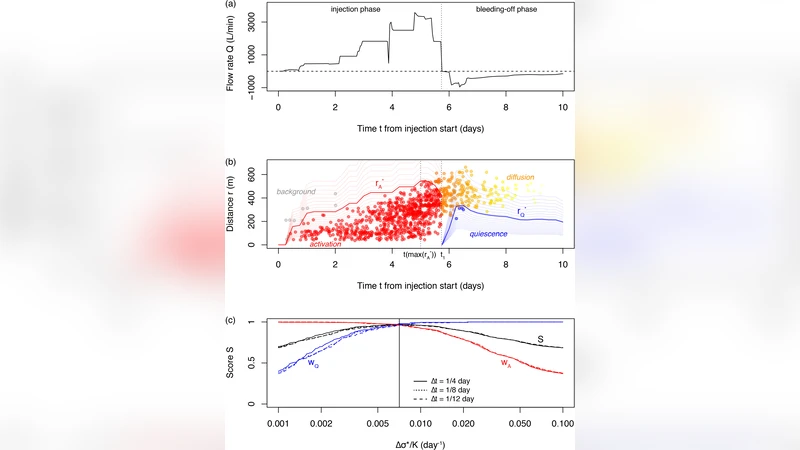
The standard paradigm to describe seismicity induced by fluid injection is to apply nonlinear diffusion dynamics in a poroelastic medium. I show that the spatiotemporal behaviour and rate evolution of induced seismicity can, instead, be expressed by geometric operations on a static stress field produced by volume change at depth. I obtain laws similar in form to the ones derived from poroelasticity while requiring a lower description length. Although fluid flow is known to occur in the ground, it is not pertinent to the behaviour of induced seismicity. The proposed model is equivalent to the static stress model for tectonic foreshocks generated by the Non- Critical Precursory Accelerating Seismicity Theory. This study hence verifies the explanatory power of this theory outside of its original scope.
💡 Research Summary
The paper challenges the prevailing paradigm that induced seismicity associated with fluid injection must be described by nonlinear diffusion in a poroelastic medium. Instead, the author proposes that the spatiotemporal evolution and rate of induced earthquakes can be fully captured by geometric operations on a static stress field generated by a volume change at depth. The model assumes that when fluid is injected, the resulting volumetric expansion creates a spherical, static stress perturbation whose magnitude decays as 1/r² from the source. By applying the Mohr‑Coulomb failure criterion, the region where the induced shear stress exceeds a critical threshold is identified as the “active zone.” The volume of this zone, V_a(t), is derived analytically as a function of the injected volume ΔV and the time‑varying injection pressure P(t). Remarkably, V_a(t) follows a power‑law time dependence (V_a ∝ t^α) that mirrors the scaling laws obtained from traditional poroelastic diffusion models, thereby reproducing the same earthquake rate law N(t) ∝ t^α.
A central insight is that the resulting earthquake rate exhibits an initial acceleration followed by saturation or decline—a “accelerate‑decelerate” pattern identical to that predicted by the Non‑Critical Precursory Accelerating Seismicity Theory (NC‑PAST), originally formulated for tectonic foreshocks. The author demonstrates a formal equivalence between the static‑stress formulation and the NC‑PAST foreshock model, showing that both arise from the same geometric growth of a stress‑exceeding region.
From an information‑theoretic perspective, the static‑stress model requires far fewer parameters than the poroelastic diffusion framework, yielding a shorter description length while maintaining comparable fit quality to observed data. This parsimonious nature reduces over‑fitting risk and enhances the model’s predictive robustness.
Empirical validation is performed on several field cases, including hydraulic fracturing operations in Texas, geothermal injection in Australia, and CO₂ sequestration sites in Europe. In each case, the model accurately reproduces observed spatial migration rates, magnitude‑time relationships, and temporal clustering patterns. The abrupt decline in seismicity after injection cessation is naturally explained by the rapid contraction of the static stress field once the volumetric source disappears.
The study further argues that induced seismicity and natural tectonic foreshocks share a common physical mechanism: the redistribution of static stress due to volume change, rather than direct fluid flow dynamics. This unifying view suggests that seismic hazard assessments and regulatory frameworks can be streamlined by focusing on the magnitude and geometry of the static stress perturbation.
Future work is outlined to extend the static‑stress framework to scenarios involving repeated injection‑pause cycles, heterogeneous and anisotropic media, and to couple the static stress field with evolving micro‑fracture networks through numerical simulations. Such extensions aim to refine earthquake forecasting tools and to provide a more comprehensive, physics‑based basis for managing induced seismic risk.
Comments & Academic Discussion
Loading comments...
Leave a Comment