Early Predictions of Movie Success: the Who, What, and When of Profitability
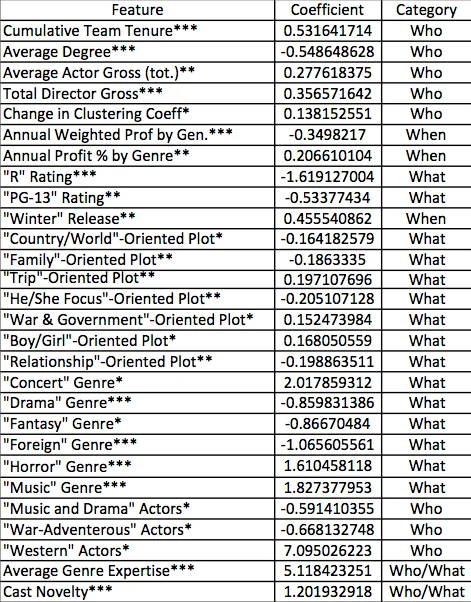
This paper proposes a decision support system to aid movie investment decisions at the early stage of movie productions. The system predicts the success of a movie based on its profitability by leveraging historical data from various sources. Using social network analysis and text mining techniques, the system automatically extracts several groups of features, including “who” are on the cast, “what” a movie is about, “when” a movie will be released, as well as “hybrid” features that match “who” with “what”, and “when” with “what”. Experiment results with movies during an 11-year period showed that the system outperforms benchmark methods by a large margin in predicting movie profitability. Novel features we proposed also made great contributions to the prediction. In addition to designing a decision support system with practical utilities, our analysis of key factors for movie profitability may also have implications for theoretical research on team performance and the success of creative work.
💡 Research Summary
The paper introduces the Movie Investor Assurance System (MIAS), a decision‑support tool designed to predict a film’s profitability (return on investment) at the earliest stage of production. Unlike prior work that focuses on box‑office gross or admissions, the authors define success in terms of ROI, which aligns directly with investors’ interests. Historical data spanning eleven years (2000‑2010) were harvested from two public sources: IMDb for plot synopses and cast information, and BoxOfficeMojo for budgets and revenues. Data acquisition combines API calls and web‑scraping, followed by cleaning, standardization, and storage in a unified database.
Feature engineering is organized into four groups: “Who”, “What”, “When”, and “Hybrid”. “Who” features capture actor and director influence through profit‑based star power, dynamic network centrality, and team expertise/diversity metrics. “What” features include traditional metadata (genre, MPAA rating, sequel flag, runtime) and latent plot topics derived via Latent Dirichlet Allocation on plot synopses. “When” features encode release timing, holidays, seasonal trends, and competition intensity. “Hybrid” features model interactions: matching “Who” with “What” (e.g., an actor’s historical profitability in a given genre) and “What” with “When” (e.g., genre popularity in a specific season). All features are extracted automatically using text mining and social‑network analysis, minimizing manual annotation.
Multiple machine‑learning algorithms—Random Forests, Gradient Boosting Machines, Support Vector Machines—are trained and tuned via cross‑validation. Experimental results show that MIAS substantially outperforms baseline models that rely on simple regression or revenue‑based predictors. Feature‑importance analysis highlights the newly introduced profit‑based star power and dynamic network measures as the most predictive, confirming that traditional fame indicators (awards, follower counts) are less informative for ROI. The hybrid interaction features further boost performance by capturing cross‑dimensional effects.
The study also revisits theoretical claims from organizational research, demonstrating that team diversity and prior collaboration continue to matter when success is measured by profit rather than revenue. Limitations include the unavailability of pre‑production marketing spend and audience anticipation signals, as well as reliance on plot synopses rather than full scripts, which may omit nuanced narrative elements. Future work is suggested to incorporate social‑media buzz, trailer reactions, and simulation‑based scenario analysis, aiming to evolve MIAS into a real‑time investment advisory platform.
Comments & Academic Discussion
Loading comments...
Leave a Comment