Measuring Contextual Relationships in Temporal Social Networks by Circle Link
Network science has released its talents in social network analysis based on the information of static topologies. In reality social contacts are dynamic and evolve concurrently in time. Nowadays they can be recorded by ubiquitous information technologies, and generated into temporal social networks to provide new sights in social reality mining. Here, we define \emph{circle link} to measure contextual relationships in three empirical social temporal networks, and find that the tendency of friends having frequent continuous interactions with their common friend prefer to be close, which can be considered as the extension of Granovetter’s hypothesis in temporal social networks. Finally, we present a heuristic method based on circle link to predict relationships and acquire acceptable results.
💡 Research Summary
The paper addresses the growing need to analyze social interactions that evolve over time rather than relying on static network representations. By leveraging high‑resolution temporal contact data collected through RFID sensors at a conference (HT), a science‑gallery exhibition (SG), and Wi‑Fi login records on a university campus (WF), the authors construct three temporal social networks, each spanning three days. From these event streams they extract ego‑centric sequences of conversations, ignoring the duration of each event and ordering them by start time.
The central contribution is the introduction of the “circle link” concept. A circle link between two partners B and C of an ego A is recorded each time A finishes a conversation with B and immediately starts a conversation with C. The weight of a circle link is the total number of such consecutive interactions across the whole observation period. This metric captures a specific form of contextual relationship: two individuals who repeatedly appear as successive conversation partners of a common third person are likely to share a latent social tie.
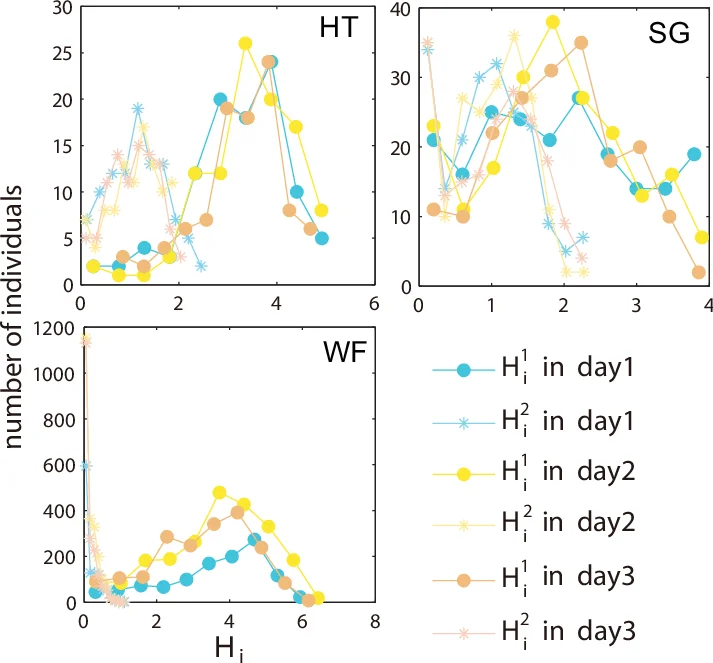
Before defining circle links, the authors compute two entropy‑based measures used in prior work on conversation predictability: the unconditional entropy H₁ (the uncertainty of an ego’s partner choice) and the conditional entropy H₂ (the uncertainty of the next partner given the current one). Across all datasets H₂ is consistently lower than H₁, confirming that knowledge of the current partner reduces uncertainty about the next partner and justifying the focus on consecutive interactions.
To assess whether ego‑centric memory effects influence the formation of circle links, the paper introduces the Self‑Circle Rate (SCR), the proportion of self‑loops (i.e., an ego talking to the same partner consecutively). Comparing SCR to a null model where contacts are memory‑less (SCR_null = 1/|N_i|) yields a ratio m₀. In the conference data (HT) m₀ > 1, indicating a strong memory effect; in the gallery data (SG) m₀ ≈ 1, suggesting near‑random behavior; and in the indoor Wi‑Fi data (WF) m₀ < 1, implying an “inverse‑memory” where people tend to avoid repeating the same partner immediately. This demonstrates that memory mechanisms are context‑dependent.
The authors then examine correlations between circle‑link weights (W_CL) and traditional static network metrics: edge weight (W_L), defined as the total number of contacts between two nodes, and edge clustering coefficient (C_CL), which measures the overlap of neighbors. Pearson correlation coefficients reveal that W_CL is positively correlated with W_L in all three datasets (ρ ranging from 0.55 to 0.74), supporting an extension of Granovetter’s hypothesis that strong ties tend to be embedded in dense local structures, now expressed in temporal terms. Correlations between W_CL and C_CL differ by setting: they are modest (≈0.2–0.3) in the two face‑to‑face networks (HT, SG) but strong (≈0.7–0.8) in the indoor Wi‑Fi network (WF), indicating that “continuous group talk” involving three or more participants is more prevalent in environments with higher overall clustering.
For practical utility, a simple relationship‑prediction algorithm is proposed: if W_CL(i,j) > 0, the pair (i,j) is predicted to have a latent relationship; otherwise, no relationship is predicted. The ground truth is taken from the aggregated static network where an edge exists if W_L > 0. The method’s performance is evaluated using precision (TP/(TP+FP)) and recall (TP/(TP+FN)). Results show moderate precision in the face‑to‑face datasets (≈0.44–0.57) and high precision in the Wi‑Fi dataset (≈0.78–0.85). Recall varies more widely (0.25–0.66), with the SG network achieving the highest recall due to stronger temporal clustering. The high precision, especially in WF, is attributed to the strong positive correlation between the predictor (W_CL) and both the edge weight and edge clustering coefficient. A t‑test confirms that the Circle Rate (CR), defined as the proportion of overlapping circle links among a node’s neighbors, is significantly larger than both the weighted clustering coefficient and the unweighted clustering coefficient in WF (p < 0.005).
In conclusion, the paper demonstrates that circle links provide a meaningful, temporally aware measure of contextual social relationships. Memory effects are not universal; they depend on the social setting, ranging from strong reinforcement (HT) to near‑random (SG) to avoidance (WF). The circle‑link‑based predictor, despite its simplicity, can uncover latent ties using only a limited set of sensors, making it attractive for large‑scale, privacy‑preserving social monitoring. Future work is suggested on extending the model to directed circle links, optimizing the observation window, scaling to real‑time streams, and applying the concept to other interaction modalities such as online messaging or social media platforms.
Comments & Academic Discussion
Loading comments...
Leave a Comment