Scaled-Free Objects
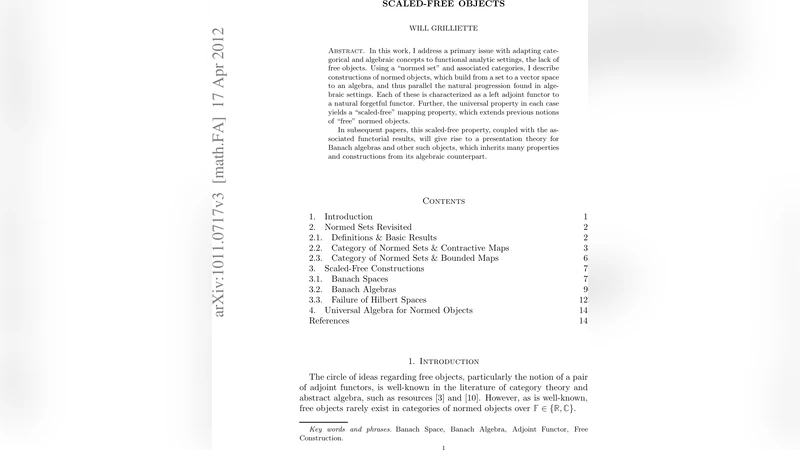
In this work, I address a primary issue with adapting categorical and algebraic concepts to functional analytic settings, the lack of free objects. Using a “normed set” and associated categories, I describe constructions of normed objects, which build from a set to a vector space to an algebra, and thus parallel the natural progression found in algebraic settings. Each of these is characterized as a left adjoint functor to a natural forgetful functor. Further, the universal property in each case yields a “scaled-free” mapping property, which extends previous notions of “free” normed objects. In subsequent papers, this scaled-free property, coupled with the associated functorial results, will give rise to a presentation theory for Banach algebras and other such objects, which inherits many properties and constructions from its algebraic counterpart.
💡 Research Summary
The paper tackles a long‑standing obstacle in functional‑analytic categories: the absence of genuine free objects. Classical algebraic constructions (free groups, free algebras, etc.) rely on a forgetful functor that admits a left adjoint, guaranteeing a universal mapping property. In Banach‑type settings, the requirement of completeness and boundedness destroys the usual free constructions, leaving a gap in the categorical toolkit.
To fill this gap the author introduces the notion of a normed set. A normed set is a pair ((S,|\cdot|)) where (S) is an ordinary set and (|\cdot|:S\to\mathbb{R}_{>0}) assigns a positive “scale” to each element. This extra datum records the size of generators already at the set level, allowing later linear and algebraic extensions to respect the intended norm automatically.
Three nested categories are built on top of normed sets:
- ( \mathcal{C}_0) – the category of normed sets, with a forgetful functor (U_0:\mathcal{C}_0\to\mathbf{Set}) that drops the scale.
- ( \mathcal{C}_1) – the category of normed vector spaces (not yet complete). The forgetful functor (U_1:\mathcal{C}_1\to\mathcal{C}_0) sends a space to its chosen Hamel basis equipped with the induced scale.
- ( \mathcal{C}_2) – the category of normed algebras (again not required to be complete). The functor (U_2:\mathcal{C}_2\to\mathcal{C}_1) forgets the multiplication, retaining the underlying normed space.
For each (i=0,1,2) the paper proves that (U_i) possesses a left adjoint (F_i). Concretely:
- (F_0) takes a bare set and equips it with the smallest possible norm (the “free normed set”).
- (F_1) takes a normed set ((S,|\cdot|)) and forms the scaled‑free normed vector space: formal finite linear combinations (\sum a_s s) with norm (|\sum a_s s|=\sum |a_s|,|s|). This space is then completed to obtain a Banach space when needed.
- (F_2) builds the scaled‑free normed algebra by first forming the tensor algebra on (F_1(S)) and then completing it with respect to the induced algebra norm. The result is a Banach algebra that is universal for bounded algebra homomorphisms out of the original set of generators.
The universal property is not the classical “any function extends uniquely” but a scaled‑free mapping property: a map (f:S\to U_1(V)) (or (U_2(A))) must satisfy a boundedness condition (|f(s)|\le C|s|) for some constant (C). Under this hypothesis there exists a unique continuous linear (or continuous algebra) map (\widehat f) extending (f). Thus the adjunctions encode both algebraic freeness and analytic control (norm preservation up to a scalar factor).
This framework resolves the “no free Banach algebra” problem. Ordinary free algebras are algebraically free but typically non‑complete; forcing completion destroys the universal property. By integrating the scale at the generator level, the construction yields a Banach algebra that is simultaneously free (in the categorical sense) and complete. The paper sketches how the same pattern can be applied to C(^*)-algebras, Banach modules, and other analytic structures, suggesting a broad categorical infrastructure for functional analysis.
Finally, the author outlines a research program: using these scaled‑free objects to develop a presentation theory for Banach algebras analogous to the classical theory for groups and rings. Generators and relations would be encoded as normed sets together with bounded relations, and the left adjoints would produce the corresponding quotient Banach algebras. Such a theory promises to import many algebraic techniques (e.g., Gröbner‑type bases, homological constructions) into the analytic realm, potentially simplifying proofs and revealing new structural insights.
In summary, the paper provides a clean categorical solution to the lack of free objects in normed contexts by enriching the notion of generators with a norm, constructing left adjoints that yield “scaled‑free” Banach‑type objects, and laying the groundwork for a systematic presentation theory in functional analysis.
Comments & Academic Discussion
Loading comments...
Leave a Comment