On a Dehn-Sommerville functional for simplicial complexes
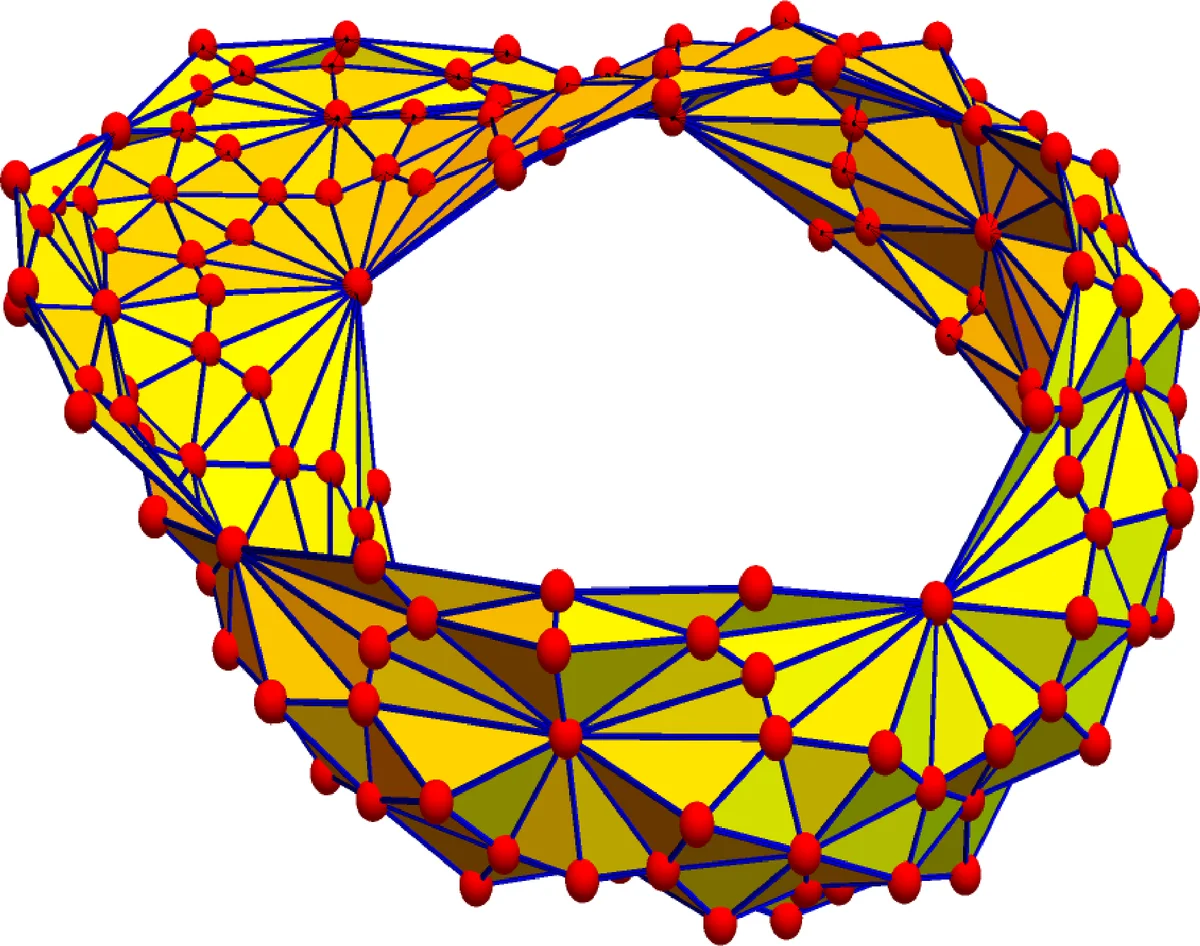
Assume G is a finite abstract simplicial complex with f-vector (v0,v1, …), and generating function f(x) = sum(k=1 v(k-1) x^k = v0 x + v1 x^2+ v2 x^3 + …, the Euler characteristic of G can be written as chi(G)=f(0)-f(-1). We study here the functional f1’(0)-f1’(-1), where f1’ is the derivative of the generating function f1 of G1. The Barycentric refinement G1 of G is the Whitney complex of the finite simple graph for which the faces of G are the vertices and where two faces are connected if one is a subset of the other. Let L is the connection Laplacian of G, which is L=1+A, where A is the adjacency matrix of the connection graph G’, which has the same vertex set than G1 but where two faces are connected they intersect. We have f1’(0)=tr(L) and for the Green function g L^(-1) also f1’(-1)=tr(g) so that eta1(G) = f1’(0)-f1’(-1) is equal to eta(G)=tr(L-L^(-1). The established formula tr(g)=f1’(-1) for the generating function of G1 complements the determinant expression det(L)=det(g)=zeta(-1) for the Bowen-Lanford zeta function zeta(z)=1/det(1-z A) of the connection graph G’ of G. We also establish a Gauss-Bonnet formula eta1(G) = sum(x in V(G1) chi(S(x)), where S(x) is the unit sphere of x the graph generated by all vertices in G1 directly connected to x. Finally, we point out that the functional eta0(G) = sum(x in V(G) chi(S(x)) on graphs takes arbitrary small and arbitrary large values on every homotopy type of graphs.
💡 Research Summary
The paper introduces a novel functional η(G) for a finite abstract simplicial complex G, defined via the trace of the difference between the connection Laplacian L and its inverse: η(G)=tr(L−L⁻¹). The construction starts by associating two graphs to G: the Barycentric refinement G₁, whose vertices are the faces of G and edges encode the inclusion relation, and the connection graph G₀, which shares the same vertex set but connects two faces whenever they intersect. The adjacency matrix A of G₀ leads to the connection Laplacian L=I+A, a unimodular integer matrix whose inverse g=L⁻¹ also has integer entries.
A generating function f₁(x)=∑{k≥1}v{k−1}(G₁)x^{k} encodes the f‑vector of G₁. The paper shows that the derivative at zero, f₁′(0), equals tr(L), while the derivative at –1, f₁′(–1), equals tr(g). Consequently η(G)=f₁′(0)−f₁′(–1)=tr(L−L⁻¹). This analytic expression mirrors the classic Euler characteristic χ(G)=f(0)−f(–1), but it operates on the refined complex G₁.
A key result is a Gauss‑Bonnet type formula: η(G) equals the sum over all vertices x of G₁ of the Euler characteristic of the unit sphere S(x) in G₁, i.e., η(G)=∑_{x∈V(G₁)}χ(S(x)). The proof uses the fact that the diagonal entries of g are 1−χ(S(x)). Thus η(G) can be interpreted as a curvature integral, where the curvature at each face is simply χ of its unit sphere.
When G is two‑dimensional, the formula collapses to η(G)=2v₁−3v₂, a linear combination of edge and triangle counts. This is precisely the Dehn‑Sommerville relation for 2‑dimensional simplicial polytopes, showing that η(G) generalizes classical Dehn‑Sommerville invariants to arbitrary complexes and higher dimensions (the general expression being 2v₁−3v₂+4v₃−5v₄+⋯ with alternating signs).
The paper also connects η(G) to the Bowen‑Lanford zeta function ζ(s)=1/det(I−sA) of the connection graph. Since ζ(−1)=det(L)=det(g), the determinant at s=−1 coincides with the product of eigenvalues of L, while η(G) involves the sum of eigenvalues of L and of L⁻¹. This duality between determinant and trace provides a spectral perspective on the functional.
The authors dub H=L−L⁻¹ the “hydrogen operator”. In continuous physics, the inverse Laplacian represents the Coulomb potential 1/|x−y|, so H can be viewed as a discrete analogue of a Hamiltonian consisting of kinetic (L) and potential (−L⁻¹) parts. The trace η(G) then plays the role of a total energy functional, opening a variational viewpoint.
A striking observation is that the related functional η₀(G)=∑_{v∈V(G)}χ(S(v)) (the sum of unit‑sphere Euler characteristics taken on the original complex G) can attain arbitrarily large positive or negative values within any homotopy class of graphs. The paper provides explicit constructions: gluing a disk inside a sphere creates η(G)=−8; iterated suspensions or joins can produce unbounded growth. Hence η₀ is not a topological invariant but a sensitive measure of local combinatorial curvature.
Several concrete examples illustrate the theory. For a cycle graph Cₙ, G₁ is a larger cycle C_{2n}, each unit sphere has χ=2, yielding η(Cₙ)=4n. For a discrete 2‑dimensional manifold (all unit spheres are cycles), η vanishes. For a discrete 3‑dimensional manifold (unit spheres are 2‑spheres), η equals twice the number of vertices of G₁.
In summary, the paper weaves together combinatorial topology (f‑vectors, Dehn‑Sommerville relations), spectral graph theory (connection Laplacian, eigenvalues, zeta function), and discrete differential geometry (Gauss‑Bonnet curvature) to define and analyze η(G). It demonstrates that η(G) serves as a bridge linking these domains, provides explicit formulas for its computation, and shows its flexibility as both an invariant under Barycentric refinement and a functional capable of unbounded variation across homotopy types. The work opens several avenues for future research, including extremal problems for η, relationships with Betti numbers, and deeper physical interpretations of the hydrogen operator.
Comments & Academic Discussion
Loading comments...
Leave a Comment