An example of geometric origami design with benefit of graph enumeration algorithms
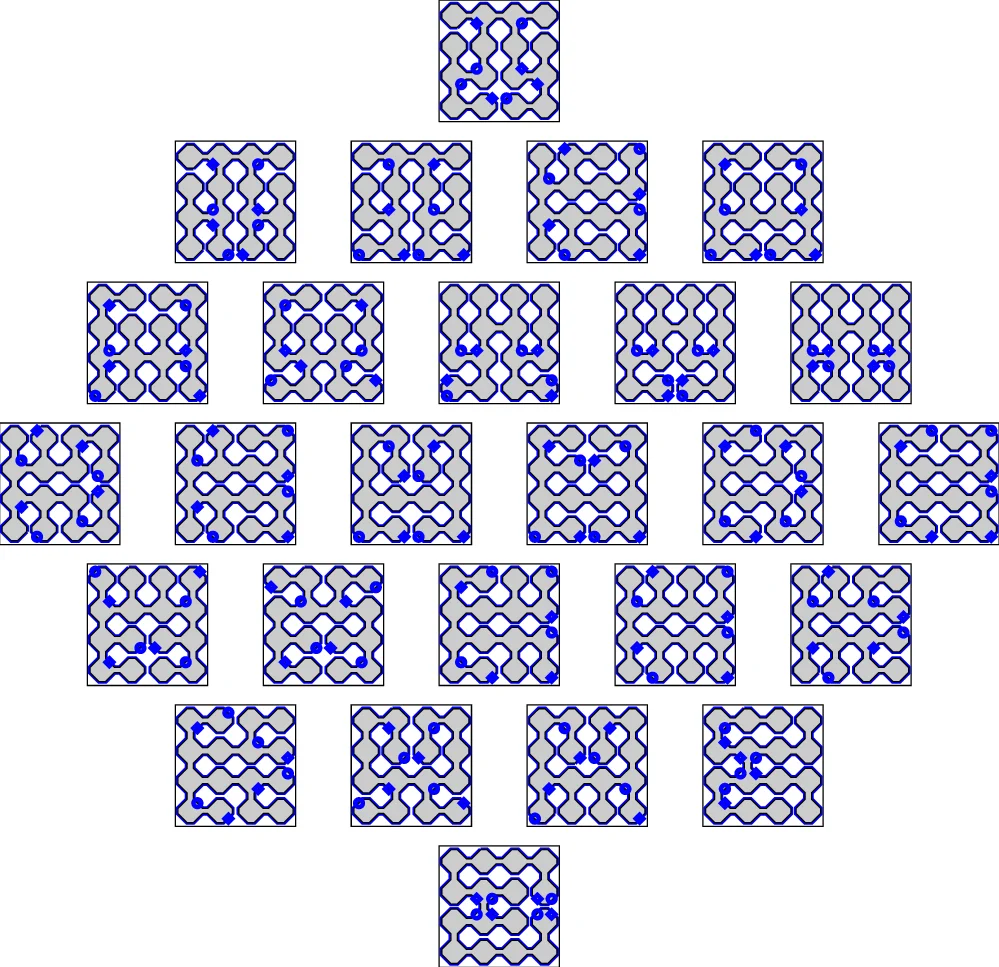
This article is concerned with an example of complex planar geometry arising from flat origami challenges. The complexity of solution algorithms is illustrated, depending on the depth of the initial analysis of the problem, starting from brute force enumeration, up to the equivalence to a dedicated problem in graph theory. This leads to algorithms starting from an untractable case on modern computers, up to a run of few seconds on a portable personal computer. This emphasizes the need for a prior analysis by humans before considering the assistance of computers for complex design problems. The graph problem is an enumeration of spanning trees from a grid graph, leading to a coarse scale description of the topology of the paper edge on the flat-folded state.
💡 Research Summary
The paper investigates a challenging flat‑origami design problem: constructing an 8 × 8 chessboard‑style pixel matrix from a single square sheet of two‑colored paper, where each square must be independently flip‑able to change its colour. The central geometric constraint is that the paper’s original edge must trace a single closed, non‑crossing curve on the flat‑folded model, passing through one diagonal of every board cell. The authors explore three algorithmic approaches, each progressively more sophisticated, to find such an edge path.
First, a naïve brute‑force enumeration is considered. For each of the n² cells one must choose one of two diagonals, leading to 2^(n²) possible configurations. Even for n = 8 this yields about 1.8 × 10¹⁹ candidates, far beyond the capability of modern computers. The authors present a table of case counts that illustrates the explosive growth of this approach.
Second, a “path‑growing” method is introduced. Starting from a partial non‑crossing path, the algorithm extends the path one diagonal at a time, backtracking when constraints (closed loop, no self‑intersection, correct corner handling) are violated. This reduces the search space to roughly 2^(n²/2 − n) possibilities, which for n = 8 is still about 1.6 × 10⁷. Although dramatically smaller than the brute‑force count, it remains computationally prohibitive.
The breakthrough comes from reformulating the geometric problem as a graph‑theoretic one. By rotating the grid 45° and considering the cells formed by half‑diagonals, the interior region bounded by the desired edge curve can be represented as a square grid graph whose vertices correspond to the (n/2)² “half‑cell” corners. The required edge curve is exactly a spanning tree of this grid graph: a connected, acyclic set of ν − 1 edges (ν = (n/2)²). The number of spanning trees N for an n × n board is given by Kirchhoff’s matrix‑tree theorem; for n = 8, N = 100 352, a known integer sequence (A007341). This representation collapses the problem from the original fine‑scale diagonal choices to a coarser combinatorial structure.
Efficient enumeration of all spanning trees is possible using algorithms such as Knuth’s “gray‑span” method, which runs in O(N + ν + e) time (e being the number of graph edges). The authors implemented this approach and generated all 100 352 trees in a few seconds on a standard laptop. After eliminating trees that are equivalent under the dihedral symmetry group of the square (rotations and reflections), only 12 600 distinct edge patterns remain. This matches the count obtained independently by the path‑growing approach, providing a cross‑validation of the implementations.
Beyond enumeration, the paper discusses a necessary geometric condition for any flat‑foldable crease pattern: the contraction property. All distances between pairs of points on the paper must not increase during folding. The authors analyze this condition for the boundary points and show that certain corner configurations violate it, thereby pruning infeasible edge patterns early in the search.
The study concludes that a substantial reduction in computational complexity is achieved by first performing a human‑led abstraction of the problem into a well‑studied graph domain, then applying specialized algorithms. What initially appears to be an NP‑hard search becomes tractable, allowing the construction of an optimal 8 × 8 pixel matrix from a 32 × 32 sheet of two‑colored paper in seconds. This work highlights the importance of mathematical insight and problem reformulation before relying on brute computational power in complex origami design.
Comments & Academic Discussion
Loading comments...
Leave a Comment